Backend Developer Freelancer for Business
A practical guide to hiring a Backend Developer Freelancer for business websites, PHP systems, Laravel projects, CRM, ERP, and admin panels.

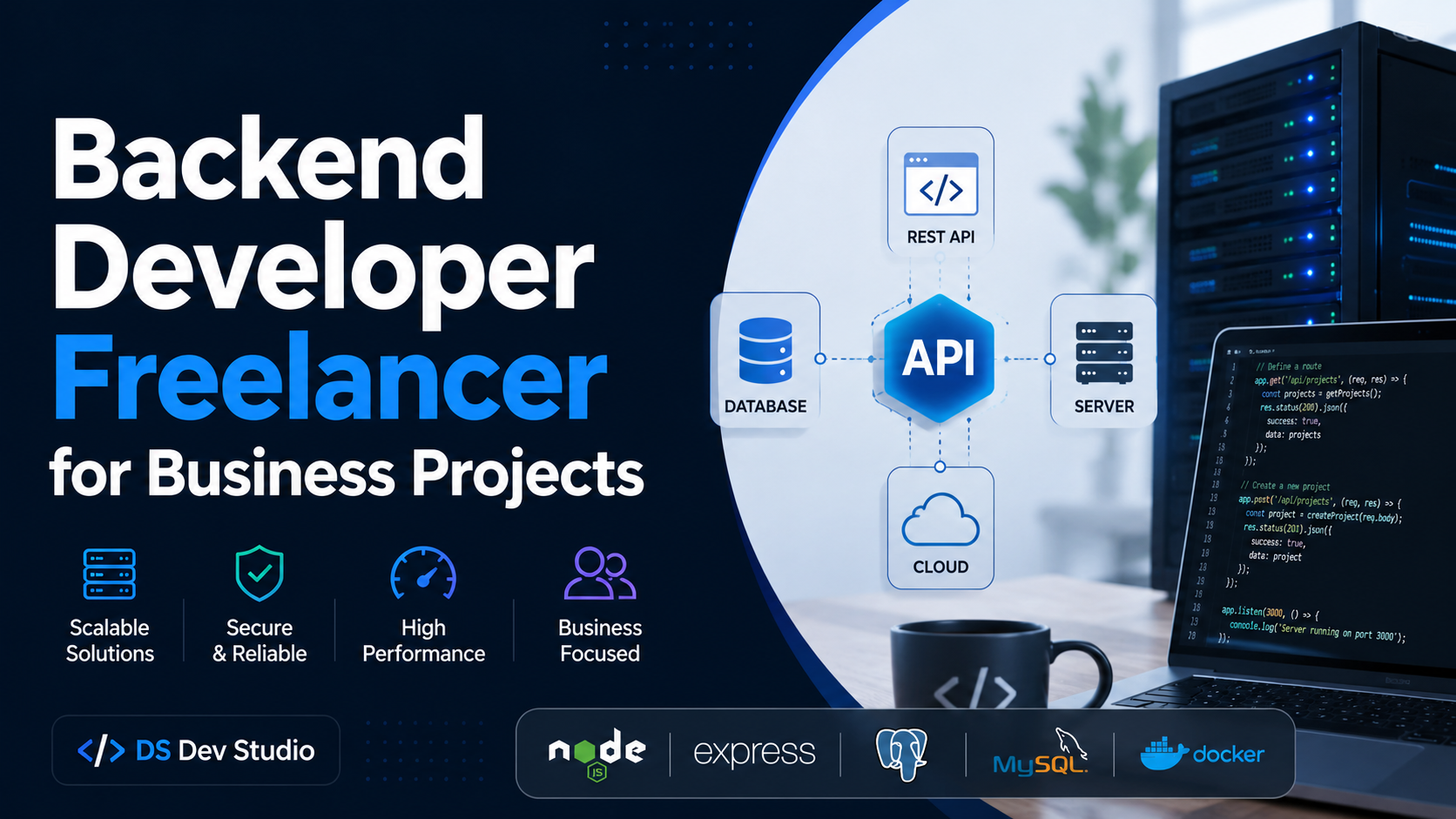
Backend developer freelancers provide the expertise to facilitate developing the capabilities of websites or web apps. Backend development encompasses all the tasks assosciated with making the site functional behind the scenes while pages rich in color or animation are what the customers see. Back-end development is responsible for forms, databases, APIs, login systems, free panels, modules of CRM systems, workflow of ERP, permissions of users, reports, uploads, e-mail notifications, and management of business processes.
Backend development is critical for business projects that require storing, processing, controlling, and moving data over the web. A simple static site may consist of some pages and contact information, however, in the case of a business solution involving inquiry forms, customer data, dashboards, filters, reporting, and admin controls, a proper backend model must be in place.
For smaller businesses and startups, working with a freelance backend developer is a reasonable choice. This option offers small enterprises, agencies, and others a way to achieve required backend functionalities without needing to employ a full scale cloud development team in-house. A freelancer can tackle smaller projects that include creating a PHP form, Laravel admin panel, CodeIgniter CRM module, MySQL database, API integration, or anything else in this practical area of expertise.
What does a Backend Developer do?
Backend developers deal with the server-side part of any application or website. Their work includes such tasks as designing a database, managing forms, creating APIs, logic for the dashboard, managing administrator functions, validating data, defining user roles, building business processes, and communication between the frontend and backend. Simply put, backend development means that a choice is made regarding what happens once the user has clicked a button, filled out a form, logged in, changed a record, or opened the dashboard.
In other words, when a customer fills out the contact page on the website, the back-end processes the form by ensuring the legality of the information provided, storing it in the database, sending notification emails, and redirecting the customer to the page with the message of gratitude. Further, when the admin changes information about the user, the back-end checks whether he has privileges and makes the corresponding update in the database. Though these operations are not seen as in a design, they still play an essential role in the working of the business.
Depending on which project they choose to work on, some of the common technologies used by Backend Developers in India include PHP, Laravel, CodeIgniter, MySQL, REST APIs, Javascript, and server-side tools. The choice of stack optimally depends on the business requirement, growth plan, budgetary constraints, and the existing system.
When should you hire a Backend Developer?
Hiring a Backend Developer becomes imperative when your site or app has to go beyond designing visual pages. When it comes to the users’ ability to enter information, the administrators’ capacity to control the data, the team’s ability to create dashboards, and the possible integration of the system with other solutions, the need arises to carry out backend development. The unquestionable expertise of a backend developer gives him/her the opportunity to create all the logical systems that work correctly.
Most businesses detect the necessity of backend development when they want to automate certain processes. For instance, information might be received via emails but not properly stored in the system. The records of customers might be kept in spreadsheets. The information may need to be accessible by authorized users. Managers might require reports. In this situation backend development makes it possible to convert disorganized work into structured digital work processes.
- You require contact forms that are capable of storing, transmitting, or processing information
- You require control panels, dashboards, or internal management screens
- You require CRM or ERP modules to facilitate business processes
- You require MySQL database establishment and structured data storage.
- You need PHP, Laravel, or CodeIgniter development.
- You need REST API development or integration.
- You require backend bug fixing, performance enhancement, or adding new features.
- You require authorization systems, user roles, authorizations, or secure access.
- You require reports, filters, exports, or dashboards statistics.
- You need back-end support for your React, WordPress, or customized website project.
Backend development for business websites
Initially, business sites are fundamentally informational sites. However, they may later require backend capabilities. For example, a business can get inquiries, send automated emails, accumulate leads, track service requests, create blogs, write case studies, or manage their site’s content through its admin panel. We need to think about such matters as backend functions beforehand.
A backend developer implements the implementation of different functionalities including contact form flows, inquiry databases, admin authorizations, notification emails, and secure data. Many businesses find it practical to use backend development solutions that enable them to reduce the amount of lost leads and forget about the necessity of the email monitoring. If backend capabilities are designed effectively, the website can work better for business purposes.
For businesses that are based on providing services, backend development is crucial in construction of inquiry forms for projects, forms to request quotes, dashboards for clients, requests for appointments, content management sections and reports targeted internally. Even a mere option of saving messages sent through the contact form in a database contributes to better business management and follow up.
PHP backend development for practical business systems
Several enterprises employ PHP programming language for its web development services for their business websites and back-end systems. A PHP Developer freelancer is capable of creating several useful technologies like form handling, database workflow, admin panels, CRM modules, website functions, and many more. The high degree of flexibility of the PHP technology ensures its effectiveness in developing various business projects.
PHP works well not just for small projects but also for bigger back end systems. Many simple projects may have a simple contact form that sends messages via e-mail and is stored in a database. Bigger projects may have a CRM, an admin dashboard, file uploads, reports, user roles, and API lines as part of their functionality. It should be clear about the requirements of the business in order to set the boundaries.
Professional PHP CRM Developers have the capability to develop lead management systems, manage customer records, create follow-up screens, filters as well as reports. PHP is employed together with frameworks like CodeIgniter and Laravel in cases where a proper structure, reusability of code, and maintenance of the architecture are essential.
Laravel Developer Freelancer for structured backend work
Laravel is an effective framework for structured backend application development. A Laravel developer can create dashboards, APIs, authentication mechanisms, database models, routes, controllers, reports, and business logic. Such a framework is suitable for projects that require streamlined organization and potential for scale in the future.
For instance, the Laravel admin panel is ideal for the management of users, leads, services, reports, products, and inquiries. It can work well when the front-end has to communicate with other frameworks such as React with the use of APIs. For that reason, it can be good for CRM, ERP, dashboards and other applications.
A Laravel Admin Panel Developer has the ability to include role-based access, validation rules, database relationships, workflow management, and reporting features. Such features allow organizations to handle data in a better manner as opposed to manually entering data into spreadsheets or using unconnected applications.
CodeIgniter Developer Freelancer for existing business systems
CodeIgniter is convenient for easy-going PHP applications and current business frameworks. Various businesses have CRMs, admin panels, or internal systems built on CodeIgniter already. A freelance CodeIgniter developer is capable of supporting these systems, solving problems, adding modules, improving database operations, and modifying admin interfaces.
CodeIgniter is a useful option for projects that are not looking for a large framework or when the code the application is built with is already CodeIgniter. A CodeIgniterCRM developer would work on lead records, customer forms, status updates, reporting, filtering, and back-end development. Business applications that need quick and easy PHP development can also benefit from using CodeIgniter.
The selection of either Laravel or CodeIgniter generally depends upon the project. Laravel is used in most cases for larger structured systems. On the other hand, CodeIgniter can be helpful in simpler systems, lightweight applications, and old projects that need improvements. A good backend developer should suggest the right method based on the requirement of the system.
MySQL database development for business data
MySQL is often employed in storing structured business information. As a backend developer, you can create databases for users, leads, clients, products, services, inquiries, orders, records, functions and log activities. Thus it is necessary to plan your database thoroughly because the backend relies on proper data structure.
Should a database be poorly planned, changing it in the future will be an uphill task. Some of the problems that arise as the project grows include duplicate fields, poor naming, ambiguous relations in the tables, and missing indexes. Hence, including data flow strategies in advance by a backend developer on how the information is input, changed, filtered, searched, or connected with other modules is fundamental.
Database design is crucial in projects involving ERP and CRM. The database may house customer records, lead stages, follow-up notes, tasks, invoices, products, inventory, employees, or approvals. When the database is built properly, MySQL will be able to support those databases.
API integration in backend development
API integration plays a vital role in connecting one system to another. API technology is imperative for various tasks such as integrating forms, dashboards, using third-party services, payment tools, CRM systems, exchange of data, frontend-backend integration, and using external business tools. The API Integration Developers have the expertise in connecting any website or application to various systems.
For example, a React frontend may need to pull records from a Laravel API. A contact form may send information to a notification service. A CRM dashboard may need to see filtered records from the backend. A payment or a booking flow may need to connect with a third-party provider. In these cases, API development and error checking has to be planned.
Good API implementation should incorporate validation, loading statuses, error messages, authentication when necessary, and understandable replies. Backend APIs should be organized in such a way that the frontend can use them successfully. If APIs are designed poorly, dashboards and forms can be difficult to handle.
Backend development for CRM and admin panels
The creation of CRM systems and admin panels requires solid backend planning. Thanks to a backend developer, one can create data tables, forms, edit views, delete workflows, filters, roles, records, reports, and API-based processes. Such functionality allows businesses to manage information in one place without relying on emails and spreadsheets.
An admin panel developer is capable of creating management platforms for managing leads, customers, services, products, inquiries, blogs, projects, files, and users. While admin panels should be user friendly, they also require an adequate back end structure. The functions seen by the users must be limited to actions that they have permission to perform, and the sensitive data must be dealt with appropriately.
The various modules of a CRM system might consist of functions such as lead acquisition, client detail, notes, tracking communications, checking current status, applying filters, generating reports, and granting access to certain employees. The ERPs modules may consist of the employee record, inventory, approval processes, ordering, invoices, and more. It relies on the backend developer to design the connecting logic of each module.
Security and validation in backend projects
Backend systems have the weight of significant business information on their shoulders, hence, their security and validation are of utmost importance. A backend developer must validate the inputs in forms, secure admin paths, manage user entitlements, refrain from writing unsafe database queries, and block unauthorized actions. Even a basic business app requires some security considerations.
Validation plays a critical role in ensuring quality of data. When a user submits an incomplete form, an incorrect email format, fails to submit his mobile number, or submits an invalid record, the backend has to deal with the situation appropriately. Proper validations will enable users to avoid broken workflows and database records to be kept clean.
Security does not only mean complicated systems. Contact forms, login pages, admin pages, file uploading, and database actions need to be handled carefully. A good freelancer Back-end Developer should test working modes and cut down unnecessary risks before launching.
How to plan a backend project before development
When it comes to hiring a backend developer, it is important that you know your requirements clearly first. To do so, we suggest that you start by identifying the kind of data that your system should work with. Once you have a clear idea of the data to be used, you will also identify the users of that data and what can they do with that. After this, you will also have to tell them what sort of reports, filters, emails, dashboards, etc., are required. Following this way will help make backend planning easy.
For instance, if there is a necessity for a CRM module, it is important to identify what fields should be included for leads and customers. Then decision should be made whether note entry, status changes, follow-up dates, and reporting is required. If the requirement is from admin interface point of view, then which areas need to be managed by admin should be defined. If the project involves implementation of API module, it is critical to provide information about which system will be integrated with which data. Therefore, proper planning allows software development team to create relevant project estimation.
- Itemize the different roles of users such as admin, director, team member, and client.
- Determine the information that will be stored in the database.
- Itemize all the essential forms, tables, filters, and reports.
- Decide on whether there should be login and role-based access.
- Clarify if React, WordPress, PHP, Laravel, or CodeIgniter will be used.
- Undergo the process of identifying any third-party instruments or APIs that need to be integrated.
- Conduct testing in terms of form submission, editing data, searching, filtering options, and identifying the permission.
How DS Dev Studio can help
Deepak Sharma’s DS Dev Studio provides services in PHP backend development, Laravel app development, CodeIgniter solutions, MySQL database management, API services, admin panels, CRM systems, ERP functionalities, and backend support. The studio specializes in delivering authentic backend software that meets the needs of actual business processes.
Deepak Sharma’s job as a web developer includes both frontend and backend development, creating React interfaces, PHP systems, admin panels, forms, dashboards, and CRM-style modules among other achievements. This skill set can be beneficial in cases when both a pleasant interface for users and reliable backend operation of online systems is and important.
If you are looking for the services of a Backend Developer for your business project, the DS Dev Studio can help you in planning the backend part of the project, establishing the database operations, developing the APIs, implementing admin functions, optimizing the existing PHP applications, and linking the backend programming with frontend pages or dashboards or whatever use you wish.
Conclusion
The importance of a freelance backend developer implies that if a project needs the proper functioning of its backend systems, it is necessary to hire someone who has appropriate skills and knowledge to deal with this aspect. It is true that frontend design entails the ways users interact with a website, its frontend UI, but it is backend development that takes care of data storage, data processing, form-generation, maintenance of database records, execution of the processing cycle, API connection, and administration of admin panels. Backend development serves to build a solid functionality for the business website or web application using all possible tools available on the market, beginning with PHP forms and MySQL databases and ending with Laravel technologies, CodeIgniter CRM modules, ERP workflows, and APIs. Deepak Sharma’s DS Dev Studio has everything required to help businesses come up with the real backend solution based on PHP, Laravel, CodeIgniter, MySQL database, and APIs. If a business gets ready for a more sophisticated system rather than just relying on spreadsheets and primitive forms on the website, the hiring of the right backend developer is crucial.
Useful internal links
Frequently asked questions
Can I hire Deepak Sharma as a Backend Developer Freelancer?+
Yes. You can hire Deepak Sharma for PHP backend development, Laravel projects, CodeIgniter systems, MySQL database work, API integration, CRM modules, ERP modules, admin panels, backend bug fixing, and custom business tools.
Can a backend developer build admin panels?+
Yes. A backend developer can build admin panels with forms, tables, records, filters, user workflows, database operations, role-based access, reports, and management features.
Can DS Dev Studio work on PHP CRM projects?+
Yes. DS Dev Studio can work on PHP CRM projects, CodeIgniter CRM systems, Laravel admin panels, MySQL databases, API workflows, dashboards, and backend business tools.
What is API integration in backend development?+
API integration connects one system with another. It can be used for forms, dashboards, third-party services, payment tools, CRM systems, frontend-backend communication, or data exchange.
Do business websites need backend development?+
Simple websites may not need complex backend work, but websites with forms, admin control, user login, dashboards, data storage, reports, API connections, or workflows need backend development.