Business Website Developer Guide for Service-Based Companies
A practical guide for service-based companies that need a Business Website Developer for professional websites, service pages, responsive layouts, enquiry forms, and SEO-friendly structure.

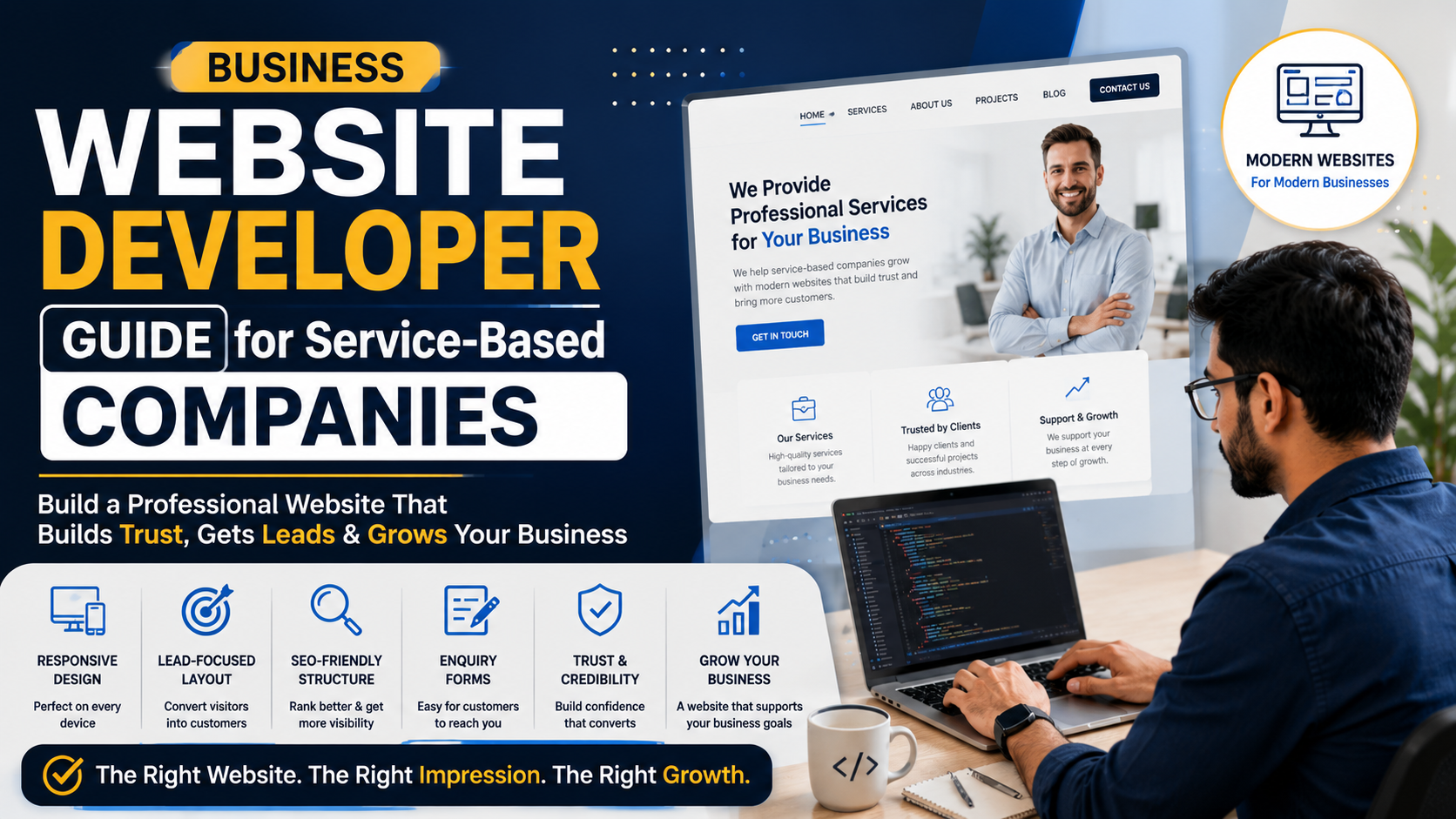
A Business Website Developer helps service-based companies build professional websites that explain services clearly, build trust, collect enquiries, and support long-term online visibility. For a service business, the website is often the first place where potential customers check what the company does, how the service works, what experience the business has, and how to contact the team.
Service-based companies need websites that are different from simple brochure pages. A service business website should guide visitors from awareness to enquiry. It should explain the problem, present the service, show credibility, answer common questions, and make contact simple. This is where a skilled Business Website Developer becomes useful.
Whether you run a consulting business, agency, coaching institute, repair service, local company, IT service business, real estate service, healthcare practice, legal service, marketing agency, design studio, or freelance service brand, your website should support your business goals. It should not only look attractive; it should help customers understand why they should choose your service.
A Website Developer Freelancer can help service-based companies create responsive pages, service detail pages, landing pages, contact forms, project sections, FAQ sections, blog structures, and SEO-friendly layouts. The goal is to create a website that works as a practical business asset rather than just an online profile.
Why service-based companies need a professional website
Service-based companies depend heavily on trust. Unlike physical products, services are often judged before delivery. Customers want to know whether the company understands their problem, whether the service is reliable, whether the team has experience, and whether the business looks professional. A website helps answer these questions before the first conversation.
A professional service business website gives visitors one central place to understand your offerings. Instead of depending only on social media pages, WhatsApp messages, referrals, or offline networking, the website gives your business a structured digital presence. It can show services, process, FAQs, case studies, contact details, and useful information in one place.
Small and growing service companies also need websites because customers usually research before contacting. A visitor may compare several businesses before deciding. If your website is clear, responsive, helpful, and easy to contact from, it can create a better impression than a competitor website that looks outdated or confusing.
This is why hiring a Business Website Developer is important. The developer should build a website that communicates service value clearly, works on every device, supports SEO-friendly structure, and creates a smooth path from page visit to enquiry.
What makes a service business website effective?
An effective service business website should be clear, focused, responsive, and built around customer questions. It should explain what the service is, who it is for, how the process works, what results or support customers can expect, and how to get started. The website should not force visitors to guess.
Many service websites fail because they use generic statements such as we provide best solutions or we are trusted experts without explaining the actual service. A better website uses clear headings, simple explanations, service-specific sections, proof points, process steps, FAQs, and strong contact options.
A Custom Website Developer can structure a website around the business model. A service-based company may need individual service pages, industry-specific landing pages, lead forms, testimonials, case studies, blog content, and trust sections. These elements help visitors understand the company more clearly.
- Clear homepage message explaining what the company does.
- Service pages for each major offering.
- Responsive design for mobile, tablet, laptop, and desktop.
- Contact forms and CTA buttons for enquiries.
- Trust sections such as testimonials, experience, process, or case studies.
- SEO-friendly headings, metadata, image alt text, and internal links.
- FAQ sections that answer common customer questions.
- Project or portfolio examples where relevant.
- Blog content for long-term service visibility.
- Fast loading, clean layout, and user-friendly navigation.
Homepage structure for service-based companies
The homepage is usually the first page visitors see, so it must explain the business quickly. A good homepage should include a clear hero section, short business introduction, service overview, trust signals, process section, project examples, FAQs, and a contact CTA. The page should guide users toward deeper service pages and enquiry options.
The hero section should be specific. Instead of saying we help businesses grow, a service-based company should explain the exact service and target audience. For example, a web development company can say it builds responsive business websites, landing pages, service pages, and custom web applications for small businesses and service providers.
The homepage should also reduce confusion. Visitors should immediately understand what the company offers. Service cards should link to individual service pages. CTA buttons should guide users to contact or view services. The contact section should be easy to find. A Business Website Developer should plan the homepage as a navigation and trust-building page, not only a visual landing screen.
Service pages are the backbone of a service business website
Service pages are extremely important for service-based companies. A homepage can introduce the business, but service pages explain each offering in detail. A customer searching for a specific service wants clear information about that service, not a general description mixed with unrelated offerings.
For example, a web development business may need separate pages for website development, React frontend development, WordPress customization, landing page development, backend development, and web app or admin panel development. Each page can explain what the service includes, who it is for, common use cases, process, FAQs, and contact options.
A service page should include a strong H1, useful H2 headings, service explanation, benefits, process, related examples, FAQs, and CTA sections. It should also link to related services and contact pages. This makes the page more useful for users and more SEO-friendly for search engines.
An SEO Friendly Website Developer should build service pages carefully because they are often the most important pages for organic visibility. Each page should focus on one main service instead of trying to rank for everything at once.
Responsive Website Development for service companies
Responsive Website Development is essential for service-based companies because many customers open websites from mobile phones. They may click through Google Search, WhatsApp, social media, email, ads, or referrals. If the website does not work properly on mobile, the visitor may leave before reading the service details.
A responsive website should adjust across mobile, tablet, laptop, and desktop screens. Text should remain readable. Images should resize correctly. Buttons should be easy to tap. Forms should be simple to complete. Menus should open properly on smaller screens. Service cards should stack cleanly.
Service-based websites often have detailed content, so responsive layout matters even more. Long service pages should not feel heavy on mobile. Paragraphs should be readable. Sections should have proper spacing. CTA buttons should appear at useful points. FAQs should be easy to open and read.
A Responsive Website Developer should test the website across screen sizes and browsers. A website that looks good only on desktop is not enough. For service companies, mobile usability can directly affect enquiries.
Contact forms and enquiry flow
Contact flow is one of the most important parts of a service business website. A visitor may understand the service and trust the company, but if the contact process is confusing, the enquiry may be lost. A good website should make it simple to contact the business from multiple points.
Contact forms should ask for useful information without becoming too long. Common fields include name, email, phone number, service requirement, location, budget range, timeline, and message. For some businesses, a short form may work better. For others, a more detailed project enquiry form may be useful.
The form should work properly on mobile and desktop. It should show validation messages when fields are missing, a loading state when submitting, and a success message or thank-you page after submission. Email notifications can help the business respond quickly. If needed, backend storage or CRM integration can also be added.
A Website Developer Freelancer can build contact forms, enquiry forms, CTA sections, thank-you pages, and backend form workflows depending on the business requirement.
Trust sections that help service companies convert visitors
Service-based businesses need trust-building sections because customers often decide based on confidence. A website should show why the company is credible. Trust sections can include experience, process, testimonials, project examples, client types, certifications, FAQs, before-after examples, or case studies.
Not every business needs the same trust elements. A consultant may need testimonials and experience. A web developer may need portfolio projects and technology skills. A coaching institute may need course information and student results. A local service provider may need reviews, service areas, and contact details.
A Business Website Developer should help choose trust sections based on what customers care about. Trust should be specific, not generic. Instead of saying high-quality service, the website can show process steps, real examples, clear service details, and transparent communication points.
SEO-friendly structure for service-based websites
SEO-friendly structure is important for service companies because customers often search for specific services online. A website with only one general page may not provide enough detail. Service pages, blogs, FAQs, internal links, clean URLs, and metadata can help create a stronger foundation for visibility.
An SEO Friendly Website Developer should build pages with proper headings and content structure. Each important page should have one H1, relevant H2 headings, useful paragraphs, optimized images, image alt text, meta title, meta description, and internal links. These basics help users and search engines understand the page.
Service-based companies should also publish helpful blog content. Blog topics can answer customer questions, explain services, compare options, provide checklists, and guide users through decision-making. For example, a web development business can publish blogs about hiring a website developer, responsive website development, WordPress customization, React websites, landing pages, backend systems, and SEO-friendly website structure.
Internal linking is also important. A blog about responsive design can link to responsive website development services. A blog about landing pages can link to landing page services. A service page can link to contact. This creates a stronger website journey.
Landing pages for service campaigns
Landing pages are useful for service-based companies that run campaigns, ads, local promotions, social media offers, or service-specific lead generation. A landing page focuses on one service and one action. It is different from a general homepage because it is built around a specific goal.
A good landing page should include a clear headline, short service explanation, benefits, process, trust points, FAQs, contact form, and CTA buttons. It should remove distractions and guide visitors toward enquiry. The page should be responsive because many campaign visitors come from mobile devices.
For service companies, landing pages can be built for website development, consultation calls, coaching admissions, repair services, design packages, local services, real estate enquiries, healthcare appointments, or agency offers. A Web Developer Freelancer can create landing pages that match the campaign message and business goal.
WordPress or React for service business websites
Service-based companies often ask whether they should choose WordPress, React, or custom development. The answer depends on the project requirement. WordPress is useful when the business wants to update content, publish blogs, manage pages, and use a CMS dashboard. React is useful when the business wants custom frontend structure, reusable components, and modern user interface control.
A WordPress website can be useful for consultants, local businesses, agencies, coaches, and service providers who need regular content updates. A React website can be useful for developer portfolios, custom business websites, landing pages, dashboards, and API-connected interfaces. Custom development with PHP, Laravel, CodeIgniter, or MySQL may be needed when the project requires backend workflows.
A Custom Website Developer should recommend technology based on the project, not only personal preference. The website should be maintainable, responsive, and suitable for future updates. The right technology is the one that supports the business goal without adding unnecessary complexity.
Backend features for service-based companies
Some service-based websites need backend features. A basic website may only need pages and forms, but a growing business may need enquiry storage, admin panels, CRM modules, dashboards, reports, API integrations, user login, booking flows, or file uploads. These features help manage operations more effectively.
For example, a service company may want every enquiry stored in a database. A CRM module can track lead status, follow-up notes, assigned team member, and customer history. An admin panel can allow the team to view records, update statuses, and export reports. These features require backend planning.
A Business Website Developer with backend understanding can help decide when these features are needed. Not every business needs backend systems at the start, but the website should be built in a way that can support future growth if required.
Content planning for service business websites
Content is one of the most important parts of a service website. A strong design cannot help much if the content does not explain the service clearly. Service-based companies should prepare content that answers customer questions, explains service benefits, shows process, and gives enough detail to support enquiries.
Each service page should answer what the service is, who it is for, what problems it solves, what is included, how the process works, and how the customer can get started. This type of content is more helpful than short generic descriptions.
A Website Developer Freelancer can build the structure, but the business should provide accurate service information. The developer can then arrange the content into clean sections with headings, cards, lists, FAQs, and CTA blocks. Good content and good structure work together.
What to check before hiring a Business Website Developer
Before you hire Website Developer support for a service-based company, check whether the developer understands business goals, service page structure, responsive design, SEO-friendly layout, contact forms, and user experience. A developer should not only focus on visuals; they should understand how the website supports enquiries.
Review portfolio examples. Open the websites on mobile and desktop. Check whether the pages are clear, forms work, navigation is simple, text is readable, and service pages are structured properly. Also ask whether the developer can support future updates, blogs, landing pages, and feature improvements.
- Check business website and service page examples.
- Ask whether responsive design is included.
- Review experience with WordPress, React, PHP, Laravel, CodeIgniter, and MySQL.
- Confirm whether contact forms and enquiry workflows can be added.
- Ask about SEO basics such as headings, metadata, image alt text, and internal links.
- Discuss content requirements, timeline, revisions, and deployment.
- Ask whether future pages, blogs, and updates can be supported.
- Clarify whether backend features, APIs, or admin panels can be added later.
Common mistakes service companies make with websites
One common mistake is creating a website with only a homepage and contact page. This may not be enough for a service-based company. Customers need detailed service information before contacting. Without service pages, the website may feel incomplete and may not support SEO properly.
Another mistake is ignoring mobile responsiveness. Many visitors open websites from mobile phones. If the website is difficult to read or contact from on mobile, the business may lose enquiries. A third mistake is using generic content that does not explain the service clearly.
Some companies also hide contact options. Visitors should not need to search for how to contact the business. CTA buttons, contact forms, phone links, email links, and contact sections should be placed naturally across the website.
A Business Website Developer can help avoid these mistakes by planning the website structure properly from the beginning.
How DS Dev Studio can help
DS Dev Studio by Deepak Sharma can help service-based companies with business website development, responsive website development, service pages, landing pages, React websites, WordPress customization, backend features, contact forms, admin panels, CRM modules, and custom web applications.
Deepak Sharma Web Developer work focuses on practical website development for small businesses, service providers, consultants, agencies, startups, freelancers, and growing companies. The goal is to build websites that explain services clearly, work smoothly across devices, support enquiries, and provide a strong foundation for future growth.
To hire Website Developer support for a service-based company, DS Dev Studio can help plan your website structure, build responsive pages, create service sections, set up contact forms, add SEO-friendly layout, and prepare the website for real users. The focus is on clear communication, practical development, and business-focused website structure.
Conclusion
A Business Website Developer plays an important role in helping service-based companies build a professional and practical online presence. A strong service business website should explain services clearly, work properly on every device, include contact forms, build trust, support SEO-friendly structure, and guide visitors toward enquiries. It should include a clear homepage, service pages, responsive layouts, CTA sections, FAQs, trust elements, and useful content. DS Dev Studio by Deepak Sharma can help service-based companies create business websites, landing pages, React websites, WordPress websites, backend features, admin panels, CRM modules, and custom web applications. With the right website structure and development approach, service-based companies can create a stronger digital foundation for trust, visibility, and future growth.
Useful internal links
Frequently asked questions
Why do service-based companies need a Business Website Developer?+
Service-based companies need a Business Website Developer to create professional websites that explain services, build trust, collect enquiries, work on all devices, and support SEO-friendly online visibility.
Can I hire Deepak Sharma as a Business Website Developer?+
Yes. You can hire Deepak Sharma for business websites, service pages, responsive layouts, React websites, WordPress customization, landing pages, contact forms, backend systems, and custom web applications.
What pages should a service business website include?+
A service business website should usually include Home, About, Services, individual service pages, Projects or Case Studies, Blogs, FAQs, Contact, and landing pages where needed.
Can DS Dev Studio build SEO-friendly service pages?+
Yes. DS Dev Studio can build SEO-friendly service pages with clear headings, metadata, internal links, image alt text, FAQs, responsive layout, and useful service-focused content.
Can a service business website include backend features?+
Yes. A service business website can include backend forms, enquiry storage, admin panels, CRM modules, dashboards, reports, API integrations, and database-driven workflows.