Full Stack Web Developer Freelancer Guide
A practical guide to hiring a Full Stack Web Developer Freelancer for complete websites, backend systems, admin panels, and web applications.

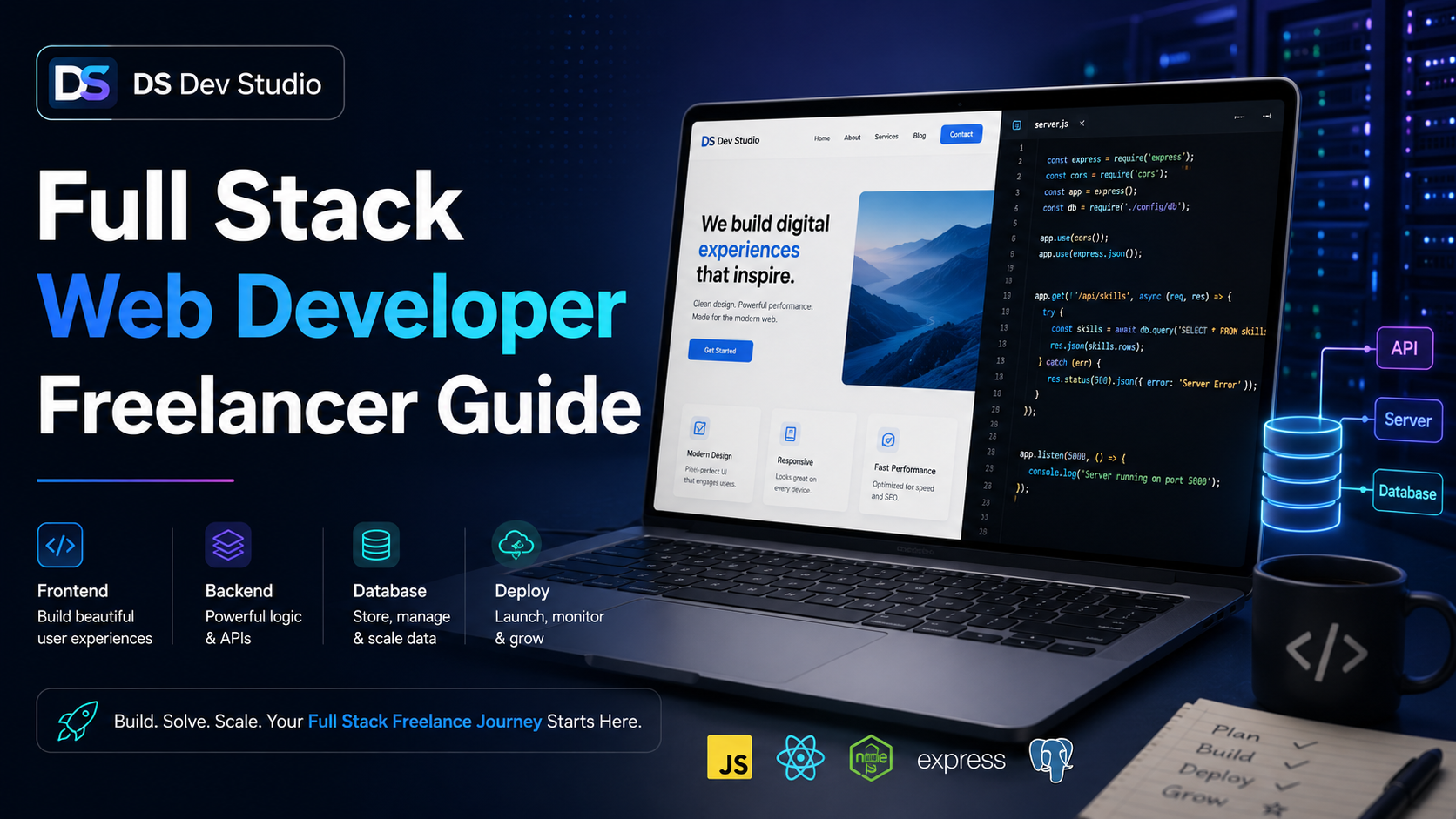
A Full Stack Web Developer Freelancer is capable of performing the task of frontend and backend development efficiently. Such efficiency is a requirement when organizations need their websites and web applications developed in terms of user-centered pages, responsive interfaces, forms, panels, workflows, APIs, and unique requirements. Rather than having multiple specialists for different functions, a full stack developer takes care of the entire procedure from design development to backend logic realization.
Small enterprises, up-and-coming businesses, organizations, consulting firms, and service providers may find full stack software development a feasible solution. A company might require a simple website, a contact us form, an interesting blog creation, an admin panel, a customer relationship module, an API connection, or an application based on a database. Such needs demand both front end and back end strategies. A Full Stack Developer Freelancer will grasp the whole project and implement it in a more cohesive manner.
Full stack development doesn’t mean working with every technology at the same time. It is all about having knowledge about both the interface and the backend. A good full stack developer will know exactly when to work with React and when it is enough to just use HTML/CSS; when to use WordPress, when the PHP back end is necessary, as well as when to use Django or CodeIgniter and other technologies including MySQL and REST APIs.
What does a Full Stack Web Developer do?
A Full Stack Web Developer deals with aspects of both the frontend and the backend. They oversee everything, starting from the responsive design layout and website functionality to backend logic and database structure. The frontend is the segment that users interact with. It consists of all that users see like web pages, buttons, menus, headings, images, cards, forms, and other responsive parts. Lastly, the backend is a segment that stores data, processes forms, maintains user accounts, and handles APIs.
As an instance, when a visitor fills out the contact form, the front end shows all the fields and the button. The back end performs the data validation, sends the message, keeps the record of the request, and redirects the visitor to the thank-you page. In case the administrator edits the entry, the front end displays the form, while the back end modifies the database. A full stack developer knows both the front end and the back end parts and ensures the correct operation of both.
The role of full stack development becomes vital for websites that require beyond mere simple static pages. While a commercial website may begin with just the home page and services page, other things may follow such as blogs, project details pages, contact forms, admin controls, CRM records, and API-integrated sections. A full stack developer can set up the layout in such a way that adding subsequent features becomes an easier task.
When should you hire a Full Stack Developer Freelancer?
Engaging the services of a Full Stack Developer Freelancer would be ideal if your project embodies components that involve both interface design and functionality. If what you need is only a very simple visual representation, a frontend developer will do. For database or server-side work, a backend developer might suffice. However, if your whole project comprises a complete website or application that includes all components and the related functionality, working on full-stack building would be more efficient and effective.
A freelancer who specializes in full-stack development comes in really handy when there are many areas to deal with on a project that is well understood. For example, a project that has a front end written in React may just as well have a back end written in PHP, in addition to a MySQL database, a contact form, a storage for inquiries, and an admin dashboard before or during the deployment stage. Instead of hiring separate professionals to deal with each part of the project and struggle to manage communication between them, it is much easier to work with a full-stack freelancer.
- It is necessary to have a fully developed business website having both frontend and backend features.
- It is requisite to have all those modules that will help build forms pages, keep data to cash customization information.
- The website that utilizes React with PHP, Laravel or CodeIgniter for backend services is the ideal solution.
- The web pages of the project have to be integrated with API having dashboard or CRM to manage necessary evidence.
- It is necessary to have a website developed by the same developer who will provide both frontend and backend services.
- Having the website means that you will have the ready-to-use and improved system with complete assurance.
- It means that there will be no difficulties during communication between two different parties of developers.
- You must plan the project having great opportunities to grow.
Frontend work in full stack development
Front end development refers to all of the things visible on the user part of satisfaction. In particular, many pages are involved in front end development, such as home page, about page, services page, projects page, blogs page, contact page, landing pages, forms, menus, cards, sliders, FAQ sections, buttons, responsive layouts and others. The primary focus when hiring a front-end developer is on the appearance of a project and the whole user experience.
A freelancer full-stack web developer should have a clear grasp of frontend quality. The site must be functioning smoothly on mobile phones, tablets, laptops, and desktops. The content that users see must be legible, the forms easy to understand and fill, the navigation simple, pictures loaded appropriately, and sections spaced in a uniform way. Even a remarkable backend performance cannot save a website if it gives users trouble in the interface.
React is beneficial to frontend web development especially when it comes to projects that need components that can be reused, web pages based on routes, dynamic content, dashboards and interfaces connected to APIs. For instance, reusable components such as service cards, blog cards, project cards, contact forms and detail pages can be developed and managed in a more efficient manner.
Backend work in full stack development
When we talk about the work done on the backend, we refer to everything that works behind the scenes of the website, such as results of filling in a contact form, notifications via emails, storing databases, logging in users, managing admin panel and customer relationship management modules (CRM), Enterprise resource planning (ERP), uploading files, and generating reporting as well as filtering data and having access points for APIs and business logic rules. Companies refer to hiring backend developers when the website requires data storage or server-side functionality development.
Backend development is essential for a website because it helps in making the website functional apart from mere aesthetics. For instance, a company may want to capture inquiries through its website and save them in an administration board. A CRM system may need information about leads, customer particulars, feedback follow-ups as well as status updates. An admin board may be required to have user roles, tables, filters, and reports.
Full stack developers work with PHP, Laravel, CodeIgniter, MySQL, REST APIs, and other possible backend tools depending on the project specifications. The PHP programming language comes in handy in developing ERP systems. Laravel is helpful for structured backend development while CodeIgniter can come in handy in lightweight or already existing solutions. Designed to support structured data collection and storage, MySQL is widely used to store structured data.
Full stack development for business websites
Business websites require more than just static pages. A full stack developer has the ability to create service pages, landing pages, contact forms, thank you pages, CRM workflows, backend databases, and store admin functions. This is what makes the website useful for business, apart from just being present online.
Take, for example, a company website where a contact page should exist containing input boxes for the full name of the customer, their email, mobile phone number, address, type of project, and project details. Upon submission of the contact form, the business might also require an email notification and redirect to a thank-you page. Later, the same business may need to have the records stored in the database created by the form and presented through the admin panel. All of these tasks can be performed by a skillful full stack developer.
Full stack development is beneficial for a company with plans for expanding in the future. There are chances that the website will consist of blog webpages, case studies, pages with descriptions of services provided, pages with downloadable materials, dashboards, and customer portals. If the project is executed according to the right plan, future incorporations will be easier to conduct.
Full stack development for web applications
Web application developers create websites that users access using a web browser. These websites may consist of tools for customer relationship management (CRM), backend administration, enterprise resource planning (ERP), reports, dashboards, booking systems, query management tools, etc. The work usually requires both front-end and back-end skills.
A web app's frontend may have login forms, dashboard widgets, grids, filters, forms, edit screens, and navigation. Backend on the other hand might include authentication services, database queries, access rights, API logic, validity tests, and reporting mechanisms. A freelancer working in full stack development will connect these and create a useful system for actual business processes.
Careful planning is essential when it comes to web applications. The company must determine user roles, required modules, information fields, actions, reports, and integrations before development starts. Doing so will allow the agency to deliver a solution that works rather than distracts the developers from their work with extra functionality.
React, PHP, Laravel, CodeIgniter, and MySQL in full stack projects
Distinct technologies play specific roles when one works in the full-stack development domain. The React framework specializes in building front-end interfaces and reusable components. PHP is recognized as a popular technology that is primarily used in creating backend functionalities and business-oriented websites. In addition, Laravel technology can be employed in designing interesting backend applications, APIs, and management panels. Another technology known as CodeIgniter is used in lightweight PHP solutions including existing business projects. MySQL database can manage structured data including users, leads, customers, services, products and report etc.
A full stack developer should not select technology simply because it is in vogue. The choice should be based on business needs. For example, a straightforward business website may not require a sophisticated stack. A CRM dashboard may need a combination of React and Laravel or PHP-based backend. If the company wishes to use WordPress, this would be a better option since it allows for easy content management. Similarly, if the already existing system has been developed on CodeIgniter framework, then it would be a viable option for project development.
The main goal is to create a dependable and maintainable. Fullstack developer should select the simplest stack that fulfills the requirement and allows for future development. Thus, the project remains practical and simpler to maintain later on.
API integration in full stack development
An API is vital in full-stack projects as it acts as a communication bridge between front-end and back-end. It links a website with third-party services, email tools, payment systems, CRM, analytics tools, and various other business apps or programs. Otherwise, a system remains uncommunicative and therefore inefficient.
React dashboard, for instance, can ask the backend API for client information. Contact form can send the information to an email platform. Admin panel can change the information using the APIs. Reporting page can receive selected data from the database. The mentioned interactions require a correct implementation of the backend routes, validation, as well as error handling and front-end states.
A skilled full stack developer knows what loading statuses, error messages, form validation, secure requests, and clean API responses are. They help with making a web application user-friendly and easier to maintain.
Admin panels and dashboards
Control panels and dashboards have become a standard necessity in full stack apps. Organizations may need control panels to supervise inquiries, services, blogs, projects, users, reports, customer data, inventory, and even internal operations. These panels necessitate both a front-end interface and back-end database logic.
A full stack developer can build features such as creating tables, forms, filters, editing screens, deleting actions, uploading files, generating reports, and creating user roles. Frontend design needs to be straightforward and user-friendly while backend is responsible for data processing. Moreover, admin panels must assure both validity and security enabling users to execute allowed actions only.
For small businesses, complex admin panels aren’t essential. A simple existing dashboard is enough. It will take care of inquiries, record-keeping and provide useful reports, saving time and manual labor.
What to check before hiring a Full Stack Developer Freelancer
Prior to engaging with a full stack developer, it is advisable to confirm their familiarity with the theories of both frontend and backend development. A portfolio can be used to check particular merits of the developer: including design implementation, responsiveness, project structure, and examples from practice. The examples of the backend work may include forms, admin panels, CRM modules, API integration, or database-related features.
You must make sure that you talk about project scope clearly. Discuss pages, features and roles of users, forms, databases, administration screens, APIs, and deployment needs. Having a clear scope makes it possible for the developer to estimate the project and helps avoid mistakes.
- Validate the frontend expertise of a developer in HTML, CSS, JavaScript, ReactJS, and Tailwind CSS.
- Validate the backend skills of a developer in PHP, Laravel, CodeIgniter, MySQL, and APIs.
- Assess the portfolio and real-life projects undertaken by the prospective candidate.
- Inquire about the developer’s knowledge of responsive design and mobile compatibility testing.
- Enquire about the handling of the contact forms, admin panels, and database.
- Check if deployment and post-delivery support are a part of the deal.
- Discuss future updates, maintenance services, and feature upgrades offered by the candidate.
How DS Dev Studio can help
Deepak Sharma is the founder of DS Dev Studio, which aids in React frontend development as well as PHP backend development, Laravel projects, CodeIgniter systems, WordPress modification, admin panels, CRM modules, and custom web applications development. The studio aims to provide useful web solutions that meet the actual business requirements.
The duties of a Full Stack Developer include developing business sites, landing pages, service pages, contact forms, React interfaces, back-end workflows, MySQL database structure, Administration interfaces, and API dashboard applications. This will benefit customers requiring a good web site and a stable and reliable backend site.
If you are seeking web developer assistance for an entire project, DS Dev Studio can help to set up the framework, create a user interface, design backend processes, interact with Application Programming Interface, integrate forms, perform deployment, and keep improving your website or app with time.
Conclusion
Whenever a project requires complete support of the development process from front-end to back-end, the services of a freelance full stack web developer can be required. The full stack developer has the ability to develop websites that have various features including user interactive pages, responsive designs, forms, and APIs, as well as databases, dashboards, and custom web applications. This explains why full stack development is the best option for businesses that want a single working process, instead of having separate front-end and back-end development processes. DS Dev Studio established by Deepak Sharma can assist you in the creation of different types of business websites, including React applications, projects created using PHP programming language, Laravel and CodeIgniter projects as well as in the development of admin panels, CRM solutions, and unique web applications. Choosing the right full stack specialist for your project can help make the development process more effective and efficient.
Useful internal links
Frequently asked questions
Can I hire Deepak Sharma as a Full Stack Web Developer Freelancer?+
Yes. You can hire Deepak Sharma for frontend, backend, React, PHP, WordPress, Laravel, CodeIgniter, admin panels, CRM modules, APIs, and custom web applications.
Is a full stack developer good for small business websites?+
Yes. A full stack developer can handle complete website development, including responsive pages, backend forms, database work, contact flow, admin functionality, and future website improvements.
What technologies can a full stack developer use?+
A full stack developer can use ReactJS, JavaScript, PHP, Laravel, CodeIgniter, MySQL, WordPress, REST APIs, HTML, CSS, Tailwind CSS, Bootstrap, and deployment tools depending on the project.
Can a full stack developer build admin panels?+
Yes. A full stack developer can build admin panels, dashboards, CRM systems, ERP modules, forms, tables, filters, reports, data management workflows, and API-connected interfaces.
Should I hire a frontend developer or full stack developer?+
If your project only needs UI, hire a frontend developer. If your project needs UI plus backend, APIs, database, forms, admin functionality, dashboards, or custom workflows, hire a full stack developer.