How Blogs Help Small Business Websites Grow Online Visibility
A practical guide for small businesses that want to use blogs to grow online visibility, support SEO-friendly website structure, connect service pages, answer customer questions, and improve website enquiries.

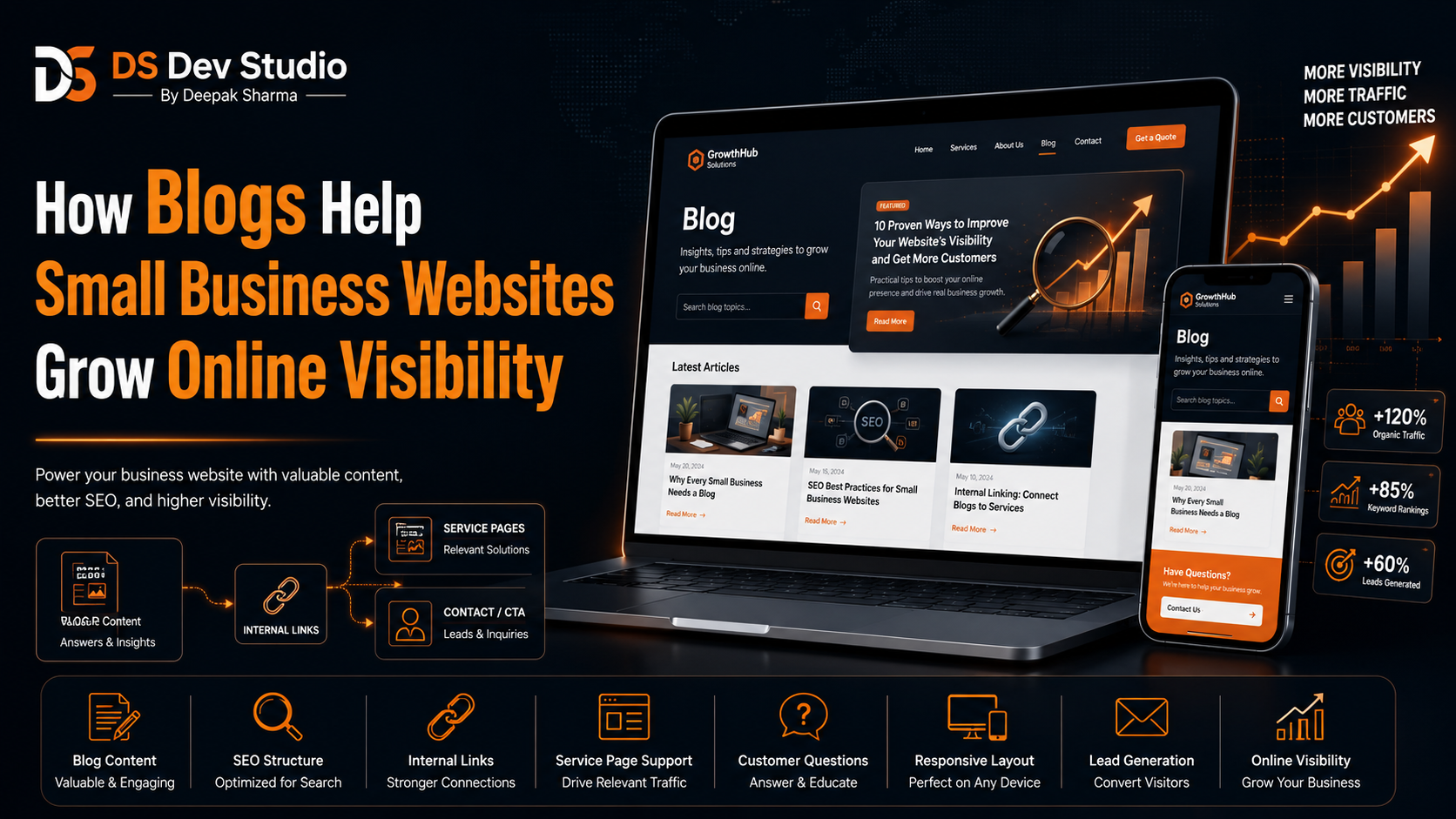
Blogs can help small business websites grow online visibility by creating useful content that answers customer questions, supports service pages, improves internal linking, and gives search engines more clear pages to understand. A small business website should not depend only on a homepage and contact page. If the website has helpful blogs connected with services, customer problems, local needs, and business topics, it can become more useful for visitors and stronger for long-term online growth.
Many small businesses build a website once and then leave it unchanged for months or years. The homepage may explain the business, and the service pages may describe offerings, but there may be no fresh or helpful content that answers what customers are actually searching for. A blog section solves this problem by giving the website a place to publish guides, FAQs, comparisons, checklists, explanations, and practical advice.
Blogs are not only for large companies. A local service provider, freelancer, consultant, coaching center, clinic, agency, repair business, real estate service, web development studio, or professional service company can use blogs to educate visitors and support enquiries. When blogs are planned properly, they can connect naturally with service pages and contact options.
DS Dev Studio by Deepak Sharma helps businesses with SEO-friendly website development, responsive website development, blog structure, service pages, WordPress customization, React frontend development, landing pages, contact forms, PHP backend systems, API integration, admin panels, CRM modules, and custom web applications. This guide explains how blogs help small business websites grow online visibility and how to plan a useful blog section.
Why blogs matter for small business websites
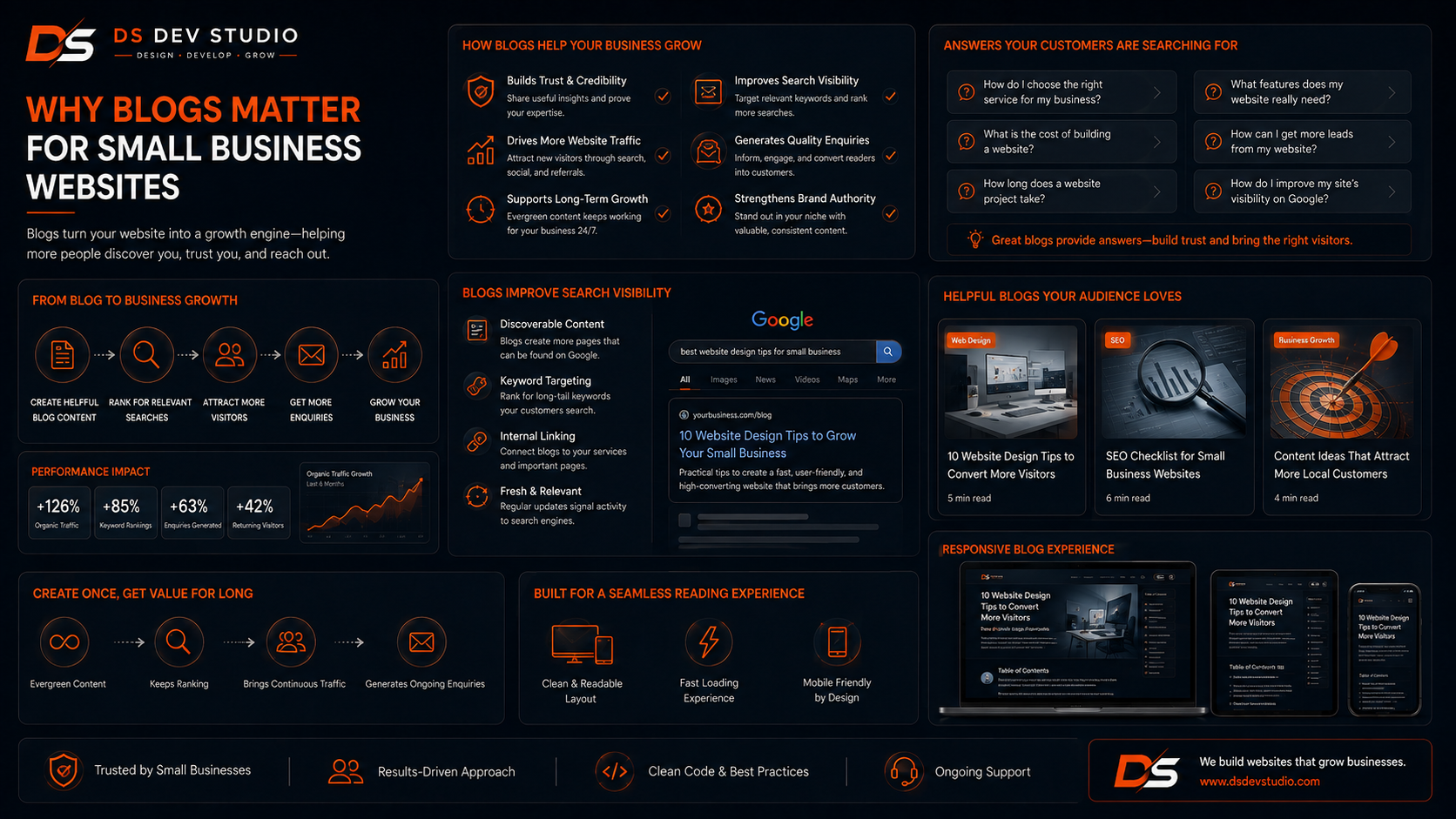
Blogs matter because small business customers often search for answers before they contact a business. They may not directly search for a company name. Instead, they may search for questions, problems, comparisons, costs, process details, service benefits, or how-to information. If your website has blogs that answer these topics, it creates more chances for visitors to discover your business.
A small business website with only a few static pages has limited content. It may explain who you are and what you do, but it may not cover the many questions customers have before making a decision. Blogs expand the website by adding useful pages around those questions.
For example, a web development business can publish blogs about how to hire a website developer, why responsive website development matters, how WordPress customization helps small businesses, what React frontend development is, why service pages matter, and how API integration connects contact forms with CRMs. These blogs help visitors understand the service before contacting.
Blogs support SEO-friendly website development
SEO Friendly Website Development is not only about technical settings. It also depends on useful content, clear page structure, internal links, headings, metadata, responsive design, image alt text, and fast loading. Blogs support this structure by creating helpful pages that cover topics related to your services.
A blog gives your website more opportunities to target customer questions and long-tail search terms. Instead of trying to put every detail on the homepage, you can create focused blog posts. Each blog can cover one topic clearly and then link to the relevant service page.
An SEO Friendly Website Developer should plan the blog section as part of the full website structure. Blogs should not be random. They should connect with services, customer needs, internal links, and business goals. This makes the website more organized and useful.
Blogs answer customer questions before enquiry
Customers usually have questions before they contact a business. They may want to know how a service works, what to prepare, what mistakes to avoid, how long a project may take, what options are available, and which solution is suitable for their situation. Blogs can answer these questions in detail.
When a blog answers a real customer question, it builds trust. The visitor feels that the business understands their problem. This can make them more comfortable exploring service pages or submitting an enquiry. Helpful blogs can reduce confusion and support the decision-making process.
For example, a blog titled “How to Plan a Small Business Website Before Hiring a Developer” can help a visitor prepare content, pages, forms, branding, and features. After reading the blog, the visitor may be more ready to contact a Website Developer Freelancer with clear requirements.
Blogs create more entry points to your website
Every blog post can become an entry point to your website. A visitor may not first land on your homepage. They may find a blog through search, social media, WhatsApp, email, or internal links. If the blog is helpful, the visitor may continue to a service page, project page, or contact form.
This is useful for small businesses because different visitors search in different ways. Some search for services directly. Some search for problems. Some search for comparisons. Some search for guides. Blogs allow your website to cover more of these search journeys.
A Business Website Developer should make sure blog pages are connected with the rest of the website. A blog should not be a dead end. It should guide users to related services, contact options, and helpful next steps.
Blogs strengthen service pages through internal linking
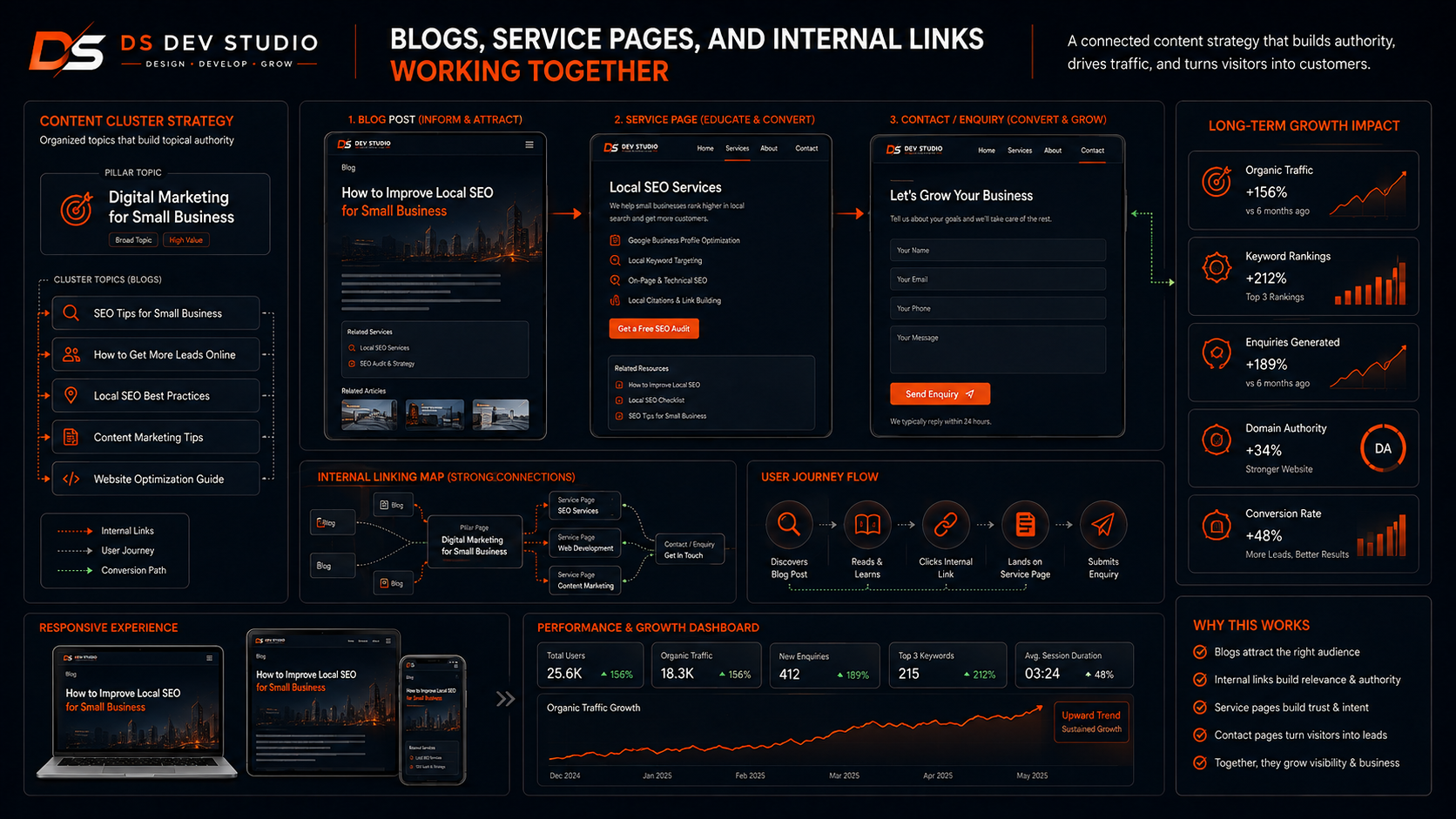
Internal linking is one of the most important reasons blogs help small business websites. A blog can link to a relevant service page, and a service page can link to related blogs. This creates a connected website structure where users can move naturally between education and action.
For example, a blog about responsive website development can link to the website development service page. A blog about React frontend development can link to the React service page. A blog about API integration can link to the API or CRM development service page. These links help visitors explore more information.
Internal links should be useful and natural. They should not be added randomly. A Website Developer Freelancer should plan the blog and service page connection while building the website structure.
- Blogs can link to relevant service pages.
- Service pages can link to supporting blog guides.
- Blogs can link to contact pages or enquiry forms.
- Blogs can connect related topics into a content cluster.
- Internal links help users continue their journey.
- Internal links support a cleaner SEO-friendly website structure.
Blogs help build topical authority
Topical authority means your website covers a topic deeply and consistently. A small business website can build stronger topical relevance by publishing blogs around its services and customer questions. Instead of having one short page about a service, the website can create multiple supporting blogs around related topics.
For example, a website development business can have a service page for website development and supporting blogs about responsive design, small business website planning, website redesign, service page development, landing pages, WordPress customization, React frontend development, and CRM integration. Together, these pages show depth around the topic.
This approach is better than publishing random blogs unrelated to the business. A small business blog should support the main services and target audience. A Custom Website Developer and SEO Friendly Website Developer can help plan this structure from the beginning.
Blogs improve trust and credibility
Blogs improve trust because they show that the business understands its field. When visitors read useful explanations, practical guides, and clear advice, they see the business as more knowledgeable. This can be especially helpful for service-based businesses where customers want confidence before contacting.
A blog also helps explain complex services in simple language. For example, technical services such as React frontend development, PHP CRM development, Laravel admin panels, CodeIgniter systems, API integration, and backend development may feel confusing to non-technical business owners. Blogs can explain these topics in business-friendly language.
Trust grows when the website answers questions honestly and practically. Blogs should not only be promotional. They should educate, guide, and help users make better decisions.
Blogs help local small businesses
Blogs can also help local small businesses improve online visibility. A local business can publish blogs that answer location-specific questions, service area needs, local customer problems, and common buying doubts. These blogs can support local service pages and Google Business Profile traffic.
For example, a local service business can publish blogs about how to choose the right service provider in its city, what customers should check before booking, common mistakes, maintenance tips, seasonal service needs, or local service comparisons. These topics can attract visitors who are researching before contacting.
A Website Developer India professional can plan blog structure for local businesses by connecting blog topics with service pages, location pages, contact details, and enquiry forms. This can help local businesses build a stronger digital presence.
Blogs support long-tail keywords
Long-tail keywords are specific search phrases that usually show clearer intent. A small business may find it difficult to compete for broad keywords, but blogs can target specific questions and detailed search topics. These topics often attract visitors who are closer to understanding their need.
For example, instead of only targeting “website developer,” a blog can target topics like “how to plan a small business website before hiring a developer,” “how blogs help small business websites grow online visibility,” or “how service pages support SEO-friendly business websites.” These topics are more specific and useful.
Long-tail blog content should still be natural and helpful. The goal is not to force search phrases. The goal is to answer specific questions clearly and connect them with relevant services.
Blogs help explain your process
Many customers want to understand how a service works before contacting. Blogs can explain your process step by step. This is useful because it reduces uncertainty and helps visitors feel prepared. A customer who understands the process may contact with clearer expectations.
For a website development service, blogs can explain planning, content preparation, responsive design, service page structure, contact form integration, SEO-friendly setup, testing, launch, and maintenance. For CRM development, blogs can explain lead tracking, customer records, admin dashboards, user roles, MySQL databases, and APIs.
Process-based blogs also help qualify leads. Visitors who read detailed process content may better understand what they need and why professional development matters.
Blogs connect education with lead generation
Blogs can educate visitors and also support lead generation when they are connected with clear CTAs. A blog should not feel like a hard sales page, but it should guide readers toward a useful next step. That next step may be contacting the business, reading a service page, viewing projects, or submitting a form.
A blog about website redesign can include a CTA to contact for website redesign support. A blog about API integration can guide readers to API integration services. A blog about small business website planning can guide readers to website development services. This creates a natural flow from learning to enquiry.
A Landing Page Developer or Business Website Developer can also use blog traffic to support campaign pages. Some blogs can link to focused landing pages where visitors can request quotes or book consultations.
Important blog types for small business websites
Small businesses should publish blog types that match customer needs. Random news-style content may not help much if it does not connect with services. Useful blog types include how-to guides, beginner guides, comparison posts, checklists, FAQs, mistake-based articles, planning guides, service explainers, local guides, and case-study style posts.
Each blog type has a purpose. How-to guides educate. Checklists help users prepare. Comparison posts help decision-making. Mistake-based articles warn users. Service explainers clarify what a service includes. Local guides support area-based visibility. Case-study style posts show proof.
- How-to guides that explain practical steps.
- Beginner guides for customers who are new to a service.
- Checklist blogs that help visitors prepare before contacting.
- Comparison blogs that explain different options.
- Mistake-based blogs that warn customers what to avoid.
- Service explainer blogs that simplify technical topics.
- Local guide blogs for area-based customer needs.
- FAQ-style blogs based on common customer doubts.
- Case-study style blogs that show project process and results.
Blog structure for better readability
A blog should be easy to read. Visitors should be able to scan headings, understand the topic, and find useful sections quickly. Long blocks of text without headings can make readers leave. A good blog layout uses clear headings, short sections, lists where useful, internal links, images, and CTA sections.
Blog readability is especially important on mobile. Many visitors read blogs from phones. The font size should be readable, line spacing should be comfortable, images should resize properly, and CTA buttons should be easy to tap. A Responsive Website Developer should make blog templates mobile-friendly.
A blog should also have a clear introduction and conclusion. The introduction should explain what the blog covers. The conclusion should summarize the main point and guide users to the next step.
SEO-friendly blog layout
An SEO-friendly blog layout should include a clear title, proper heading hierarchy, useful content sections, meta title and description, clean URL, image alt text, internal links, responsive design, and fast loading. These basics make the blog easier to understand and navigate.
The blog title should match the topic clearly. Headings should organize the content. Internal links should connect related service pages and blogs. Images should support the content and include descriptive alt text. The blog should not be overloaded with unnecessary design elements that slow down the page.
An SEO Friendly Website Developer should also make sure the blog template is clean. If the blog layout is cluttered, slow, or hard to read, it can reduce user experience even if the content is useful.
WordPress blogs for small business websites
WordPress is a popular choice for small business blogs because it makes content publishing easier. A WordPress Developer Freelancer can set up blog categories, post templates, featured images, author sections, internal links, related posts, SEO fields, and readable layouts. This allows business owners to publish blogs without touching code.
WordPress blogs are useful when the business plans to publish regularly. The business owner can add new posts, update old posts, upload images, manage categories, and edit content from the dashboard. This makes WordPress practical for content-focused business websites.
However, WordPress blog setup should be optimized. Heavy themes, too many plugins, large images, and poor templates can slow the website. A WordPress Developer Freelancer should keep the blog layout clean, responsive, and easy to manage.
React blog layouts for custom websites
React can be useful for custom blog layouts when the business wants a modern frontend, reusable components, and custom content presentation. A React Developer Freelancer can build blog cards, category filters, featured post sections, related post components, FAQ accordions, CTA blocks, and responsive article layouts.
React blog layouts are useful for custom websites where the blog is part of a larger frontend system. For example, a React website may have service pages, landing pages, projects, and blogs built from reusable components. This can create a consistent design across the website.
React blogs should still be planned with SEO-friendly structure and performance in mind. The content should be accessible, fast, and easy to read. A blog should not become complicated only because it uses React.
Blog images and visual assets
Blog images can improve readability and make content more engaging. However, images should support the topic. A blog about responsive website development can use graphics showing mobile and desktop layouts. A blog about CRM systems can use dashboard visuals. A blog about API integration can use connection diagrams.
Images should be optimized before upload. Large images can slow down blog pages, especially on mobile. Each image should have descriptive alt text. Alt text helps explain the image and supports SEO-friendly website structure.
A Business Website Developer should also make sure blog images resize properly on different screens. A good blog design balances visuals and text without slowing the page.
How blogs support landing pages and campaigns
Blogs can support landing pages and campaigns by educating visitors before they reach a conversion-focused page. A landing page usually focuses on one action, while a blog explains the topic in more detail. Together, they can support a stronger customer journey.
For example, a blog about how to plan a website can link to a landing page for website development enquiries. A blog about website redesign can link to a redesign consultation page. A blog about API integration can link to a CRM or backend automation landing page.
A Landing Page Developer should think about how blog readers can move to focused campaign pages. This helps connect educational content with lead generation.
Blogs and lead tracking
Blogs can contribute to lead generation, but the website should track enquiries properly. If a visitor reads a blog and submits a form, the business should know which page helped create the enquiry. This can be done through source tracking, hidden fields, analytics, CRM integration, or admin dashboards.
An API Integration Developer can connect blog CTA forms with MySQL databases, CRM systems, Google Sheets, email notifications, or admin panels. This helps the business track which blogs generate interest and which topics support enquiries.
Lead tracking is useful because it helps business owners decide which blog topics to create more of. If blogs about website planning generate enquiries, the business can publish more planning guides. If blogs about CRM systems attract leads, more CRM-related content can be added.
How often should small businesses publish blogs?
Small businesses do not need to publish daily. Consistency matters more than volume. A practical approach is to publish useful blogs regularly based on business capacity. Even two to four strong blogs per month can help build a better content foundation over time if they are planned around services and customer questions.
Quality is important. A short, generic blog that does not answer anything may not help. A detailed and helpful blog that explains a real problem can be more valuable. Blogs should be written for users first and then structured for SEO.
Small businesses should also update old blogs when needed. If services change, links break, images become outdated, or new information is available, older blogs can be improved. Content maintenance is part of long-term website growth.
Blog topic ideas for small business websites
Small business blog topics should come from real customer questions, service details, common mistakes, buying concerns, process explanations, and local needs. A good blog topic should help a potential customer understand something useful before contacting the business.
For DS Dev Studio, useful topics include website planning, hiring a website developer, responsive design, website redesign, service page development, landing pages, React frontend development, WordPress customization, PHP CRM systems, Laravel admin panels, CodeIgniter CRM development, API integration, and small business online visibility.
- How to choose the right service provider.
- What to prepare before starting a project.
- Common mistakes customers should avoid.
- Beginner guide to a service or solution.
- Comparison between two service options.
- Checklist before hiring a professional.
- How a service solves a common business problem.
- Why a specific feature matters for business growth.
- How local businesses can improve online presence.
- How technology supports better lead management.
Common blogging mistakes small businesses should avoid
One common mistake is publishing blogs without strategy. Random posts that do not connect with services, customer questions, or business goals may not help much. A blog section should support the full website structure.
Another mistake is writing only promotional content. Blogs should not only say how good the business is. They should answer questions, explain problems, provide guidance, and help readers make informed decisions. Helpful content builds stronger trust than constant promotion.
Other mistakes include no internal links, weak headings, poor mobile layout, no CTA, slow images, duplicate topics, no categories, no blog maintenance, and no connection with service pages. A skilled SEO Friendly Website Developer can help avoid these issues through better blog structure and development.
What to prepare before adding blogs to your website
Before adding blogs to your small business website, prepare your main service categories, customer questions, target audience, content topics, blog layout preference, images, CTA goals, and internal linking plan. This helps the developer create a blog section that supports your business instead of looking like a separate unused area.
If your website is built in WordPress, decide categories and blog template structure. If your website is built in React, decide how blog content will be managed and displayed. If you need lead tracking, decide whether blog CTAs should connect with CRM, email, or admin dashboard.
- Prepare service categories that blogs should support.
- List common customer questions and doubts.
- Prepare blog topic ideas connected with services.
- Decide blog categories and URL structure.
- Prepare images or graphic style for blog posts.
- Plan internal links from blogs to service pages.
- Decide CTA placement for enquiries or contact.
- Clarify whether blogs will be managed in WordPress, React, or custom backend.
- Discuss SEO-friendly headings, metadata, image alt text, and mobile layout.
How DS Dev Studio can help
DS Dev Studio by Deepak Sharma can help small businesses build blog sections that support SEO-friendly website structure, service pages, internal linking, responsive layouts, content growth, and lead generation. This can include WordPress blog setup, React blog layouts, custom blog templates, blog cards, category pages, related post sections, CTA blocks, and contact form integration.
Deepak Sharma Web Developer work includes HTML, CSS, JavaScript, ReactJS, WordPress, PHP, Laravel, CodeIgniter, MySQL, APIs, frontend development, backend development, responsive UI, business websites, service pages, blogs, admin panels, CRM systems, and full stack web development. This is useful for businesses that want blogs connected with their full website system.
If you want blogs to help your small business website grow online visibility, DS Dev Studio can help plan the blog structure, create SEO-friendly layouts, connect blogs with service pages, improve mobile readability, add CTA sections, optimize images, and connect enquiries with backend systems where needed.
Conclusion
Blogs help small business websites grow online visibility by creating useful pages that answer customer questions, support service pages, improve internal linking, target long-tail topics, build trust, and guide visitors toward enquiry. A strong blog section should be planned around real customer needs, business services, SEO-friendly structure, responsive design, readable layouts, internal links, CTA sections, and content consistency. Small businesses should avoid random posts, weak headings, poor mobile layout, no internal links, and purely promotional content. DS Dev Studio by Deepak Sharma can help businesses with blog section development, SEO-friendly website development, responsive blog layouts, WordPress blog setup, React blog components, service pages, landing pages, contact forms, API integration, CRM workflows, admin panels, and custom web applications. With the right blogging strategy and development structure, a small business website can become more visible, more helpful, and better prepared for long-term online growth.
Useful internal links
Frequently asked questions
Can blogs help small business websites grow online visibility?+
Yes. Blogs can help small business websites grow online visibility by answering customer questions, supporting service pages, targeting long-tail topics, improving internal links, and creating more useful entry points to the website.
Can I hire Deepak Sharma to build a blog section for my business website?+
Yes. You can hire Deepak Sharma for blog section development, SEO-friendly blog layouts, WordPress blog setup, React blog layouts, responsive website development, service pages, contact forms, backend systems, and API integration.
Should a small business use WordPress for blogs?+
WordPress is useful when a small business wants easy blog publishing, categories, featured images, page editing, and content management from an admin dashboard. It is a practical choice for content-focused websites.
How should blogs connect with service pages?+
Blogs should link naturally to relevant service pages, related blogs, contact pages, and landing pages. This helps visitors move from educational content to business enquiry and creates a stronger website structure.
Can DS Dev Studio connect blog enquiries with a CRM or admin dashboard?+
Yes. DS Dev Studio can connect blog CTA forms or website enquiries with email notifications, MySQL databases, Google Sheets, CRM systems, admin dashboards, or custom APIs for better lead tracking.