How to Build a Responsive Business Website That Converts Visitors
A practical guide for businesses that want to build a responsive business website with better mobile experience, clear service pages, lead generation forms, CTA sections, SEO-friendly structure, and conversion-focused design.

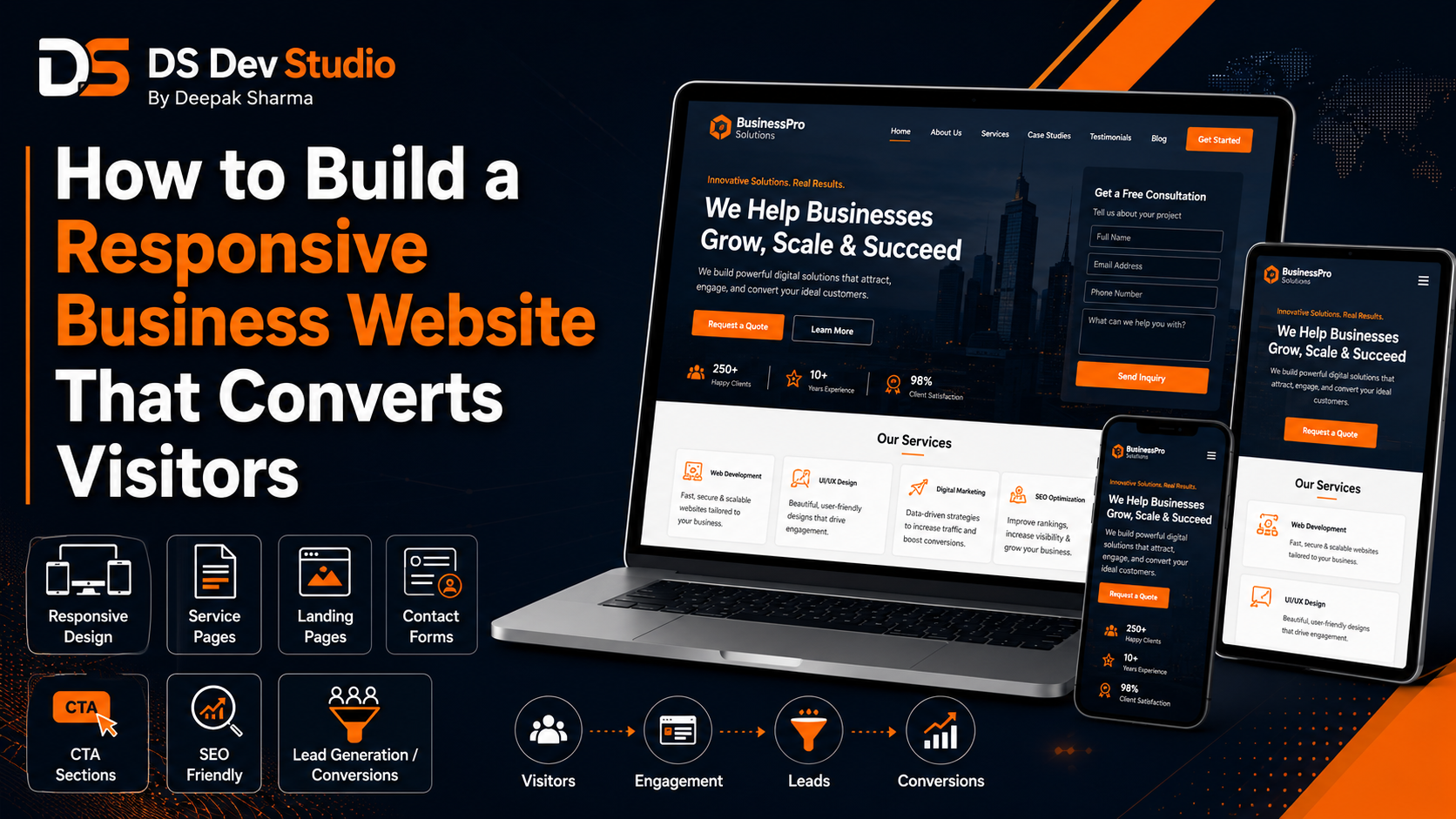
A responsive business website should do more than look good on different screen sizes. It should help visitors understand your business, trust your services, and take a clear action such as submitting a form, calling, sending a WhatsApp message, requesting a quote, or booking a consultation. When a website is responsive and conversion-focused, it becomes a practical business asset instead of only an online brochure.
Many businesses create websites with attractive visuals but weak structure. The website may look modern on desktop, but the mobile layout may be difficult to use. Service pages may not explain enough. Contact forms may be too long. CTA buttons may be hidden. The website may load slowly or fail to guide visitors toward enquiry. A responsive business website should solve these problems through proper planning, design, development, and testing.
Responsive Website Development is important because customers visit business websites from mobile phones, tablets, laptops, and desktop screens. A visitor may come from Google Search, WhatsApp, Instagram, Facebook, email, ads, Google Business Profile, or referral links. If the website does not work properly on mobile, the business may lose leads even before the visitor reads the service details.
DS Dev Studio by Deepak Sharma helps businesses build responsive websites, service pages, landing pages, React frontend interfaces, WordPress websites, contact forms, PHP backend systems, API integrations, admin panels, CRM modules, and custom web applications. This guide explains how to build a responsive business website that converts visitors into enquiries and supports long-term online growth.
What is a responsive business website?
A responsive business website is a website that automatically adjusts its layout, content, images, menus, buttons, and forms according to the user’s screen size. It should work smoothly on mobile, tablet, laptop, and desktop devices. The visitor should not need to zoom, scroll sideways, or struggle with broken sections.
A business website is also different from a personal page or basic static page. It must explain services, build trust, show proof, answer common questions, and guide visitors toward contact. A Responsive Website Developer should combine mobile-friendly design with business-focused structure so the website supports real goals.
For example, a small business website may include a homepage, about page, service pages, landing pages, project section, blog, contact form, testimonials, FAQs, and CTA buttons. All of these elements should remain readable and usable across devices. Responsive design should be planned from the start, not added as a final adjustment.
Why conversion matters in business website development
Conversion means the visitor takes a useful action. For a business website, conversion may mean submitting a contact form, calling the business, clicking a WhatsApp button, requesting a quote, downloading a brochure, booking a consultation, or visiting a service page. A website that gets visitors but does not guide them toward action may not support business growth properly.
A conversion-focused website does not pressure visitors. Instead, it gives them the right information at the right time. It explains the service clearly, removes confusion, builds confidence, and makes the next step easy. This requires thoughtful layout, clear content, visible CTA buttons, trust signals, simple forms, and responsive design.
A Business Website Developer should think about the full visitor journey. What does the visitor see first? Which service do they need? What doubts will they have? Where should the CTA appear? How easy is the form on mobile? These questions help create a website that converts better.
Start with a clear business goal
Before design or development starts, define the main goal of the website. A business website may be built for lead generation, brand trust, local visibility, service explanation, portfolio presentation, appointment booking, or customer support. The website structure should be planned around this goal.
If the main goal is lead generation, contact forms and CTA sections should be strong. If the goal is trust building, projects, testimonials, case studies, and service details become important. If the goal is local visibility, service pages, location details, and SEO-friendly content structure matter. Clear goals lead to better website decisions.
- Define whether the website should generate leads, build trust, explain services, or support campaigns.
- List the most important actions visitors should take.
- Decide which services need dedicated pages.
- Plan whether the website needs blogs, landing pages, forms, CRM, or backend features.
- Clarify whether the project needs React, WordPress, PHP, Laravel, CodeIgniter, or API integration.
- Decide how enquiries should be received and tracked after form submission.
Create a strong homepage structure
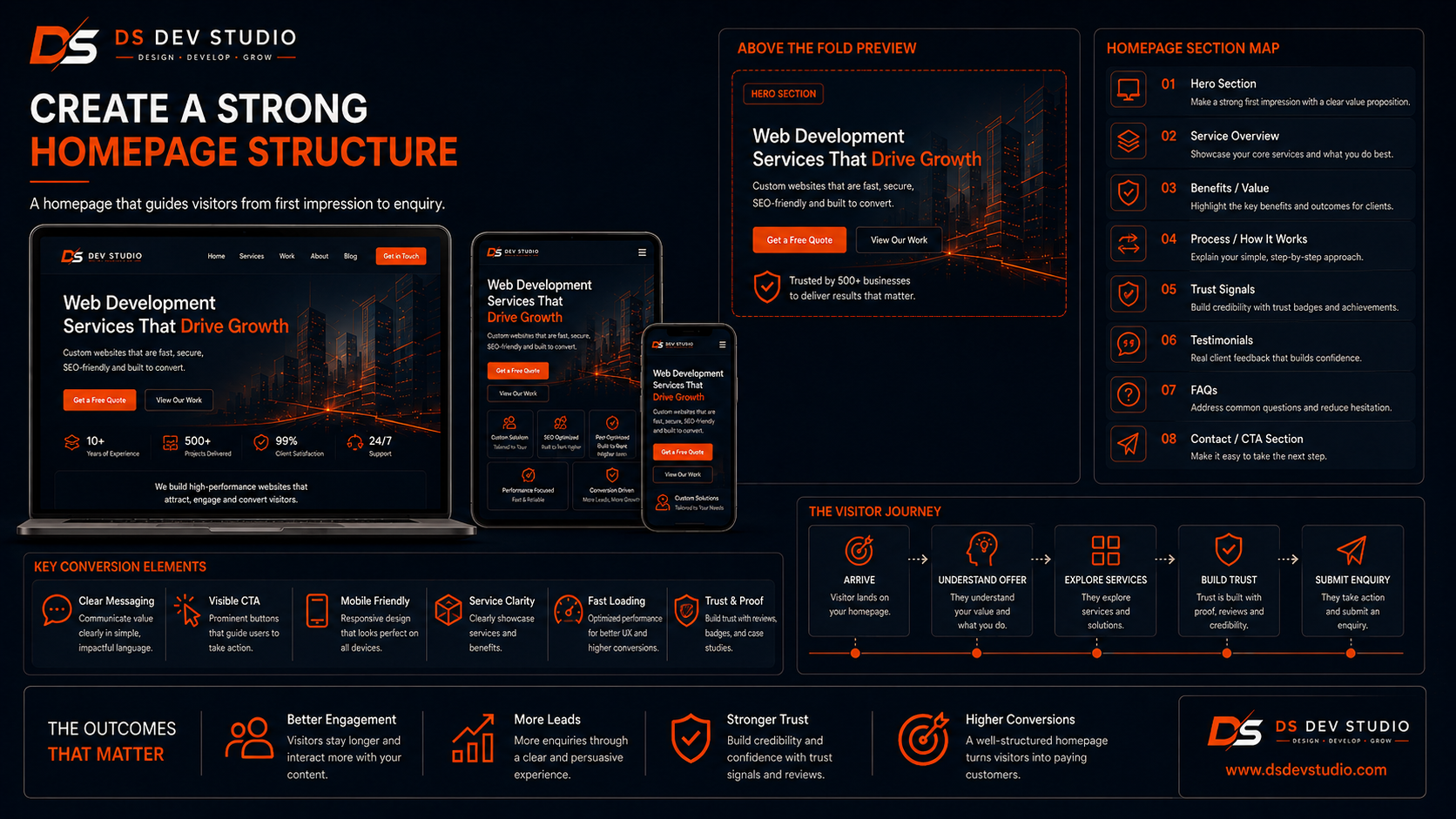
The homepage is often the first page visitors see. It should quickly explain what your business does, who you help, what services you offer, and how users can contact. A homepage should not be overloaded with random sections. Every section should help the visitor understand the business or move toward the next step.
A strong homepage usually includes a clear hero section, service overview, benefits, process, trust signals, project highlights, testimonials, FAQs, blog previews, and contact CTA. The hero section should be clear enough that visitors understand the business within a few seconds.
On mobile, the homepage should be easy to scan. The headline should not be too long. CTA buttons should be easy to tap. Images should not push important content too far down. Service cards should stack properly. A Responsive Website Developer should test the homepage with real content, not only placeholder text.
Use clear messaging above the fold
Above the fold means the first visible section of the page before the visitor scrolls. This section is important because users decide quickly whether to continue. A responsive business website should use this area to explain the main value clearly.
A good above-the-fold section includes a clear headline, short supporting text, CTA button, and relevant visual or trust point. The headline should not be vague. Instead of saying only “Grow Your Business,” a stronger message can explain the actual service, such as “Responsive Website Development for Small Businesses” or “Custom Business Websites That Help Generate Enquiries.”
A Website Developer Freelancer should make sure this section works well on mobile. The headline, short text, button, and visual should not feel crowded. If the first mobile screen is confusing, many visitors may leave before reading more.
Build dedicated service pages
Service pages are important for conversion because visitors often want details before contacting. A homepage can introduce services, but each important service should have its own page when possible. A service page gives the business space to explain what is included, who it is for, what problems it solves, and how the process works.
A strong service page can include service introduction, benefits, features, process, use cases, FAQs, related services, testimonials, and contact CTA. This helps visitors understand the service clearly and reduces repeated basic questions.
For DS Dev Studio, service pages can include website development, React frontend development, WordPress customization, landing page development, backend development, API integration, admin panels, CRM web applications, and custom web application development. A Custom Website Developer should create service pages that support both user clarity and SEO-friendly structure.
Create landing pages for focused campaigns
Landing pages are useful when a business wants to promote one specific service, offer, or campaign. A landing page is more focused than a homepage. It should guide visitors toward one main action such as sending an enquiry, booking a call, requesting a quote, or contacting through WhatsApp.
A Landing Page Developer can build campaign pages for small business websites, website redesign, WordPress development, React frontend development, local services, consultation offers, or lead generation campaigns. The page should match the traffic source. If the visitor clicks an ad about one service, the landing page should immediately explain that same service.
Landing pages should be responsive, fast, and simple. They should include a clear headline, benefit sections, trust points, CTA buttons, FAQs, and a short form. Too many distractions can reduce conversion.
Focus on mobile-first user experience
A responsive business website should be planned with mobile users in mind. Many visitors come from mobile channels such as WhatsApp, Instagram, Google Search, email, and ads. If the mobile experience is weak, the website may lose potential leads even if the desktop version looks professional.
Mobile-first user experience includes readable font size, proper spacing, simple navigation, easy CTA buttons, optimized images, short forms, and fast loading. Users should be able to understand the business and contact quickly without zooming or struggling with layout issues.
A Responsive Website Developer should test the website across different screen widths. Menus, cards, images, accordions, forms, buttons, and tables should all work properly. Mobile testing should happen for every important page, not only the homepage.
Use strong CTA buttons
CTA buttons guide visitors toward action. Common CTAs include Contact Now, Get a Quote, Book a Call, Start Your Project, Request Consultation, Send Enquiry, or Talk to Developer. A business website should use CTA text that matches the visitor’s intent.
CTA placement matters. Buttons should appear near the hero section, after service explanations, after trust sections, near forms, and at the end of important pages. However, the website should not feel pushy. The CTA should appear where the visitor naturally needs a next step.
On mobile, CTA buttons should be large enough to tap easily. They should have proper spacing and clear labels. A small or hidden button can reduce enquiries. A Frontend Developer Freelancer should make CTA buttons consistent across the website.
Design contact forms that are easy to complete
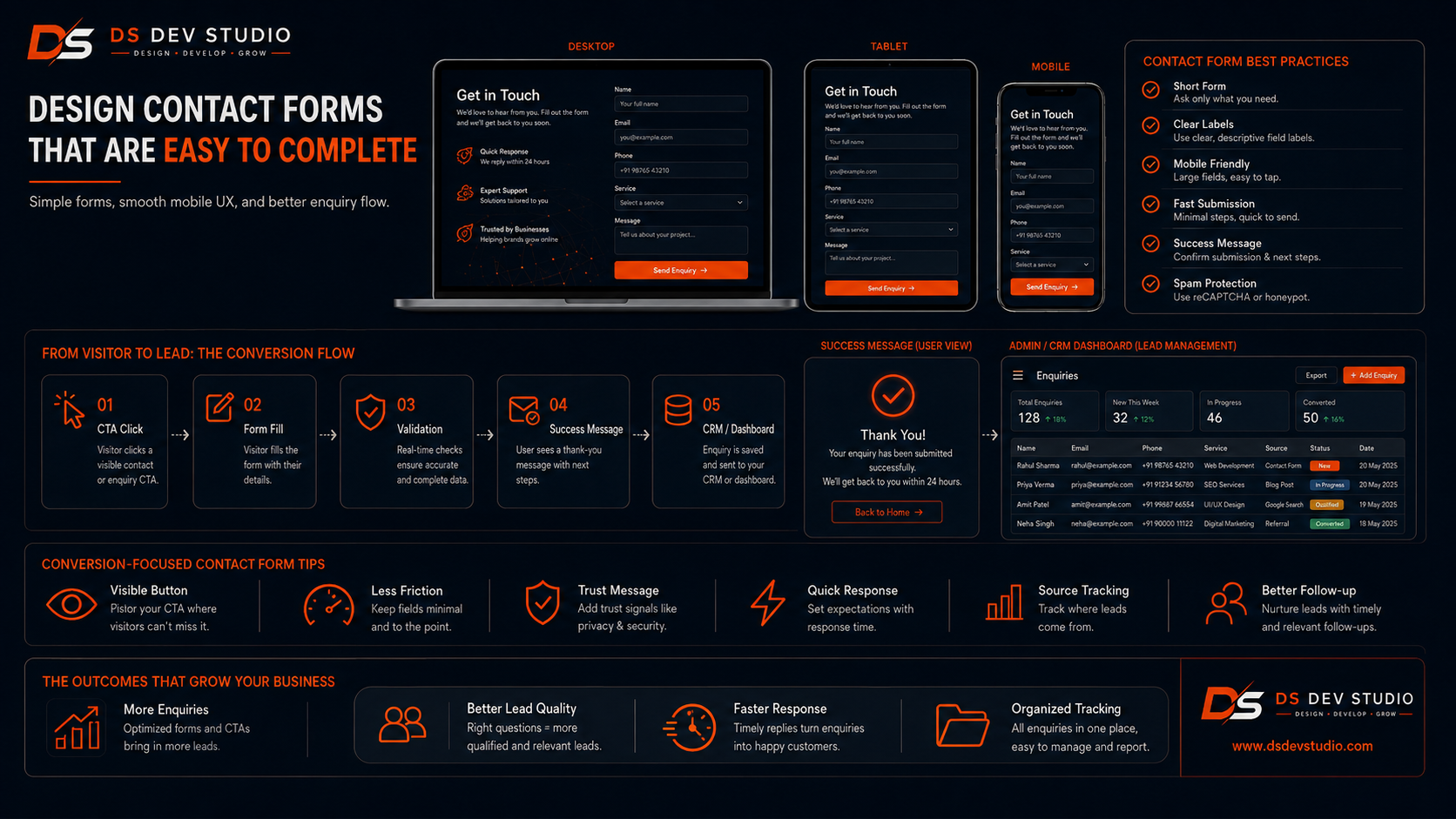
Contact forms are one of the most important conversion points on a business website. A form should be simple, clear, and mobile-friendly. If the form is too long or confusing, visitors may leave without submitting. The form should collect enough information for the first conversation without creating unnecessary friction.
A basic business form may include name, phone number, email, service requirement, and message. Some businesses may need location, budget, timeline, or preferred contact method. The form should use clear labels, proper validation, success messages, and error messages.
A Backend Developer Freelancer can connect forms with email notifications, MySQL database, Google Sheets, CRM systems, admin dashboards, or API workflows. This makes the website more useful because leads can be tracked properly after submission.
Add trust signals across the website
Trust signals help visitors feel confident before contacting a business. A responsive business website should include proof and credibility elements in the right places. These can include testimonials, project examples, client logos, process steps, FAQs, real images, certifications, case studies, and clear contact details.
Trust signals should not be fake or generic. Real project examples, clear service descriptions, honest testimonials, and practical FAQs work better than random badges. Visitors want to know whether the business can actually solve their problem.
A Business Website Developer should place trust sections naturally. For example, testimonials can appear after service benefits. Project examples can appear before the contact CTA. FAQs can appear near the end of service pages to answer doubts before enquiry.
Use SEO-friendly website structure
An SEO Friendly Website Developer builds websites with structure that supports both users and search visibility. SEO-friendly structure includes clear headings, clean URLs, metadata, image alt text, internal links, readable content, fast loading, and responsive design.
A business website should not depend only on a homepage. Important services should have dedicated pages. Blogs should answer customer questions. Landing pages should focus on specific offers. Internal links should connect blogs, services, projects, and contact pages naturally.
SEO-friendly development does not mean keyword stuffing. It means building a website that is useful, organized, easy to read, and technically clean. A Custom Website Developer should plan website structure before building pages.
Improve website speed and performance
Website speed affects both user experience and conversion. If a page loads slowly, visitors may leave before reading services or submitting a form. Slow loading is especially harmful on mobile devices because many users may be on mobile networks.
A developer can improve speed by optimizing images, reducing unnecessary scripts, using clean CSS and JavaScript, avoiding heavy plugins, using efficient components, compressing assets, and testing performance before launch. For WordPress websites, plugin control and caching matter. For React websites, component and asset optimization matter.
A responsive website should also feel smooth while scrolling and interacting. Heavy animations, large videos, and unoptimized sections can reduce performance. Business websites should prioritize clarity, speed, and usability over unnecessary effects.
Choose the right technology: React, WordPress, or custom development
The right technology depends on the business requirement. WordPress is useful for small businesses that want easy content management, blog publishing, page editing, and a dashboard for updates. A WordPress Developer Freelancer can customize WordPress with responsive pages, forms, blogs, and service layouts.
React is useful when the website needs custom frontend interfaces, reusable components, landing page systems, dashboard screens, API-connected forms, or future web application features. A React Developer Freelancer can build modern responsive interfaces with reusable components.
PHP, Laravel, CodeIgniter, MySQL, and APIs are useful when the website needs backend features such as CRM systems, admin panels, lead tracking, database storage, reports, or business automation. A Full Stack Web Developer Freelancer can connect frontend and backend features into one complete system.
Use internal links to guide visitors
Internal links help users move through the website. A blog about responsive website development can link to website development services. A service page can link to related blogs. A landing page can link to contact. A project page can link to related services. This creates a better user journey.
Internal links also help organize website content. Visitors should not reach a dead end after reading a page. Every useful page should guide them toward another relevant page or action. This supports both navigation and conversion.
A Website Developer Freelancer should plan internal links while building the website. Internal linking should feel natural and useful, not forced. The goal is to help visitors find the next relevant step.
Connect the website with CRM or admin dashboard
A responsive business website converts better when enquiries are tracked properly after submission. If form data only goes to email, leads can be missed. A CRM or admin dashboard can store leads, customer records, follow-ups, notes, statuses, and reports in one place.
An API Integration Developer can connect contact forms with a CRM, MySQL database, Google Sheets, email notifications, or admin panel. For example, when a user submits a form, the system can store the lead, send an email alert, show the record in a dashboard, and track the source page.
This is useful for businesses that receive regular enquiries from service pages, landing pages, blogs, and contact pages. A website should not only generate leads; it should help the business manage those leads properly.
Test the website before launch
Testing is important before launching a responsive business website. A website can look complete but still have issues with forms, mobile layout, links, buttons, images, speed, metadata, or backend connections. These issues can reduce conversion if they are not fixed before launch.
Every important page should be tested on mobile, tablet, laptop, and desktop. Forms should be submitted and checked. CTA buttons should be clicked. Internal links should be opened. Images should load correctly. Menus should work properly. Success and error messages should be verified.
- Test homepage, service pages, landing pages, blogs, and contact page.
- Check mobile responsiveness across different screen sizes.
- Submit all contact forms and check where data is received.
- Click CTA buttons, WhatsApp links, email links, and phone links.
- Check internal links, navigation menu, footer links, and blog links.
- Optimize image size, alt text, and loading performance.
- Review metadata, headings, URLs, and SEO-friendly page structure.
- Confirm CRM, API, database, or admin dashboard connections if used.
Track performance after launch
A business website should improve after launch. Tracking helps you understand whether visitors are contacting, which pages are useful, which forms are working, and which services receive interest. Without tracking, it becomes difficult to improve conversion.
Businesses can track form submissions, CTA clicks, phone clicks, WhatsApp clicks, landing page leads, service page visits, blog traffic, and lead sources. If the website is connected with a CRM, the business can also track lead status, follow-ups, and conversions.
A Custom Website Developer can add basic tracking support and ensure forms capture useful lead information. After launch, new pages, better CTAs, improved content, and additional landing pages can be added based on performance.
Common mistakes that reduce website conversions
One common mistake is creating a website that looks good but does not explain the business clearly. If visitors cannot understand what you offer, they will not contact. Clear messaging should come before decoration.
Another mistake is ignoring mobile design. Many visitors come from mobile devices. If the website is difficult to use on mobile, conversion can drop. Mobile layout, forms, CTA buttons, and page speed should be tested carefully.
Other mistakes include weak CTA buttons, long forms, no service pages, slow loading, poor internal links, no trust signals, confusing navigation, generic content, broken forms, no CRM tracking, and no post-launch updates. A skilled Responsive Website Developer can help avoid these problems through proper planning and testing.
What to prepare before building a responsive business website
Before building a responsive business website, prepare your business details, services, target audience, website goal, required pages, brand colors, logo, images, testimonials, FAQs, contact information, and reference websites. Clear preparation helps the developer build a website that matches your business.
If you need backend features, prepare form fields, lead tracking needs, CRM workflow, user roles, and reporting requirements. If you need content growth, prepare blog topics and service page topics. If you need landing pages, prepare campaign offers and CTA goals.
- Prepare business name, logo, brand colors, and contact details.
- List required pages such as Home, About, Services, Blog, Projects, and Contact.
- Prepare service descriptions, FAQs, testimonials, and project examples.
- Define CTA goals such as quote request, call booking, WhatsApp, or enquiry form.
- Prepare form fields and decide where leads should be stored.
- Share reference websites for design and structure direction.
- Clarify whether the site should use WordPress, React, or custom development.
- Discuss responsive testing, speed, SEO structure, launch, and maintenance.
How DS Dev Studio can help
DS Dev Studio by Deepak Sharma can help businesses build responsive business websites that are clear, mobile-friendly, SEO-friendly, and conversion-focused. Services can include website planning, responsive website development, custom homepage design, service pages, landing pages, React frontend development, WordPress customization, contact forms, backend systems, API integration, admin panels, and CRM workflows.
Deepak Sharma Web Developer work includes HTML, CSS, JavaScript, ReactJS, WordPress, PHP, Laravel, CodeIgniter, MySQL, APIs, frontend development, backend development, responsive UI, business dashboards, CRM systems, and full stack web development. This is useful for businesses that need both website design and practical technical functionality.
If you want to build a responsive business website that converts visitors, DS Dev Studio can help plan the structure, create mobile-friendly layouts, write clear section flow, build service pages, develop landing pages, connect forms, improve CTA placement, add backend support, and prepare the website for long-term growth.
Conclusion
To build a responsive business website that converts visitors, businesses need more than a visually attractive design. The website should have clear messaging, strong homepage structure, dedicated service pages, focused landing pages, mobile-friendly layouts, visible CTA buttons, simple contact forms, trust signals, fast loading, SEO-friendly structure, internal links, and reliable lead tracking. A responsive website should work smoothly across devices and guide visitors toward useful actions such as enquiry, call, WhatsApp, quote request, or consultation booking. DS Dev Studio by Deepak Sharma can help businesses with responsive website development, React frontend development, WordPress customization, service pages, landing pages, contact forms, API integration, backend systems, admin panels, CRM modules, and custom web applications. With the right development approach, your business website can become a stronger digital asset for trust, visibility, enquiries, and long-term growth.
Useful internal links
Frequently asked questions
Can I hire Deepak Sharma to build a responsive business website?+
Yes. You can hire Deepak Sharma for responsive business website development, service pages, landing pages, React frontend development, WordPress customization, contact forms, backend systems, API integration, admin panels, CRM modules, and custom web applications.
What makes a business website responsive?+
A responsive business website adjusts properly across mobile, tablet, laptop, and desktop screens. Text, images, menus, buttons, forms, cards, and sections should remain readable and easy to use on every device.
How can a website convert more visitors?+
A website can convert more visitors by using clear messaging, strong service pages, visible CTA buttons, simple forms, trust signals, fast loading, mobile-friendly design, SEO-friendly structure, and proper lead tracking.
Can DS Dev Studio connect website forms with CRM or admin dashboard?+
Yes. DS Dev Studio can connect website forms with email notifications, MySQL databases, Google Sheets, CRM systems, admin dashboards, or custom APIs for better lead tracking and follow-up management.
Should I use WordPress or React for a responsive business website?+
WordPress is useful when easy content management and blog publishing are important. React is useful for custom frontend interfaces, reusable components, landing pages, dashboards, and API-connected pages. The right choice depends on your business requirement.