Landing Page Developer Guide for Small Business Lead Generation
A practical guide for small businesses that want to hire a Landing Page Developer for lead generation, responsive landing pages, service offers, contact forms, CTA sections, and business website growth.

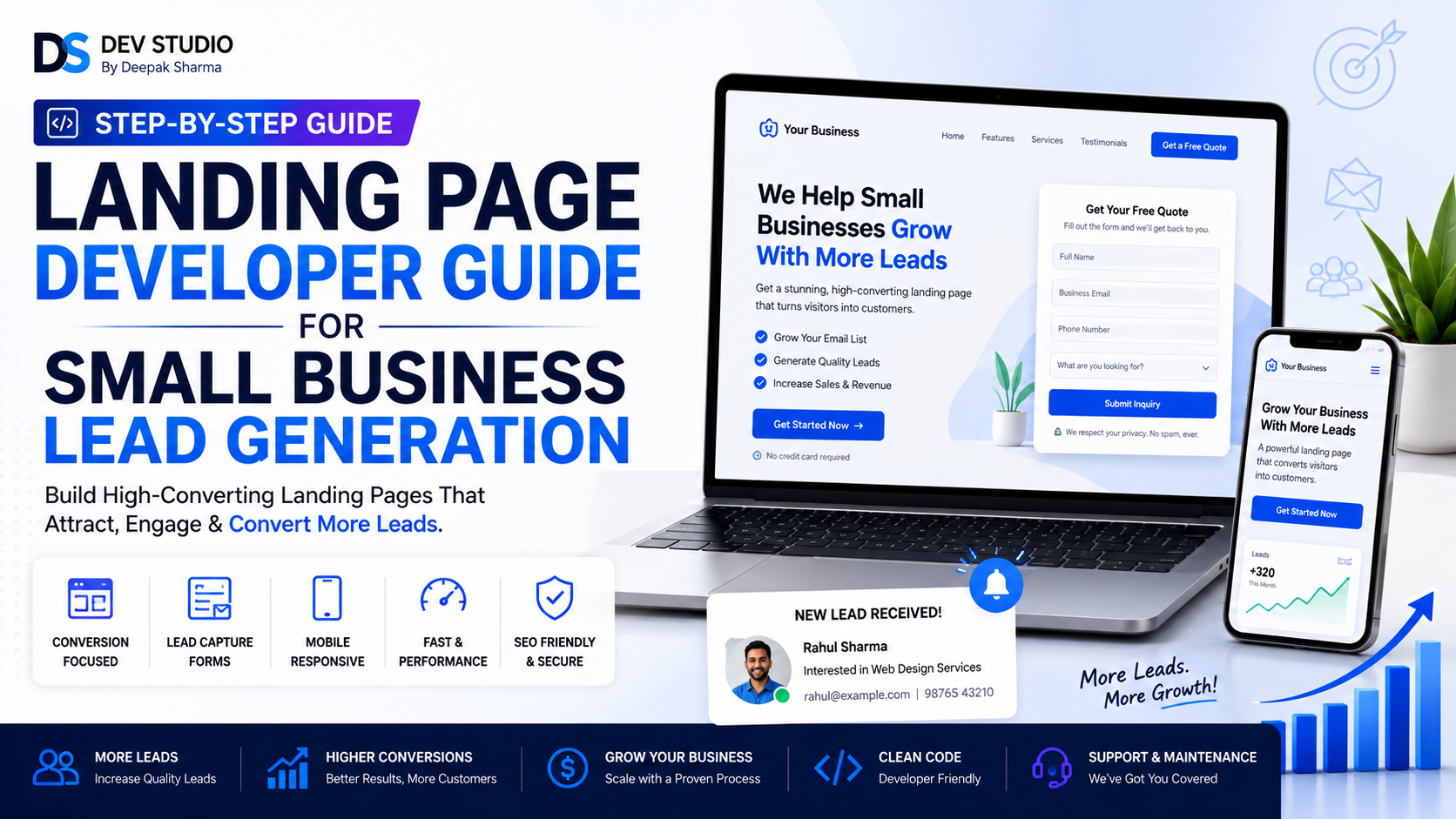
A Landing Page Developer helps small businesses create focused web pages that are designed for one main goal: lead generation. A normal business website may include many pages such as Home, About, Services, Blog, Projects, and Contact. A landing page is different because it focuses on one offer, one service, one campaign, or one action. For small businesses, this can make enquiries more focused and easier to track.
Small businesses often run campaigns through Google Ads, Meta Ads, WhatsApp, email, social media, local promotions, referral links, and Google Business Profile updates. If all visitors are sent to a general homepage, they may not immediately understand the specific offer. A landing page solves this by giving campaign visitors a clear message, strong benefits, trust points, FAQs, and a simple enquiry form.
Landing page development is not only about design. A good landing page should be responsive, fast, clear, persuasive, easy to read, and simple to use on mobile devices. It should have a strong headline, focused content, clear CTA buttons, a short form, trust signals, and a smooth user journey. A skilled Landing Page Developer can build this page around the business goal instead of using a generic template.
DS Dev Studio by Deepak Sharma helps small businesses with landing page development, responsive website development, business websites, React frontend development, WordPress customization, service pages, SEO-friendly website structure, contact forms, PHP backend systems, API integration, admin panels, CRM modules, and custom web applications. This guide explains how a Landing Page Developer can help small businesses improve lead generation.
What does a Landing Page Developer do?
A Landing Page Developer builds focused pages that support a specific business goal. The work can include page layout, headline structure, responsive design, CTA placement, form development, benefit sections, trust blocks, FAQ sections, image optimization, speed improvement, and backend form connection. The goal is to make the page easy for visitors to understand and easy for the business to receive enquiries.
For example, a small business may want a landing page for website development services, coaching admission enquiries, clinic appointments, real estate leads, travel packages, repair services, consultation booking, digital marketing services, or local service offers. The developer creates a page that explains the offer clearly and encourages the visitor to take one action.
A good Landing Page Developer should understand frontend development, responsive UI, form design, CTA structure, page speed, user experience, and basic SEO-friendly page structure. The developer should also understand how the landing page fits into the larger business website, campaign, and lead management process.
Why landing pages matter for small business lead generation
Landing pages matter because small businesses need clear and focused enquiry flow. A homepage usually explains the whole business. It may have many links, services, sections, blogs, and navigation options. This is useful for general visitors, but campaign traffic often needs a more direct page. A landing page keeps the message focused and reduces unnecessary distractions.
If a user clicks an ad for one specific service, the page should talk about that service immediately. If the page opens with unrelated business information, the user may leave. A focused landing page matches the visitor’s expectation and gives them a direct path to contact, request a quote, book a call, or submit an enquiry.
For small businesses, landing pages can improve the quality of leads because the page can explain who the service is for, what problem it solves, what benefits the customer gets, and what information is needed in the form. This helps users self-qualify before submitting an enquiry.
Landing page vs homepage
A homepage is the main overview page of a business website. It introduces the business, services, trust points, projects, blogs, and contact options. It is useful for general visitors who want to explore the business. A landing page is more focused. It is usually created for one service, one campaign, one offer, or one audience group.
For example, a website development business may have a homepage explaining all services. But a separate landing page can focus only on small business website development. Another landing page can focus only on React frontend development. Another can focus on WordPress website development. Each landing page can speak directly to a specific need.
A Business Website Developer should understand when to use a homepage and when to use a landing page. The homepage builds overall brand presence. The landing page supports focused lead generation. Both are useful, but they serve different purposes.
What makes a landing page effective?
An effective landing page has one clear message and one clear action. Visitors should quickly understand what the offer is, why it matters, who it is for, what benefits they get, and how to contact. If the page tries to explain too many things at once, users may become confused and leave without taking action.
A good landing page should include a strong headline, short supporting text, clear CTA button, benefit-focused sections, trust signals, simple form, FAQ section, and mobile-friendly design. It should avoid unnecessary links, heavy distractions, long complicated forms, and unclear messaging.
- Clear headline focused on one service or offer.
- Short introduction that explains the value quickly.
- Strong CTA buttons placed at natural decision points.
- Benefit sections that explain why the offer matters.
- Trust signals such as testimonials, project examples, or experience points.
- Simple enquiry form with only required fields.
- Responsive layout for mobile, tablet, laptop, and desktop users.
- Fast loading images and lightweight frontend structure.
- FAQ section to answer common objections.
- Clear success message after form submission.
Landing page structure for small businesses
A small business landing page should follow a simple structure that guides the visitor from interest to action. The page should not feel like a long random brochure. Each section should answer one question in the visitor’s mind. What is this offer? Why should I care? Can I trust this business? What is included? How do I contact?
The top section should communicate the main message quickly. The next sections can explain benefits, services, process, proof, FAQs, and contact. The form should appear where users are ready to submit details. CTA buttons can be repeated after important sections so users do not have to search for the next step.
A Landing Page Developer should plan the page based on the business type. A coaching institute landing page may need course highlights and admission form. A service business may need benefits and quote request form. A clinic may need appointment booking. A web development business may need services, project examples, and consultation CTA.
Strong headline and opening section
The headline is one of the most important parts of a landing page. It should tell visitors what the page is about without confusion. A weak headline can make users leave quickly. A strong headline should mention the service, audience, or benefit clearly.
For example, instead of a vague headline like “Grow Your Business Online,” a more focused headline can say “Professional Website Development for Small Businesses” or “Landing Pages That Help Service Businesses Generate More Enquiries.” Clear headlines help users understand the offer faster.
The opening section should also include a short supporting paragraph and CTA button. On mobile, this section should be readable and not overloaded. A Responsive Website Developer should make sure the headline, text, button, and visual stack properly on smaller screens.
CTA buttons for lead generation
CTA means call to action. It tells users what to do next. Common landing page CTA buttons include Get a Quote, Book a Call, Request Consultation, Contact Now, Start Your Project, Send Enquiry, or Talk to Developer. CTA buttons should be clear and action-focused.
CTA placement matters. A CTA button should appear near the hero section, after benefit sections, near the form, and at the end of the page. However, the page should not feel aggressive. The CTA should appear where it naturally helps the user move forward.
A Landing Page Developer should also make CTA buttons mobile-friendly. Buttons should have enough size and spacing for touch screens. If users need to zoom or tap carefully, the page can lose enquiries. A good CTA should be easy to see and easy to use.
Lead generation forms on landing pages
Forms are critical for landing page lead generation. A form collects the visitor’s details and turns interest into an enquiry. But if the form is too long, confusing, or difficult to complete on mobile, users may abandon it. A small business landing page should use a simple and practical form.
A basic lead form may include name, phone number, email, service requirement, and message. For some businesses, location, budget, timeline, or preferred contact method may also be useful. The form should ask only what is necessary for the first conversation. Extra fields can reduce submissions if they are not needed.
A Website Developer Freelancer can connect the form with email notifications, Google Sheets, a CRM dashboard, or database storage. This helps the business manage leads properly after submission. A landing page is more useful when form data is not lost in a single inbox.
Responsive landing page development
Responsive Website Development is essential for landing pages because many campaign visitors come from mobile devices. A user may click from WhatsApp, Instagram, Facebook, Google Search, or an ad. The landing page should open quickly and work smoothly on the user’s phone.
On mobile, the page should have readable text, proper spacing, easy CTA buttons, simple forms, optimized images, and clean section stacking. Users should not need to zoom or scroll sideways. The landing page should guide them naturally from the headline to the enquiry form.
A Responsive Website Developer should test landing pages on different device widths before launch. Hero sections, forms, testimonials, FAQ accordions, pricing cards, service cards, and footer sections should all work properly. Mobile testing is not optional for lead generation pages.
Landing page content for small businesses
Landing page content should be simple, direct, and useful. Small businesses should avoid writing long generic paragraphs that do not explain the offer. Visitors want to know what is being offered, why it is useful, what is included, and how to contact. The content should answer these questions clearly.
Benefit-focused content works better than only feature lists. For example, instead of saying “responsive layout,” the page can explain that the website will work properly on mobile and help visitors contact easily. Instead of saying “custom design,” explain that the page will match the business brand and service goal.
A SEO Friendly Website Developer can also structure landing page content with proper headings, natural keywords, clear sections, image alt text, and internal links where useful. Even when the landing page is campaign-focused, it should still follow clean website development practices.
Trust signals on landing pages
Trust signals help visitors feel more confident before submitting a form. Small businesses may use testimonials, project examples, client logos, ratings, experience points, service process, real images, portfolio links, FAQs, and clear contact information as trust signals. These elements reduce doubt.
A landing page should show trust signals naturally. For example, after explaining the offer, the page can show previous work, client feedback, process steps, or common questions. If the visitor is unsure, these details can help them continue toward enquiry.
A Custom Website Developer should avoid fake or generic trust blocks. Real information works better. If a business has project screenshots, service examples, client feedback, or business experience, these should be presented clearly and professionally.
Landing pages for service-based businesses
Service-based businesses can benefit strongly from landing pages because each service can have its own focused message. A business may offer website development, WordPress development, React frontend development, coaching, consulting, repair, travel, clinic services, design, marketing, construction, or local services. Each service may need a different landing page.
A service landing page should explain the specific service, who it is for, what problems it solves, what benefits it offers, what the process looks like, and how the user can enquire. The CTA should match the service. For example, Book a Consultation may work for consulting, while Get a Website Quote may work for web development.
A Business Website Developer can connect landing pages with the main website structure. The landing page can link to related service pages, blog posts, and contact page where useful. This creates a better user journey without distracting from the main goal.
Landing pages for local businesses
Local businesses can use landing pages for specific locations, offers, services, or campaigns. For example, a local business in Rajasthan may create landing pages for a service in Jaipur, Jodhpur, Udaipur, Kota, Ajmer, Bikaner, Alwar, or nearby areas where relevant. The content should remain natural and useful instead of forcing location names.
Local landing pages should include clear service area details, contact options, WhatsApp CTA, map or location details where needed, local trust points, and a simple enquiry form. The page should help users understand whether the business serves their area and how to contact quickly.
A Freelance Web Developer India or Website Developer for Small Business can help create landing pages that match local customer behavior. Local users often want fast answers, direct contact, and proof of trust. The page should support these needs.
Landing page design for mobile users
Mobile users behave differently from desktop users. They scroll quickly, scan headings, tap buttons, and expect fast loading. A landing page designed for mobile should be clear from the first screen. The headline, short text, and CTA should be visible without overwhelming the user.
Mobile landing page design should avoid overly large images, tiny text, cramped sections, long forms, and hidden buttons. Forms should use full-width fields. CTA buttons should be easy to tap. Sections should have enough spacing. The page should feel smooth and simple.
A Responsive Website Developer should test the page on real mobile widths and with real content. Placeholder text may look fine, but real service names, long headlines, and actual images can break the layout. Proper testing helps avoid these issues before launch.
Landing page speed and performance
Landing page speed is important because campaign visitors may leave if the page loads slowly. Heavy images, too many scripts, large videos, unnecessary animations, and bloated plugins can slow down landing pages. A fast page gives visitors a better experience and supports enquiry flow.
A Landing Page Developer should optimize images, reduce unnecessary code, use lightweight sections, avoid excessive animations, and test loading performance. For WordPress landing pages, plugin and theme choices matter. For React landing pages, component structure and asset optimization matter.
Small businesses should keep landing pages focused and lightweight. A landing page does not need every feature from the main website. It needs a clear message, useful proof, fast loading, and a simple path to enquiry.
React landing page development
React can be useful for landing page development when the business needs custom frontend components, reusable sections, dynamic forms, API-connected content, or future expansion. A React Developer Freelancer can build landing page components such as hero sections, benefit cards, CTA blocks, FAQ accordions, testimonial blocks, pricing cards, and contact forms.
React is helpful when a business wants multiple landing pages with consistent structure. The same components can be reused with different content. For example, a web development business can create separate landing pages for website development, React frontend development, WordPress development, landing page development, and API integration using reusable sections.
React landing pages should still be optimized for speed, responsiveness, and SEO-friendly structure where needed. A page should not become heavy only because React is used. A good Frontend Developer Freelancer should keep the landing page practical and user-focused.
WordPress landing page development
WordPress is useful for landing pages when the business wants easy editing and content management. A WordPress Developer Freelancer can build landing pages using custom templates, page builder sections, blocks, forms, and SEO tools. This can be practical for small businesses that want to update content without touching code.
However, WordPress landing pages should be built carefully. Too many plugins, heavy page builders, and unoptimized images can slow down the page. The layout should remain responsive and focused. The form should work properly and show clear success messages.
A WordPress landing page can be useful for local services, coaching offers, consultation pages, small business campaigns, and content-driven lead generation. The developer should make sure the page is mobile-friendly and easy to update after launch.
Backend and CRM connection for landing pages
Landing pages become more useful when leads are managed properly after submission. A Backend Developer Freelancer can connect landing page forms with email notifications, databases, Google Sheets, admin panels, or CRM systems. This helps small businesses avoid losing leads in scattered inboxes.
For example, a visitor submits a form on a landing page. The backend validates the data, stores it in MySQL, sends an email alert, and adds the lead to a CRM dashboard. The business team can then update status, add notes, and follow up. This creates a complete lead generation workflow.
An API Integration Developer can also connect landing pages with third-party tools such as email platforms, WhatsApp APIs, SMS tools, CRM platforms, and marketing systems. These integrations can improve response time and reduce manual data entry.
SEO-friendly landing pages
Not every landing page is created for organic search. Some are only used for ads or campaigns. Still, an SEO Friendly Website Developer should build landing pages with clean structure, readable content, proper headings, optimized images, fast loading, and responsive design. These basics help users even if the page is not focused on organic ranking.
If a landing page is meant to attract search traffic, it needs more detailed content, clear topic focus, useful sections, FAQs, internal links, and metadata. It should not be too thin. A search-focused landing page may work more like a service page with a stronger CTA.
The right structure depends on the page goal. A paid campaign landing page can be shorter and more focused. An SEO landing page may need deeper content and internal links. A Landing Page Developer should understand the difference before building the page.
Tracking landing page leads
Lead tracking helps small businesses understand whether a landing page is working. Tracking can include form submissions, button clicks, phone clicks, WhatsApp clicks, source tracking, UTM parameters, and CRM status. Without tracking, the business may not know which campaign or page is generating leads.
A Website Developer Freelancer can set up form tracking, thank-you messages, lead source fields, and CRM integration where required. If the business runs multiple campaigns, tracking becomes more important because each landing page should show its own results.
Tracking should be planned before the campaign starts. If leads are coming from ads, social media, WhatsApp, email, or Google Business Profile, the landing page should be able to identify sources where possible. This helps business owners make better marketing decisions.
Common landing page mistakes small businesses should avoid
One common mistake is sending campaign traffic to a general homepage instead of a focused landing page. The homepage may not match the campaign message, so users may become confused. A landing page should match the promise made in the ad, post, message, or link.
Another mistake is using a long and complicated form. Small businesses often ask too many questions too early. If the visitor only wants a first conversation, a short enquiry form may work better. More details can be collected later during follow-up.
Other mistakes include weak headline, unclear CTA, no trust signals, slow loading, poor mobile layout, too many distractions, no success message, missing form validation, no tracking, and no follow-up process. A skilled Landing Page Developer can help avoid these problems.
What to prepare before hiring a Landing Page Developer
Before hiring a Landing Page Developer, prepare your offer, target audience, campaign goal, service details, CTA, form fields, images, testimonials, FAQs, and reference pages. Clear preparation helps the developer create a page that matches your lead generation goal.
If you are running ads or a campaign, share the ad message, target audience, expected action, and traffic source. The landing page should match the campaign. If users click an ad for one service, the landing page should focus on that same service.
- Prepare the main offer or service for the landing page.
- Define the target audience and campaign goal.
- Prepare headline ideas, benefits, service details, and FAQs.
- Share brand colors, logo, images, and trust elements.
- Decide CTA text such as Get a Quote, Book a Call, or Send Enquiry.
- Prepare form fields such as name, phone, email, service, and message.
- Clarify whether leads should go to email, Google Sheets, database, or CRM.
- Discuss responsive design, speed, tracking, testing, and deployment.
What to check before hiring a developer
Before hiring a landing page developer, check whether they understand responsive design, CTA placement, form layout, frontend development, website speed, basic SEO structure, and lead flow. A landing page is not only a design task; it is a business conversion page.
Review previous landing pages on mobile and desktop. Check whether the headline is clear, buttons are visible, forms are easy, sections are focused, and the page loads quickly. A good landing page should guide users toward action without confusion.
Also ask about backend form handling and tracking. If leads are submitted but not delivered properly, the landing page fails. The developer should explain how form submissions will be received, where data will go, and how success or error messages will appear.
How DS Dev Studio can help
DS Dev Studio by Deepak Sharma can help small businesses with landing page development, responsive landing pages, lead generation pages, service offer pages, React landing pages, WordPress landing pages, contact forms, CTA sections, form backend connection, API integration, and CRM lead workflows.
Deepak Sharma Web Developer work includes HTML, CSS, JavaScript, ReactJS, WordPress, PHP, Laravel, CodeIgniter, MySQL, APIs, frontend development, backend development, responsive UI, business websites, admin panels, CRM systems, and custom web applications. This is useful for businesses that need both landing page design and technical lead handling.
If you want to hire a Landing Page Developer for small business lead generation, DS Dev Studio can help plan the page structure, create responsive layouts, write clear section flow, build forms, connect leads to email or CRM, improve CTA placement, and prepare the page for campaigns and future updates.
Conclusion
A Landing Page Developer can help small businesses generate better leads by creating focused pages for specific services, offers, campaigns, and customer actions. A strong landing page should have a clear headline, focused message, benefit sections, trust signals, responsive design, fast loading, CTA buttons, and a simple enquiry form. It should also connect properly with email, database, Google Sheets, CRM, or backend systems so leads are not lost after submission. DS Dev Studio by Deepak Sharma can help businesses with landing page development, responsive website development, React frontend development, WordPress customization, contact forms, backend systems, API integration, CRM workflows, and small business website growth. With the right landing page structure, small businesses can turn campaign traffic into clearer enquiries and build a stronger lead generation process.
Useful internal links
Frequently asked questions
Can I hire Deepak Sharma as a Landing Page Developer?+
Yes. You can hire Deepak Sharma for landing page development, responsive lead generation pages, React landing pages, WordPress landing pages, contact forms, backend connections, API integration, and small business website development.
Why does a small business need a landing page?+
A small business needs a landing page when it wants to promote one service, offer, campaign, or enquiry goal with a focused page that guides visitors toward a form, call, WhatsApp message, or consultation request.
What should a lead generation landing page include?+
A lead generation landing page should include a clear headline, short explanation, benefits, trust signals, CTA buttons, FAQs, simple enquiry form, mobile-friendly layout, fast loading, and clear success message after submission.
Can DS Dev Studio connect landing page forms with CRM?+
Yes. DS Dev Studio can connect landing page forms with email notifications, Google Sheets, MySQL database, admin panels, or CRM systems using backend development and API integration.
Should I build landing pages in React or WordPress?+
React is useful for custom frontend landing pages, reusable sections, and API-connected experiences. WordPress is useful when easy editing and content management are important. The right choice depends on your business requirement.