Landing Page Developer for Small Business
A guide for small businesses that want a Landing Page Developer for service pages, lead generation, campaign pages, and business enquiries.

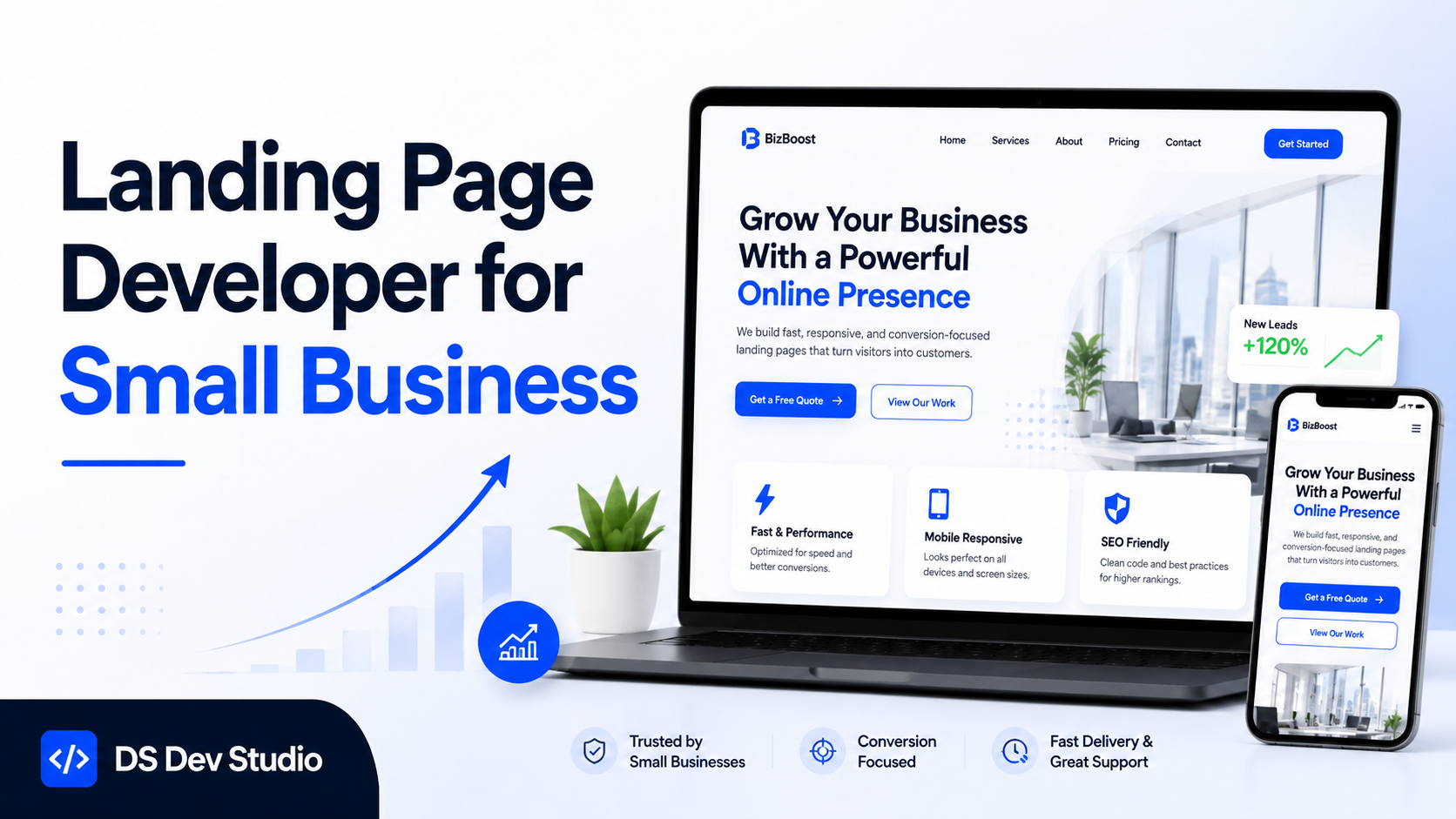
Landing Page Development is designed to help small companies craft targeted landing pages to achieve one specific objective. This objective may include generating leads, advertising a service, obtaining product inquiries, generating traffic for a marketing campaign, making phone bookings, receiving requests for quotes, collecting data in forms, or determining the project information from customers who express interest in anything. The main difference between a landing page and a full website lies in the fact that instead of creating a whole website, a landing page is designed to focus on one offer targeting one specific audience performing one action.
The use of a landing page for small businesses can be much more beneficial than directing every visitor to a standard homepage. While a homepage typically consists of multiple sections and links, landing pages are often far more focused. A landing page describes the offer, creates trust, answers frequently asked questions, and shows the potential client what buttons to hit, including the contact form, phone call, WhatsApp link, or inquiry button. Due to this focused nature, landing pages can often be utilized in campaigns, advertisements for services, local promotions, seasonal offers, and certain business goals.
A well-designed landing page is just part of the equation. It should include copy that communicates clearly; a layout that is logical; a page that is responsive; features that provide trustworthiness, correctly placed calls to action; pages that load quickly and are optimised for search engines; and a smooth procedure for making inquiries. This is a major reason why the services of Landing Page Developer.
Why small businesses need landing pages
Many small companies have various marketing drives like advertising, regional campaigns, or service-related promotions. Sending users to a homepage is not effective as the homepage contains several messages like the name of the company, details of all services offered, projects, blogs, and contact information. A landing page delivers a clear message and indicates the next step.
Illustratively, a neighborhood service company might prefer inquiries for a particular service only. A consulting firm might require potential customers to get in touch over a call. One startup might wish to obtain user registrations for an early offer and a freelancer might want website development leads. Hence the situation demands a targeted landing page where a potential client will find only information relevant to him and get persuades to take a specific action.
Any website developer that works with small businesses should be cognizant of the fact that small companies are after results in most cases. The complexity of a website may not matter for certain projects. In most situations, a simple one-pager with a catchy headline, a description of a service, an outline of benefits, a contact form, FAQs, and social proof may be more helpful for a campaign than a huge website page cluttered with unnecessary elements.
What makes a landing page different from a normal website page?
Normally, any page of a website is integrated into the entire website structure and can link to various sections of services, articles, projects, etc. However, landing page has more precise nature because it focuses on one specific user intention and significant user action as well. This page should not have any irrelevant information that would distract the user from completing the given task.
This doesn’t mean that landing pages have to be of minimal length. What it should have is enough content to guide visitors toward making a choice. A landing page must explain what is being offered and in what way it is useful. The content should also ensure credibility, facilitate communication and hold the reader’s attention.
Small companies benefit from landing pages as they have the capability to create one for every individual service. A company might create a page for website development, another one for WordPress customization, a page for both React frontend development and backend development finally a page for limited time offer. Each page is catered to specifically defined audience and messages.
What a strong landing page should include
The headline is the most important part of the landing page. Within seconds of landing on this page, the visitors must be clear about what the offer is all about. If they don’t understand the headline well, they are likely to leave before reading anything on the page. The headline must imply what the business is offering and whom it is helping. For example, the landing page for small business websites should clearly state that it is helping small businesses to create responsive and professional websites.
Once the header is written, the page needs to show an introduction to the service, list of benefits, trust elements, description of how service works, call-to-action buttons, and a form for getting contact information from the leads. This needs to contain the answers to the most common questions of the visitors even before they think of them. The landing page needs to be mobile-friendly since many users open campaign pages via social media, search ads, WhatsApp links, and mobile browsers.
- An obvious headline that shows what is offered.
- A brief description of the service or product.
- Sections that feature benefits of the offer, explaining the importance of the offer.
- Content that builds trust through telling about the projects done, reviews, experience, or the process.
- A lead capture form, button, or a WhatsApp CTA.
- FAQs explaining common objections and minimizing hesitations.
- Responsive design for tablets, phones, laptops, and PCs.
- Fast-loading images and a clean layout.
- A title, description, headings, and image text that are optimized for SEO.
- A thank you page or message presented after form submission.
Landing page structure for better enquiries
The arrangement of landing pages must match the users' thinking pattern. First, they should learn what the proposal is all about. After that, they should find out if it is helpful to them. Next, they should be given reasons to rely on this company. Finally, there should be a straightforward way to get in touch with the business people. However, if the page is scattered, users may lose interest.
One good, practical structure includes sections like the hero section, service benefits, problem and solution, process, proof points, project examples, FAQs, and a concluding call to action. In addition, lead generation pages should feature a contact form which must be easy to locate. The form should request relevant details but remain relatively short. For instance, one doesn't have to go into too much detail and can instead provide their name, email address, phone number, area of residence, type of project they're interested in and other relevant information.
A Business Website Developer ought to be aware of the hesitancy of users as well. The visitors may be in doubt with respect to costs, timelines, procedures, services, support, quality, or whether the service is ideally suited for their business. FAQ sections and brief explanatory blocks can provide some answers to these questions and make submission more likely.
Landing pages for service-based businesses
Landing pages are instrumental for service-oriented businesses in launching and explaining their individual services in a more precise manner. A business can advertise all services on its homepage but a landing page can put weight on exactly one service and elaborate on its features without listing down all other services. For example, a web design company can create a landing page for web design, React front-end, WordPress customization, creation of landing pages, backend development, or administration panel development.
Every service landing page may contain exclusive advantages, expertise in the field, cases of use, ways of doing the work, features of technology, questions that arise during the process of receiving the service, and contact options for the provider. This approach suits people who already have a clear idea about the future service they want to obtain. A visitor who needs a landing page developer shouldn’t waste time on stories about every other service offered.
A landing page is beneficial to local businesses including clinics, coaching institutes, repair services, real estate consultants, interior services, restaurants, agencies, and professional services, etc. They just need a page where they describe their offer and take quick inquiries without the extra complexity.
Landing page copy and messaging
Both design and writing on the landing page are crucial. The landing page needs to be attractive, but at the same time it has to provide the definite idea of what you offer. The writing should be simple, clear and user-oriented. Avoid ambiguous phrases, but explain all the advantages instead, for instance, speedy inquiries, information about services, mobile-friendly page design, and simple communication path.
A good landing page message contains answers to three questions. What is offered? What is in it for the user? What should the user do next? When users know the answers to these questions, they better understand the message. Otherwise, if the message is vague, the visitor might not feel safe filling out a form.
A professional custom website developer can create the content of landing pages aligned with real business objectives. For example, the landing page aimed at presenting website development should do more than just mention the phrase professional websites. It should define responsive design, business pages, service parts, contact forms, SEO structure, future website maintenance, and more.
Responsive Website Development for landing pages
Responsive website design plays a vital role in the creation of landing pages. The majority of visitors to a campaign use a mobile device to reach your site. If the website is not properly optimized for mobile viewing, even the best offer will not help convert those visitors into prospects. Mobile-users tend to wish for large font size, easily tappable buttons, easy to fill out forms, images of the appropriate size, and the content displayed neatly.
To ensure a successful landing page, testing must be conducted on all devices: mobile, tablet, laptop, and desktop systems. The surface area used should not be inappropriately placed, and for your landing page, the form should not be difficult to fill out. the CTA buttons should be simple to see; the images should not push critical information beyond their limit; the page must be fast enough to appear seamless.
In the small business world, having a responsive site is no longer a choice. People who reach the landing page may come from Instagram, Facebook, Google search, WhatsApp, or a shared link. If their experience is less than great, they may never return. A landing page developer has to ensure that the mobile layout is developed in parallel with the landing page.
Landing page development with React or WordPress
One can create landing pages through React, WordPress, HTML, CSS, Tailwind CSS, PHP, etc., according to the requirements of the business. With React, one can create bespoke pages, repeated components, dynamic portions, and sites that develop rapidly. WordPress is best when the business aims at smooth management of content over the CMS and frequent updates.
In the scenario that the landing page is part of a React website, the page can incorporate the previously used components such as header and footer, CTA blocks, forms for contacting, cards section, testimonial section, and FAQ section. In this way, this developer is ensuring that the whole website maintains the same design. React is also good for creating landing pages that require multiple interactive features, forms requiring an API connection, and custom UI behavior.
When the landing page is a section of the WordPress website, it allows the business to renew content quicker. WordPress is best suited for campaign sites, service pages, and local landing pages where updates of images or text are necessary later. The right technology highly depends on the level of control, customization, and future scalability of the business.
Lead forms and thank-you pages
An effective landing page must provide a clear inquiry form for visitors to fill out. It must capture necessary to understand the lead and facilitate a successful conversation without overwhelming the user. For example, it can be useful to include fields like name, email, mobile number, location, project type, and project details in inquiry forms. We also recommend showing the user a clear success message post submitting the form or redirecting them to a Thank You page.
Pages designed to express gratitude serve an important purpose in informing user that their input is received. Moreover, these pages can provide opportunities for users to take further actions, e.g., open emails, see services, look for related articles, or reach out through various channels. Thank you pages can be used for measuring efficiency of campaigns as well.
Before launching, a Landing Page Developer has to conduct some tests on the form. Among them required fields are verified, email alerts checked, mobile version functioning, failure and success texts viewed and thank you redirect checked. Although it might seem that everything works well, a flaw of a form can lead to loss of leads.
SEO-friendly landing pages
Also, one can have an SEO-friendly landing page if they include high-quality content and structure it properly. The landing page needs to have a good title, meta description, H1, H2 headings, easy to read texts, alt texts for images, internal links, FAQs, and clean URL. These attributes will help the search engines to comprehend the landing page and users will be able to get helpful information.
Not all landing pages are designed to cater to organic search. Certain pages are specifically formed for advertising as well as campaigns. Nevertheless, a well-optimized structure positively impacts the readability, accessibility, and quality of a page. Thus, a landing page that is structured right could be used both for organic as well as paid traffic, given that the content is strong and appealing.
To illustrate, a landing page that is meant for hiring a Website Developer for Small Business should be properly developed and, therefore, should have sections related to the advantages of having a website for a business, mobile-friendly website designing, contact forms, about services page, SEO compatibility and project management. Doing so will make this page useful to the people compared to a simple page containing only contact form and one headline.
Common landing page mistakes
A lot of landing pages don't achieve their objectives as they either communicate too much or too little information. Some sites have a good number of links that take away the user's attention from the major thing to do on this page. Some pages have broad headlines that don't give a clear description of what is offered. Some pages have long forms, bad mobile version, lack of credibility signals, and an unclear call to action. All of these things lead to poor quality of inquiries and little conversion from these pages.
A typical mistake that you can make is the usage of a landing page which is not in harmony with a source of traffic. For instance, if the advertisement says something about affordable website development for small businesses, the landing page must correspond to this idea completely. If a landing page continues with the message that is different from what the user has seen in the advertisement, then the user will be perplexed and will not understand what the company offers.
An efficient Freelance Web Developer must prevent problems by planning the page layout well in advance, addressing how the page flows, the various areas of content, where to place calls-to-action (CTAs), what the mobile layout should look like, and how the forms will behave.
How DS Dev Studio can help
Deepak Sharma’s DS Dev Studio can create landing pages that are suitable for service providers, campaigns, local businesses, freelancers, consultancy firms, startups, and small businesses. The main features of these landing pages include simplified designs, responsive layouts, effective placement of CTA buttons, and form configuration for lead generation along with SEO-friendly design.
The professional background of Deepak Sharma as a web developer encompasses activities like creating business sites and using React for frontend development as well as WordPress customization, backend development, setting contact forms, developing landing pages, making control panels, and creating custom web applications. This experience becomes very helpful when working on a landing page that does not just have a static design but implies the use of complex features such as form processing, redirecting users to the thank-you page, sending out emails, and re-using certain elements on more than one site.
Should you need to engage a Website Developer or Landing Page Developer for small business promotion, DS Dev Studio will assist you with determining the offer structure, designing page layout, integrating responsive blocks, composing efficient page flow, establishing inquiry form, and providing business-ready landing pages.
Conclusion
A landing page is an excellent tool for small businesses to get the best message across. Instead of just directing all traffic to your home page, a landing page can convey a clear message about a service, offer, or marketing campaign. The landing page should have a clear headline and sections containing benefits, trust signals, responsive design, effective copy, CTA buttons, a FAQs section, and a functional inquire form, among other things. The page has to be mobile-friendly and leads users to one specific action. If you need a landing page designed to generate leads, offer services, run campaigns, or create a small business inquiry, DS Dev Studio by Deepak Sharma can help you achieve this goal through an effective search engine optimized landing page plan.
Useful internal links
Frequently asked questions
Can I hire Deepak Sharma as a Landing Page Developer?+
Yes. You can hire Deepak Sharma to build landing pages for services, campaigns, small businesses, product offers, local promotions, lead generation, and business enquiries.
What is the difference between a landing page and a website?+
A website usually has multiple pages and broader information. A landing page focuses on one offer, one audience, and one main action such as submitting a form, calling the business, or requesting a quote.
Can a landing page help small businesses get leads?+
Yes. A well-structured landing page can help small businesses explain their offer clearly, build trust quickly, answer common questions, and guide visitors toward enquiry or contact.
Can DS Dev Studio add a contact form to landing pages?+
Yes. DS Dev Studio can add enquiry forms, email notifications, thank-you page redirects, mobile fields, location fields, project type fields, and project detail fields.
Can landing pages be SEO-friendly?+
Yes. Landing pages can include proper headings, metadata, internal links, image alt text, FAQs, clean URLs, responsive design, and useful content around the service keyword.