PHP CRM Developer Guide for Lead Tracking and Customer Records
A practical guide for businesses that want to hire a PHP CRM Developer for lead tracking, customer records, admin panels, MySQL databases, follow-up workflows, reports, APIs, and custom CRM systems.

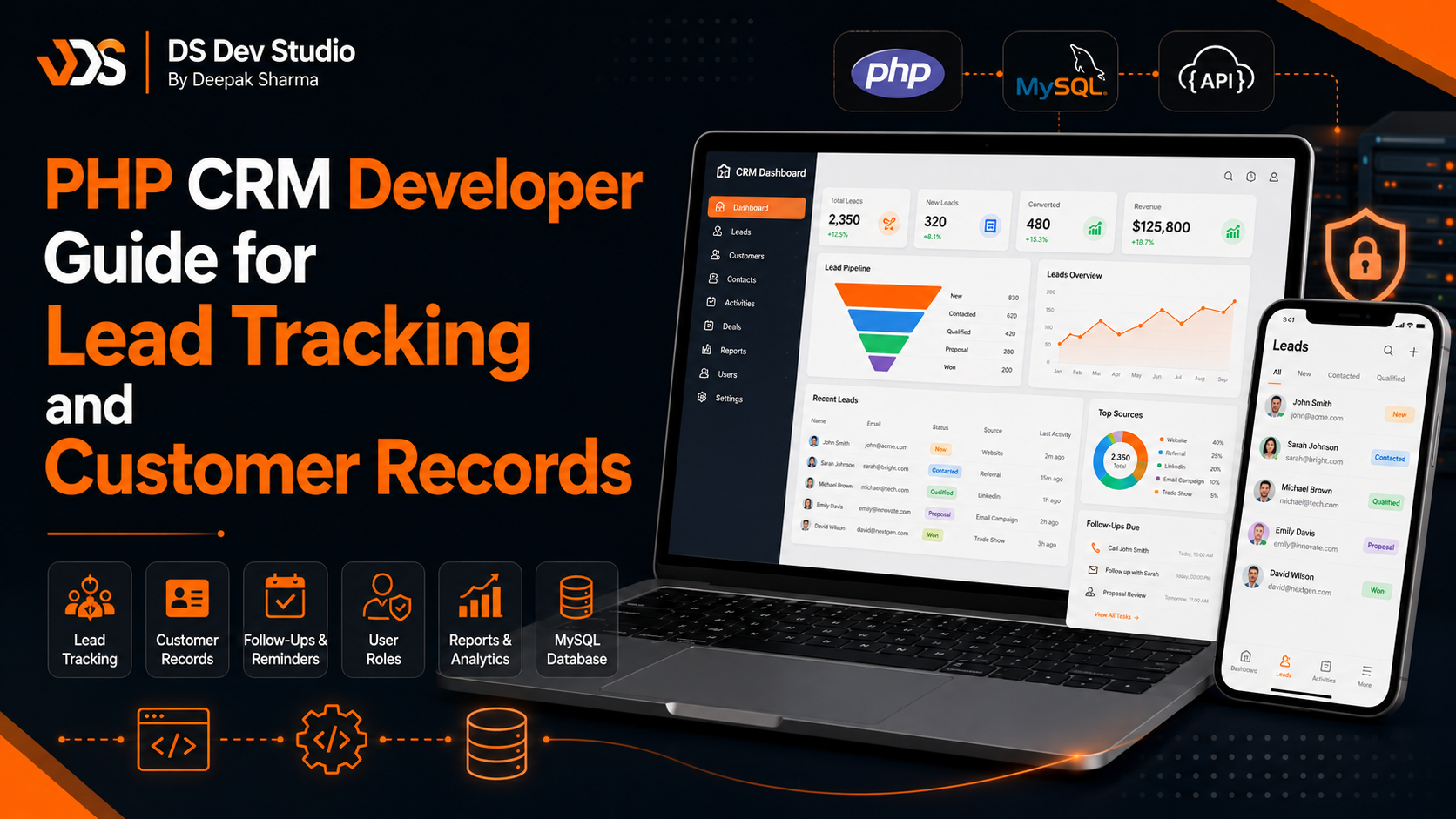
A PHP CRM Developer helps businesses build custom systems for lead tracking, customer records, follow-ups, notes, user roles, reports, and daily customer management workflows. Many small businesses start by managing enquiries through WhatsApp, email, spreadsheets, phone notes, or manual registers. This may work in the beginning, but as leads increase, the process becomes difficult to track. A custom PHP CRM system can bring all important customer and lead data into one organized dashboard.
CRM means customer relationship management. In practical business terms, a CRM helps you know who contacted your business, what service they asked for, who is handling the enquiry, what follow-up is pending, what status the lead has, and whether the person became a customer. A PHP CRM Developer can build this system according to your business process instead of forcing you to use a generic tool that may not match your workflow.
PHP is still widely used for business websites, backend systems, admin panels, CRM applications, and database-driven tools. With PHP, MySQL, Laravel, CodeIgniter, APIs, and frontend technologies, a business can build a practical CRM system that handles lead tracking and customer records in a structured way. A PHP Developer Freelancer can create simple or advanced CRM modules depending on the business need.
DS Dev Studio by Deepak Sharma helps businesses with PHP CRM development, backend development, MySQL database systems, Laravel development, CodeIgniter projects, admin panels, CRM web applications, API integration, React frontend development, responsive business websites, WordPress customization, and custom web applications. This guide explains how a PHP CRM Developer can build lead tracking and customer record systems for better business management.
What does a PHP CRM Developer do?
A PHP CRM Developer builds and improves CRM systems using PHP and related technologies. The work can include lead management modules, customer record modules, follow-up tracking, user login, user roles, admin dashboards, data tables, forms, validation, MySQL database design, reports, API connections, and backend workflows.
The developer first needs to understand how the business handles enquiries. For example, where do leads come from? Do they come from website forms, phone calls, WhatsApp, ads, referrals, landing pages, or social media? Who responds to them? What statuses are used? How are follow-ups tracked? What customer details must be saved? These questions shape the CRM system.
A good Backend Developer Freelancer should not only create screens. The developer should build a CRM that supports real work. Business users should be able to add records, update statuses, search data, filter leads, add notes, set follow-ups, view customer history, and generate useful reports without confusion.
Why lead tracking matters for businesses
Lead tracking matters because every enquiry has potential business value. If leads are not tracked properly, follow-ups can be missed, customer information can be lost, and the business may not know which marketing source is working. A lead that comes from a website form today may need follow-up tomorrow, quotation next week, and status update after discussion.
Without a CRM, leads often get scattered across inboxes, WhatsApp chats, spreadsheets, notebooks, and phone call history. This creates confusion. If more than one team member is handling enquiries, the problem becomes bigger. A PHP CRM system can store all leads in one place with source, service, status, assigned person, notes, and follow-up date.
Lead tracking also helps business owners understand performance. They can see how many leads came this month, which service got more enquiries, which source performed better, how many leads are pending, and how many converted into customers. This makes business decisions more data-driven.
Why customer records matter
Customer records matter because a business should not lose important information after a lead becomes a customer. A customer record can include contact details, service history, project details, notes, documents, payment status, support requests, follow-up history, and communication records. This helps the business serve customers better.
In many businesses, customer details remain scattered across emails, WhatsApp messages, invoices, spreadsheets, and individual employee notes. When a customer contacts again, the team may not know the full history. A CRM system solves this by keeping customer information organized and searchable.
A CRM Web Application Developer can create customer profiles where team members can view contact details, past enquiries, services taken, notes, files, next follow-up, and current status. This improves communication and makes the business look more organized.
PHP CRM system vs spreadsheet-based tracking
Spreadsheets are useful for simple tracking, but they have limitations when the business grows. A spreadsheet may work for a small number of leads, but it can become messy when multiple users update data, follow-ups are missed, duplicate records appear, or reports are needed quickly. Spreadsheets also do not provide proper user roles or workflow controls.
A PHP CRM system gives more structure. It can include login access, role-based permissions, lead forms, customer profiles, status dropdowns, follow-up reminders, notes, search filters, date filters, reports, dashboards, API connections, and activity logs. This makes it more suitable for daily business operations.
The right choice depends on the business stage. A very small business may start with spreadsheets. But when leads increase and follow-ups become difficult, a custom CRM system can save time and reduce missed opportunities.
Core modules in a PHP CRM system
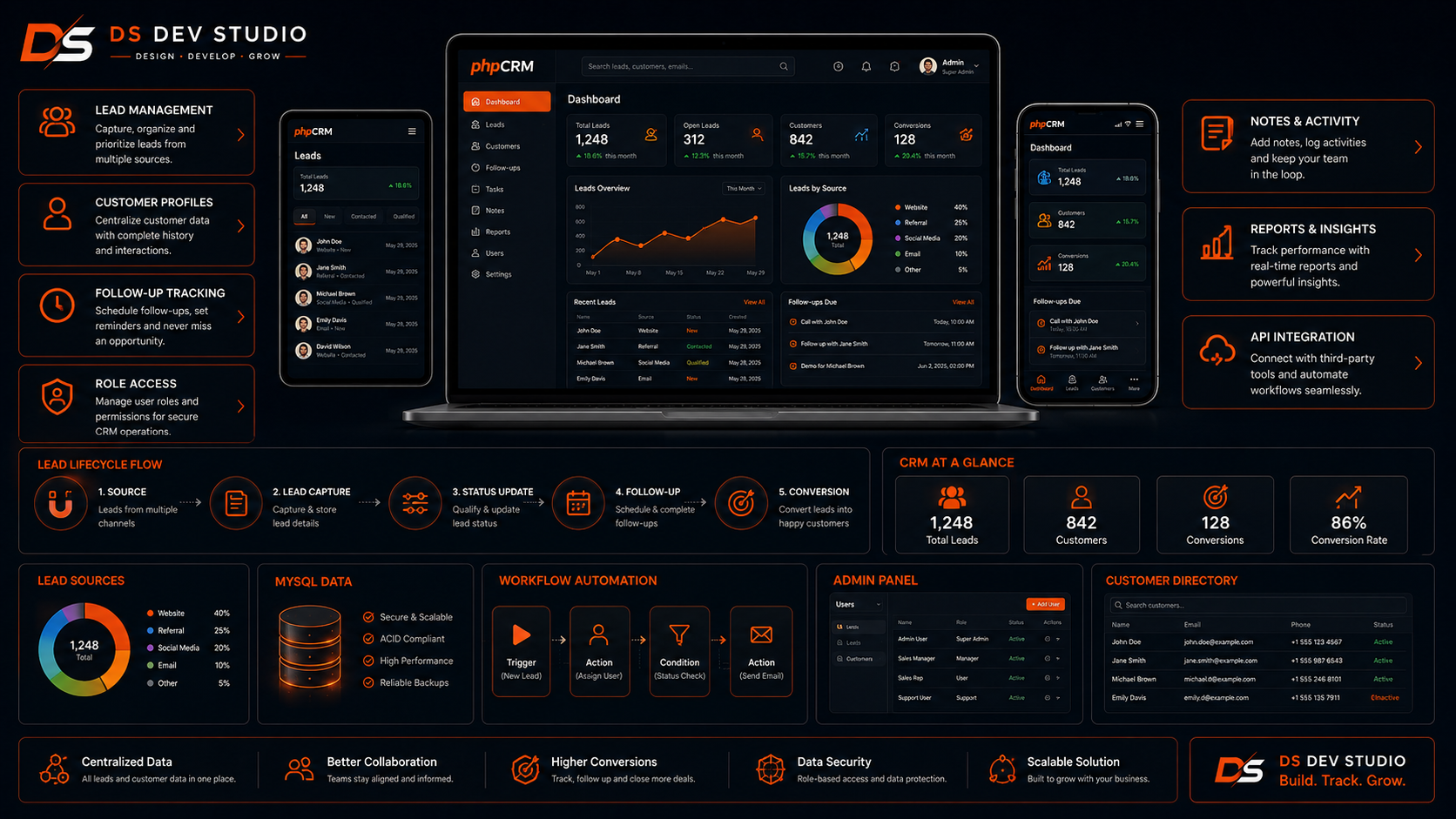
A PHP CRM system is usually divided into modules. Each module handles one important part of the workflow. For lead tracking and customer records, the most common modules include leads, customers, users, services, sources, statuses, follow-ups, notes, reports, and settings.
Modules help keep the CRM clean. Instead of mixing all information into one page, users can open the correct section and manage data properly. A PHP CRM Developer should plan modules based on the business workflow and avoid adding unnecessary complexity.
- Lead management module for new enquiries and service requests.
- Customer records module for converted leads and active customers.
- Follow-up module for calls, reminders, meetings, and next actions.
- Notes module for communication history and internal updates.
- User management module with roles and permissions.
- Service module for business offerings and enquiry categories.
- Lead source module for website, ads, WhatsApp, referrals, and calls.
- Report module for lead count, conversion status, source, and service-wise data.
- Settings module for business details and system preferences.
- API module for website forms, landing pages, and third-party tools.
Lead tracking workflow in a PHP CRM
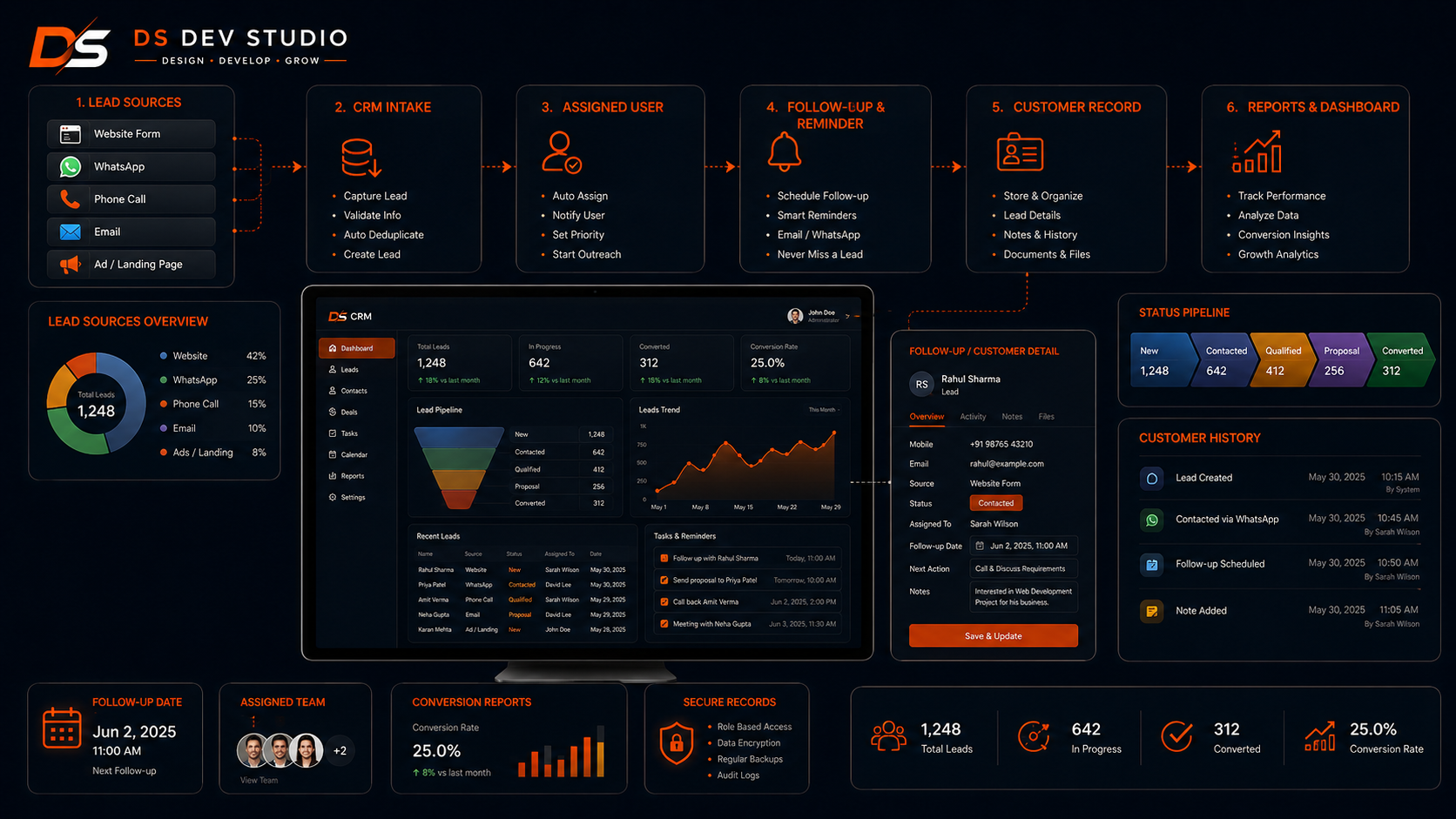
A lead tracking workflow starts when a person contacts the business. The lead may come from a website form, contact page, landing page, WhatsApp campaign, phone call, Google Business Profile, email, advertisement, or referral. The CRM should capture this lead and store it with useful details.
After the lead is added, the business can update its status. Common lead statuses include New, Contacted, Follow-Up Required, Quotation Sent, Interested, Not Interested, Converted, and Closed. These statuses help team members understand what action is needed next.
A PHP CRM Developer can build workflows where users can assign leads, add notes, set follow-up dates, upload files, and change status. The system can also show pending follow-ups so the team does not miss important conversations.
Customer record structure in a CRM system
Customer records should be structured clearly. A customer profile may include name, phone, email, company name, service taken, location, status, assigned user, notes, documents, previous enquiries, project details, and follow-up history. The exact fields depend on the business.
For example, a web development business may store customer website type, technology used, project status, hosting details, support notes, and renewal reminders. A coaching business may store course, batch, admission status, payment notes, and parent contact details. A clinic may store appointment history and service category.
A MySQL Database Developer can plan customer tables and relationships properly so customer data stays clean. A customer may have many notes, many follow-ups, many documents, and many service records. These relationships should be planned before development.
Admin panel for lead and customer management
An admin panel is the private dashboard where business users manage CRM data. A Custom Admin Panel Developer can build screens for leads, customers, users, reports, services, follow-ups, and settings. The admin panel should be simple enough for non-technical users.
The admin panel should include clear navigation, dashboard cards, searchable tables, filters, forms, action buttons, status labels, and error messages. Users should be able to add, view, edit, and update records without confusion. A CRM should make the work easier, not more complicated.
A PHP CRM Developer can build admin panels using PHP, Laravel, CodeIgniter, MySQL, Bootstrap, Tailwind CSS, React, or other frontend tools depending on the project requirement. The technology should match the business need and future scope.
User roles and permissions
User roles and permissions are important because CRM systems contain business and customer data. Not every user should have access to every feature. A business owner may need full access, while a staff member may only need assigned leads. A manager may view reports, while an editor may manage content only.
Common CRM roles include Super Admin, Admin, Manager, Sales User, Support User, Editor, and Viewer. The exact roles should match the business workflow. A PHP Developer Freelancer can build permission logic so each user sees only the modules and actions they are allowed to use.
Permissions reduce mistakes and improve security. For example, a staff user may add notes but not delete customers. A manager may assign leads but not change system settings. A clear role system keeps the CRM safer and easier to manage.
MySQL database planning for PHP CRM systems
MySQL database planning is one of the most important parts of PHP CRM development. If the database is poorly planned, the CRM can become slow, confusing, and difficult to expand. A MySQL Database Developer should plan tables, fields, relationships, indexes, and data rules carefully.
A CRM database may include tables for users, roles, leads, customers, services, sources, statuses, follow-ups, notes, files, activities, reports, and settings. These tables should connect logically. For example, a lead may belong to a service, have many notes, have many follow-ups, and be assigned to a user.
Good database planning improves search, filters, reports, performance, and future development. If the business later needs new fields, new reports, or new modules, a clean database structure makes updates easier.
Forms and validation in PHP CRM
Forms are used throughout a CRM system. Users may add leads, edit customers, create follow-ups, upload documents, change statuses, add notes, or update settings. These forms should be clear, fast, and properly validated. Validation prevents wrong or incomplete data from entering the system.
Common validation includes required fields, email format, phone number format, duplicate checks, valid dates, file type checks, file size limits, and correct status values. The CRM should show helpful error messages so users know what to fix.
A PHP CRM Developer can build validation using core PHP, Laravel validation, CodeIgniter form validation, or custom backend logic. Good validation improves data quality and reduces cleanup work later.
Follow-up tracking and reminders
Follow-up tracking is one of the most useful CRM features. Many leads do not convert immediately. They may need a second call, quotation, reminder, meeting, document sharing, or later discussion. Without follow-up tracking, these opportunities can be missed.
A PHP CRM system can include follow-up date, follow-up type, assigned user, notes, reminder status, and outcome. The dashboard can show today’s follow-ups, overdue follow-ups, and upcoming follow-ups. This helps the team stay organized.
Follow-up records also create customer history. When another team member opens the customer profile, they can see past conversations and next actions. This improves continuity and reduces repeated questions.
Reports and dashboard analytics
Reports help business owners understand CRM performance. A PHP CRM system can show total leads, new leads, converted leads, pending leads, source-wise leads, service-wise leads, user-wise follow-ups, monthly enquiries, customer growth, and lead conversion status.
Dashboard analytics should answer real business questions. Which marketing source is bringing leads? Which service has more demand? How many leads are pending? Which team member has overdue follow-ups? How many leads converted this month? These insights help the business improve its process.
A Backend Developer Freelancer can build reports using MySQL queries, date filters, status filters, user filters, and summary cards. Reports should be accurate, easy to understand, and fast to load.
Search, filters, and data tables
Search and filters are essential when CRM data grows. Users should be able to search leads by name, phone, email, service, source, status, date, or assigned user. Without search and filters, the CRM becomes difficult to use.
Data tables can include columns such as lead name, contact number, service, source, status, assigned user, follow-up date, and action buttons. Filters can allow users to see only new leads, pending follow-ups, converted customers, or service-specific records.
Pagination is also important. Loading all records at once can slow down the system. A PHP CRM Developer should use pagination and optimized queries so the CRM remains fast even when data increases.
API integration for lead capture
API integration helps a PHP CRM system collect leads from websites, landing pages, React frontends, WordPress forms, mobile apps, or third-party tools. An API allows different systems to send data into the CRM automatically instead of requiring manual entry.
For example, a business website contact form can send name, phone, email, service, message, and source to a PHP CRM API. The CRM can validate the data, store it in MySQL, assign a status, send an email notification, and show the lead in the dashboard.
An API Integration Developer can also connect the CRM with Google Sheets, email platforms, WhatsApp APIs, SMS tools, payment systems, analytics tools, or external CRM platforms. These integrations reduce manual work and improve response speed.
PHP CRM with Laravel or CodeIgniter
PHP CRM systems can be built using core PHP, Laravel, or CodeIgniter. Laravel is useful when the business needs structured backend architecture, migrations, authentication, middleware, APIs, validation, and scalable application logic. A Laravel Developer Freelancer can build strong CRM systems for growing businesses.
CodeIgniter is useful when the business needs a lightweight PHP framework or already has an existing CodeIgniter CRM. A CodeIgniter Developer Freelancer can improve old CRM systems, add modules, fix bugs, optimize database queries, and connect APIs.
The best choice depends on project scope, existing system, budget, timeline, and future plans. A PHP Developer Freelancer should recommend the right approach after understanding the workflow and technical requirements.
React frontend for PHP CRM dashboards
React can be used as a frontend for PHP CRM dashboards when the business needs a modern and interactive interface. PHP, Laravel, or CodeIgniter can handle backend APIs, authentication, database operations, and business logic. React can handle dashboard screens, tables, filters, forms, charts, and user interactions.
This setup is useful when the CRM needs a cleaner interface or when the business wants to separate frontend and backend. A React Developer Freelancer can create reusable components for dashboard cards, lead tables, customer forms, follow-up modals, status badges, and report sections.
A Full Stack Web Developer Freelancer can connect React frontend with PHP backend APIs and MySQL database workflows. This approach can support future custom web application features.
Security basics for PHP CRM systems
Security is important because CRM systems contain business and customer information. A PHP CRM Developer should protect login pages, user sessions, forms, APIs, file uploads, and database access. Weak security can expose leads, customer details, or internal business records.
Basic security practices include password hashing, input validation, output escaping, CSRF protection, role-based access, secure file uploads, safe database queries, and proper session handling. The system should not allow unauthorized users to view or modify sensitive data.
Security should be part of the CRM from the beginning. It should not be added only after development is complete. Every form, API, and user action should be checked based on access rules and data safety.
Performance optimization for PHP CRM systems
Performance matters because CRM systems are used regularly by business teams. If the dashboard is slow, tables take too long, or reports freeze, users may stop using the system properly. A CRM should remain fast and practical as data grows.
Performance can be improved through optimized MySQL queries, indexes, pagination, caching where useful, clean backend logic, and reduced unnecessary scripts. Data tables should load only required records instead of loading everything at once.
A MySQL Database Developer should check table structure and indexes. Reports should be built carefully so they do not slow down the system. A well-built CRM should support daily work without delays.
When should a business hire a PHP CRM Developer?
A business should hire a PHP CRM Developer when lead tracking and customer records are becoming difficult to manage manually. If enquiries are coming from multiple sources and follow-ups are being missed, a CRM system can help organize the process.
You should also hire a developer when your existing CRM is slow, outdated, missing important fields, difficult to use, or not connected with your website forms. A developer can improve the current system or build a new one based on your workflow.
- Hire a PHP CRM Developer when you need lead tracking.
- Hire one when customer records need better organization.
- Hire one when follow-ups are being missed.
- Hire one when website forms should connect with a CRM database.
- Hire one when you need user roles and permissions.
- Hire one when dashboards, reports, search, and filters are required.
- Hire one when your existing PHP CRM needs fixes or improvements.
- Hire one when you need Laravel, CodeIgniter, MySQL, APIs, or React support.
What to prepare before starting a PHP CRM project
Before starting a PHP CRM project, prepare your business workflow clearly. Explain how leads enter the business, who handles them, what statuses are used, what customer details should be saved, and what reports are needed. Clear planning helps the developer build the right system.
Prepare sample fields for each module. For leads, fields may include name, phone, email, service, message, source, status, assigned user, follow-up date, and notes. For customers, fields may include contact details, service history, project details, files, payment notes, and communication history.
- List required modules such as leads, customers, users, follow-ups, services, and reports.
- Define lead fields such as name, phone, email, source, service, status, and message.
- Define customer fields such as service history, notes, files, and follow-up records.
- Prepare user roles such as admin, manager, staff, support, and viewer.
- Explain workflow steps such as new lead, contacted, follow-up, converted, and closed.
- Share reporting needs such as monthly leads, source-wise leads, and pending follow-ups.
- Clarify API needs for website forms, landing pages, WhatsApp, or third-party tools.
- Discuss hosting, deployment, backup, security, maintenance, and future updates.
What to check before hiring a PHP CRM Developer
Before hiring a PHP CRM Developer, check whether they understand PHP backend development, MySQL databases, admin panels, CRM workflows, forms, validation, user roles, reports, APIs, Laravel, CodeIgniter, and security basics. CRM development requires business logic and backend experience, not only page design.
Ask whether the developer has worked on lead management systems, customer record modules, admin dashboards, searchable tables, filters, reports, and API integrations. Review live or demo systems if available. A CRM should be practical for daily use.
Also discuss maintenance. CRM systems often need new fields, new reports, role changes, bug fixes, API updates, and workflow improvements after launch. The developer should build the system in a way that can be maintained and extended.
Common PHP CRM mistakes to avoid
One common mistake is building a CRM without clear workflow planning. If lead statuses, customer fields, follow-up process, and user roles are not defined, the system can become confusing. Planning should happen before database and module development.
Another mistake is poor database design. If tables and relationships are not planned properly, the CRM may become slow and difficult to expand. MySQL structure should be designed around the real business data.
Other mistakes include weak validation, no user permissions, missing filters, no follow-up reminders, slow reports, unclear error messages, unsafe file uploads, no API security, no backup plan, and no maintenance plan. A skilled PHP CRM Developer can help avoid these problems.
How DS Dev Studio can help
DS Dev Studio by Deepak Sharma can help businesses with PHP CRM development, lead tracking systems, customer record dashboards, admin panels, MySQL database design, Laravel development, CodeIgniter improvements, API integration, backend workflows, reports, and custom web applications.
Deepak Sharma Web Developer work includes PHP, Laravel, CodeIgniter, MySQL, APIs, ReactJS, HTML, CSS, JavaScript, responsive UI, WordPress customization, frontend development, backend development, admin panels, CRM systems, and full stack web development. This is useful for businesses that need both backend CRM logic and frontend website support.
If you want to hire a PHP CRM Developer for lead tracking and customer records, DS Dev Studio can help plan the modules, design the database, build admin dashboards, create forms, add user roles, connect website enquiries, build reports, and prepare the CRM for long-term business use.
Conclusion
A PHP CRM Developer can help businesses build organized systems for lead tracking, customer records, follow-ups, notes, user roles, reports, and backend workflows. A strong CRM reduces scattered data, prevents missed follow-ups, improves customer history, and gives business owners clearer visibility into enquiries and performance. PHP, MySQL, Laravel, CodeIgniter, APIs, and React can be used together to build practical CRM systems that match real business needs. DS Dev Studio by Deepak Sharma can help businesses with PHP CRM development, lead tracking dashboards, customer record systems, admin panels, MySQL database design, Laravel and CodeIgniter development, API integration, React frontend support, and custom web applications. With the right PHP CRM development approach, businesses can manage leads and customers more clearly, improve follow-up discipline, and build a more reliable customer management process.
Useful internal links
Frequently asked questions
Can I hire Deepak Sharma as a PHP CRM Developer?+
Yes. You can hire Deepak Sharma for PHP CRM development, lead tracking systems, customer records, admin panels, MySQL databases, Laravel development, CodeIgniter improvements, API integration, reports, and custom web applications.
What does a PHP CRM Developer build?+
A PHP CRM Developer builds CRM systems with lead tracking, customer records, follow-ups, notes, user roles, admin dashboards, forms, reports, APIs, and MySQL database workflows.
Why does a business need lead tracking?+
Lead tracking helps a business store enquiries, manage statuses, assign users, schedule follow-ups, track sources, avoid missed opportunities, and understand which services or campaigns generate interest.
Can DS Dev Studio connect website forms with a PHP CRM?+
Yes. DS Dev Studio can connect website forms, landing pages, React forms, WordPress forms, and third-party tools with a PHP CRM using APIs, backend validation, and MySQL database storage.
Should a PHP CRM be built in Laravel or CodeIgniter?+
Laravel is useful for structured and scalable CRM systems. CodeIgniter is useful for lightweight CRM systems or improving existing PHP applications. The right choice depends on the project scope, existing system, and future requirements.