PHP Developer Freelancer Guide for Business Websites and Backend Systems
A practical guide for businesses that want to hire a PHP Developer Freelancer for business websites, backend systems, admin panels, CRM modules, APIs, MySQL databases, and custom web applications.

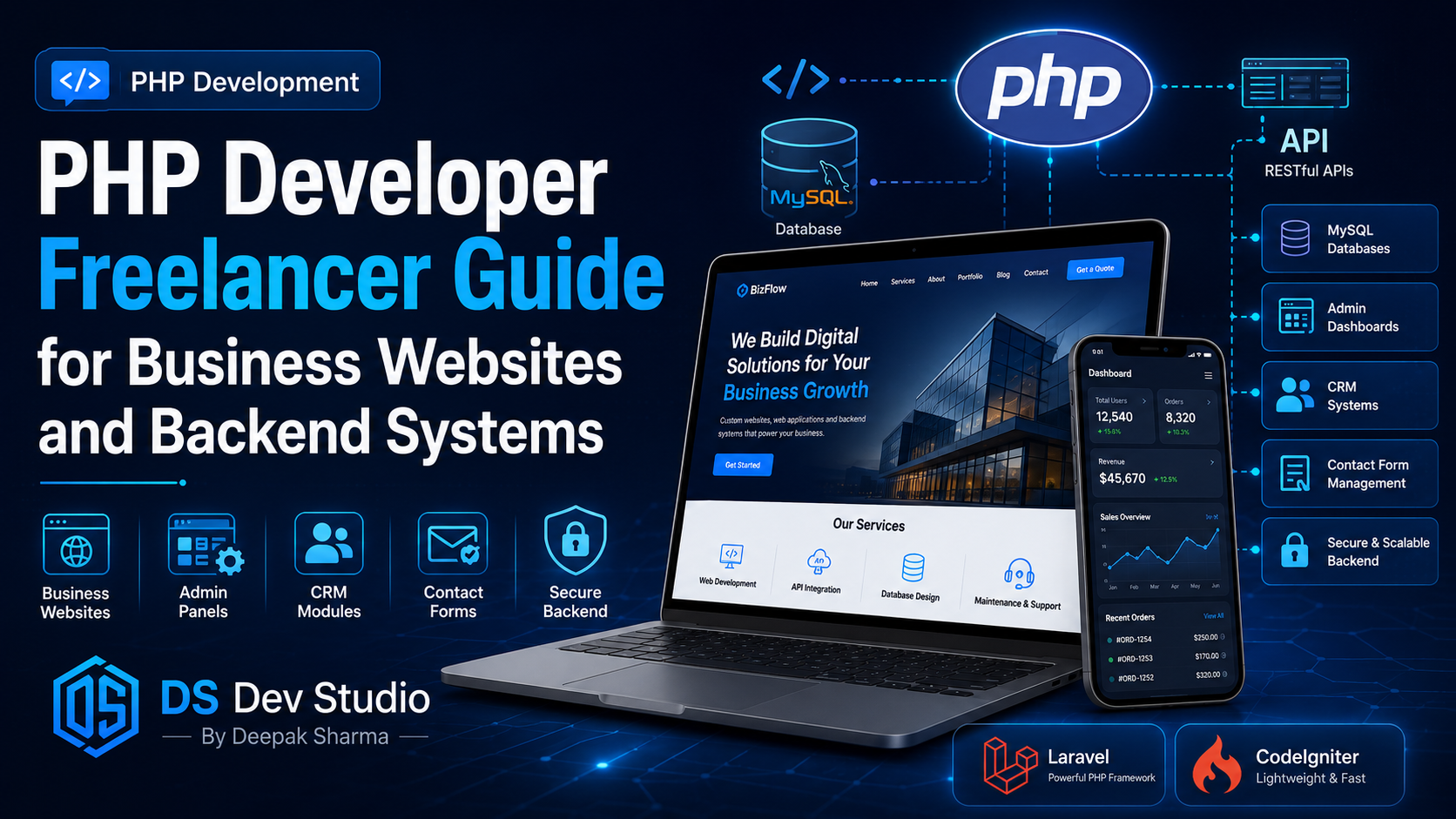
A PHP Developer Freelancer helps businesses build websites, backend systems, admin panels, CRM modules, contact form workflows, MySQL databases, APIs, and custom web applications. PHP is widely used for server-side development, and it can support both simple business websites and more advanced backend systems. For many small businesses and service-based companies, PHP remains a practical choice because it is flexible, reliable, and suitable for database-driven projects.
A business website may start as a simple online presence, but over time it may need more functionality. The business may need enquiry forms, lead storage, admin dashboards, user login, report sections, content management, API integrations, booking records, customer data, or CRM workflows. These features require backend logic, and this is where a skilled PHP Developer Freelancer can help.
PHP development is useful for businesses that need practical backend systems without unnecessary complexity. A PHP backend can process form submissions, store data in MySQL, manage admin users, connect APIs, generate reports, and support custom business workflows. It can also work with frameworks such as Laravel and CodeIgniter when the project needs more structure.
DS Dev Studio by Deepak Sharma helps businesses with PHP development, backend systems, business websites, Laravel development, CodeIgniter development, MySQL database workflows, API integration, admin panels, CRM modules, React frontend development, WordPress customization, and custom web applications. This guide explains when to hire a PHP Developer Freelancer and what businesses should check before starting a PHP backend project.
What does a PHP Developer Freelancer do?
A PHP Developer Freelancer builds the server-side part of websites and web applications. This includes form handling, database connections, user login systems, admin panels, APIs, backend logic, file uploads, content management, data validation, reports, and business workflow features. The work may not always be visible to website visitors, but it powers the important functions behind the website.
For example, when a visitor submits a contact form on a business website, the frontend shows the fields and submit button. The PHP backend receives the submitted data, validates it, stores it in a database, sends an email notification, and may show the lead inside an admin panel. This complete flow makes the website more useful for business operations.
A good PHP Developer Freelancer should understand not only coding but also business logic. If the project is a CRM, the developer should understand lead status, follow-up notes, customer records, user roles, filters, and reports. If the project is an admin panel, the developer should understand what data needs to be managed and how users will interact with it.
Why PHP is useful for business websites
PHP is useful for business websites because it can handle dynamic features that static pages cannot manage alone. A static website can show information, but a PHP-powered website can process data, connect with databases, manage forms, show dynamic content, and support admin controls. This makes PHP practical for small businesses that need functional websites.
A business website may need contact forms, enquiry storage, service management, blog management, testimonial management, project updates, login areas, or custom dashboards. PHP can support these features with proper backend planning. When combined with MySQL, PHP can store and retrieve business data efficiently.
PHP is also widely supported by many hosting providers. This makes deployment easier for many small and medium businesses. A Website Developer Freelancer with PHP experience can build practical systems that fit common hosting environments and business budgets.
When should you hire a PHP Developer Freelancer?
You should hire a PHP Developer Freelancer when your website or web application needs backend functionality. If you only need a simple static page, frontend development may be enough. But if your website needs database storage, form processing, admin panels, login systems, APIs, CRM modules, or custom workflows, PHP backend development can be useful.
Businesses often hire PHP developers when they want to upgrade a basic website into a more functional system. For example, a contact form can be upgraded into a lead management system. A service website can be upgraded with admin-controlled content. A business can add login-based dashboards, customer records, file uploads, booking records, or report sections.
- Hire a PHP developer when your website needs contact form processing.
- Hire one when enquiries need to be stored in a database.
- Hire one when you need an admin panel or dashboard.
- Hire one when your business needs a CRM module.
- Hire one when you need MySQL database design and backend workflows.
- Hire one when you need APIs or third-party integrations.
- Hire one when you need user login, authentication, or role-based access.
- Hire one when your existing PHP, Laravel, or CodeIgniter system needs updates.
PHP for contact forms and enquiry workflows
Contact forms are one of the most common reasons businesses need PHP backend development. A contact form should not only collect information visually. It should validate input, send the enquiry to the business, store the record where needed, and show a clear success message to the user.
A simple form may include name, email, phone number, service requirement, location, and message. A more advanced form may include budget, timeline, project type, file upload, preferred contact method, or source tracking. PHP can handle the submitted data and process it according to the business requirement.
For small businesses, storing form submissions can be very useful. Instead of depending only on email notifications, the business can view all enquiries inside an admin panel. This helps track leads, avoid missed messages, and improve follow-up.
PHP and MySQL database development
PHP is commonly used with MySQL for database-driven websites and web applications. MySQL can store business data such as leads, customers, users, services, products, bookings, messages, reports, files, notes, and activity records. PHP can connect with MySQL to create, read, update, and delete this data.
A MySQL Database Developer should plan the database structure carefully. Good database design includes proper tables, fields, relationships, indexes, and data types. For example, a CRM system may need tables for leads, users, statuses, notes, sources, follow-ups, and activities. A booking system may need customers, appointments, services, availability, and notifications.
Poor database planning can create problems later. Duplicate records, unclear fields, slow queries, and missing relationships can make the system difficult to maintain. A good PHP Developer Freelancer should plan the database before starting development so the backend remains organized and scalable.
PHP for admin panels
An admin panel allows business owners or team members to manage website or application data from a private dashboard. A PHP backend can power admin panels for leads, customers, services, products, blogs, projects, testimonials, bookings, users, reports, and settings.
A good admin panel should be simple, secure, and easy to use. It may include login, dashboard cards, tables, filters, search, add/edit forms, status updates, export options, and role-based access. The goal is to help the business manage data without touching the database directly.
A Backend Developer Freelancer can build admin panels using plain PHP, Laravel, CodeIgniter, MySQL, and frontend technologies. If the business needs a more modern interface, React frontend can also connect with a PHP backend through APIs.
PHP for CRM modules
CRM modules help businesses manage leads, customers, follow-ups, notes, statuses, and communication records. A PHP Developer Freelancer can build custom CRM modules for small businesses that need better lead organization but do not want a very complex enterprise system.
A custom CRM can include lead capture forms, customer records, assigned users, status changes, follow-up dates, notes, search, filters, reports, and email notifications. The backend stores and processes this data, while the admin interface helps the team use it.
For service-based companies, a CRM module can be especially useful. Every enquiry from the website can enter the CRM. The team can mark it as new, contacted, interested, converted, or closed. This creates a better process than managing enquiries only through emails or spreadsheets.
PHP for APIs and integrations
APIs allow different systems to communicate. A PHP backend can create APIs for frontend applications, mobile apps, dashboards, CRM tools, and third-party platforms. APIs can send and receive data between systems in a structured way.
An API Integration Developer can connect a business website with tools such as email services, CRM platforms, payment systems, SMS services, WhatsApp APIs, Google Sheets, analytics tools, booking systems, or marketing platforms. These integrations can reduce manual work and improve business workflows.
API development should include validation, error handling, secure access, clear response formats, and proper documentation where needed. A weak API can create data errors or security issues. A skilled PHP Developer Freelancer should build APIs that are practical and reliable.
PHP, Laravel, and CodeIgniter: what is the difference?
PHP is the programming language used for backend development. Laravel and CodeIgniter are PHP frameworks. A framework provides structure, tools, and conventions that help developers build applications in a more organized way. The right choice depends on project size, complexity, timeline, and future maintenance needs.
Plain PHP may be suitable for smaller features, simple forms, basic admin panels, or lightweight backend tasks. Laravel is useful for structured applications that need authentication, APIs, database migrations, validation, queues, and maintainable architecture. CodeIgniter is useful for lightweight PHP applications and maintaining existing CodeIgniter systems.
A Laravel Developer Freelancer may be better for a larger custom web application. A CodeIgniter Developer Freelancer may be better if your existing system is already built in CodeIgniter. A PHP Developer Freelancer should be able to recommend the right approach based on your actual business requirement.
PHP and WordPress websites
WordPress is built with PHP, which means PHP knowledge is useful for WordPress customization. A WordPress website may need theme customization, plugin adjustments, custom templates, contact forms, performance improvements, or backend changes. A PHP Developer Freelancer with WordPress understanding can support these needs.
For small business websites, WordPress can be useful when content management is important. PHP can help customize WordPress beyond basic theme settings. This may include custom fields, custom post types, template changes, form handling, or plugin-level modifications.
However, WordPress is not the right choice for every backend system. If the project needs a custom CRM, advanced admin panel, complex API system, or custom database workflow, a separate PHP, Laravel, or CodeIgniter application may be better.
PHP for custom web applications
Custom web applications are built when a business needs features that a basic website or ready-made tool cannot provide. A Custom Web Application Developer can create applications for lead management, booking systems, reports, internal tools, customer portals, admin dashboards, inventory records, service requests, or workflow automation.
PHP can power the backend of these applications. It can handle database operations, APIs, user roles, validation, reports, and business rules. The frontend can be built with HTML, CSS, JavaScript, React, Tailwind CSS, or other tools depending on the project.
For small businesses, a custom web application should be built in phases. The first version should focus on the most important workflow. Later, additional features can be added based on real usage. This keeps the project practical and avoids unnecessary complexity.
PHP backend security basics
Backend systems often handle sensitive business data, so security matters. A PHP backend should validate input, protect login systems, hash passwords, manage sessions carefully, control user access, handle errors safely, and avoid exposing sensitive information. File uploads and API access should also be managed carefully.
Businesses do not need to know every technical security detail, but they should hire a developer who understands security basics. Poor backend security can expose customer data, break workflows, or create serious maintenance problems. Security should be part of development from the beginning.
A Backend Developer Freelancer should also consider role-based access where needed. For example, an admin may access all records, while a staff member may only view assigned leads. This type of access control protects data and keeps the system organized.
PHP backend performance and reliability
Performance is important in backend systems. A dashboard that loads slowly can frustrate team members. A form that fails randomly can cause lost enquiries. A report that takes too long to generate can reduce productivity. Backend performance depends on clean code, optimized queries, proper database design, and practical architecture.
A PHP Developer Freelancer should use pagination for large tables, filters for data searching, optimized database queries, validation before processing, and clear error handling. The backend should not load unnecessary data. APIs should return only what the frontend needs.
Reliability also includes backups, testing, and post-launch support. A business web application should be checked after launch to make sure forms, dashboards, login, reports, and database actions work properly. Maintenance is important for backend systems.
PHP backend and responsive frontend connection
PHP handles backend logic, but the frontend still matters. A business web application should have a clean and responsive interface. Users should be able to submit forms, view dashboards, update records, and navigate the system easily. Backend functionality is only useful when the frontend experience is clear.
A PHP backend can connect with a frontend built using HTML, CSS, JavaScript, ReactJS, Tailwind CSS, Bootstrap, or WordPress. For example, a React frontend can send form data to a PHP API. A PHP admin panel can display MySQL data in tables. A WordPress site can connect forms with PHP workflows.
DS Dev Studio can help connect frontend and backend development. Deepak Sharma Web Developer work includes responsive websites, React frontend, PHP backend, MySQL databases, APIs, admin panels, CRM modules, and custom web applications.
SEO-friendly business websites with PHP
PHP can support SEO-friendly business websites when pages are structured properly. A website should have clean URLs, useful headings, metadata, internal links, image alt text, responsive layout, and fast loading. If PHP is used for dynamic content, the output should still be readable and organized for users and search engines.
An SEO Friendly Website Developer should make sure the website has clear service pages, blog structure, contact pages, sitemap support where needed, and optimized content sections. Backend functionality should not make the public website confusing or difficult to crawl.
For small businesses, SEO-friendly PHP websites can include service pages, project pages, blogs, FAQs, contact forms, and internal links. These elements help visitors understand the business and support long-term content growth.
What to prepare before hiring a PHP Developer Freelancer
Before hiring a PHP developer, prepare your project requirement clearly. Explain what you want the system to do, what data needs to be stored, who will use the system, what forms are required, what admin features are needed, and whether APIs or integrations are involved. Clear requirements help the developer plan the backend properly.
If you already have an existing PHP, Laravel, CodeIgniter, WordPress, or MySQL system, share the current problem. You may need bug fixing, feature additions, speed improvement, migration, redesign, API integration, or database cleanup. The developer needs this context before estimating the project.
- Prepare the main business problem the PHP backend should solve.
- List required features such as forms, admin panel, CRM, APIs, or reports.
- Explain what data needs to be stored in the database.
- Clarify user roles such as admin, staff, customer, or manager.
- Share existing website, hosting, database, or code details if available.
- Decide whether the project needs plain PHP, Laravel, CodeIgniter, WordPress, or custom development.
- Prepare form fields, dashboard requirements, and report needs.
- Discuss timeline, revisions, deployment, maintenance, and support.
What to check before hiring a PHP developer
Before you hire PHP Developer support, check whether the developer understands backend logic, MySQL database design, form handling, admin panels, APIs, authentication, validation, security basics, and business workflows. PHP skill alone is not enough if the project requires a complete backend system.
Ask about experience with PHP, Laravel, CodeIgniter, MySQL, WordPress customization, API integration, CRM modules, admin dashboards, and custom web applications. Also ask how the developer handles errors, security, database planning, deployment, and future updates.
Some backend projects cannot be shown publicly because they are private business systems. In that case, the developer can explain project types, modules, and workflows. Focus on whether the developer can understand your business process and convert it into a practical backend system.
Common PHP development mistakes to avoid
One common mistake is starting development without clear data planning. If the database is not planned properly, the system can become difficult to maintain. Another mistake is ignoring validation and security. A backend should not blindly accept data without checks. Forms, APIs, login systems, and file uploads need careful handling.
Another mistake is building everything in one unorganized file or without structure. This may work for very small scripts, but it becomes difficult to update later. For larger projects, Laravel or CodeIgniter may provide better structure. Even plain PHP projects should follow clean organization.
Businesses also sometimes ignore post-launch support. PHP backend systems need maintenance, bug fixes, updates, backups, and improvement over time. Discuss support before the project starts so the system remains reliable after launch.
How DS Dev Studio can help
DS Dev Studio by Deepak Sharma can help businesses with PHP backend development, business websites, admin panels, CRM modules, MySQL database design, contact form workflows, Laravel systems, CodeIgniter projects, API integrations, WordPress customization, and custom web applications.
Deepak Sharma Web Developer work includes both frontend and backend development. This means DS Dev Studio can help create responsive website pages, React interfaces, WordPress layouts, PHP backend logic, MySQL databases, APIs, admin dashboards, lead management systems, and custom business workflows.
If you want to hire PHP Developer support for a business website or backend system, DS Dev Studio can help plan the database, build backend logic, connect forms, create admin panels, add APIs, improve existing PHP systems, and prepare your project for future growth. The focus is on practical development that supports real business needs.
Conclusion
A PHP Developer Freelancer can help businesses build practical backend systems for websites, admin panels, CRM modules, APIs, MySQL databases, form workflows, and custom web applications. PHP is useful when a business needs more than static pages and wants to collect, store, process, and manage data. Whether you need a contact form backend, a lead management system, an admin dashboard, a Laravel application, a CodeIgniter update, or a custom PHP web application, the right developer can help plan and build the system properly. DS Dev Studio by Deepak Sharma can support PHP backend development, business websites, responsive frontend pages, API integrations, database systems, WordPress customization, and complete web application development. With the right PHP development approach, a business website can become a functional system that supports enquiries, workflows, data management, and long-term growth.
Useful internal links
Frequently asked questions
Can I hire Deepak Sharma as a PHP Developer Freelancer?+
Yes. You can hire Deepak Sharma for PHP backend development, business websites, admin panels, CRM modules, MySQL databases, Laravel systems, CodeIgniter projects, APIs, contact forms, and custom web applications.
When should I hire a PHP Developer Freelancer?+
You should hire a PHP Developer Freelancer when your website needs backend features such as forms, database storage, admin panels, login systems, CRM modules, APIs, reports, or custom business workflows.
Can PHP be used for business websites?+
Yes. PHP can be used for business websites, contact forms, dynamic pages, WordPress customization, admin panels, backend systems, MySQL databases, APIs, and custom web applications.
Can DS Dev Studio build PHP admin panels and CRM systems?+
Yes. DS Dev Studio can build PHP admin panels, CRM modules, enquiry management systems, dashboards, MySQL database workflows, user roles, reports, APIs, and backend business systems.
Should I choose PHP, Laravel, or CodeIgniter?+
Plain PHP can work for smaller backend tasks. Laravel is useful for structured and scalable applications. CodeIgniter is useful for lightweight PHP systems or existing CodeIgniter projects. The best choice depends on your project requirement.