React Frontend Development Guide for Service-Based Business Websites
A practical guide for service-based businesses that want React Frontend Development for responsive websites, service pages, landing pages, reusable components, contact forms, and business website growth.

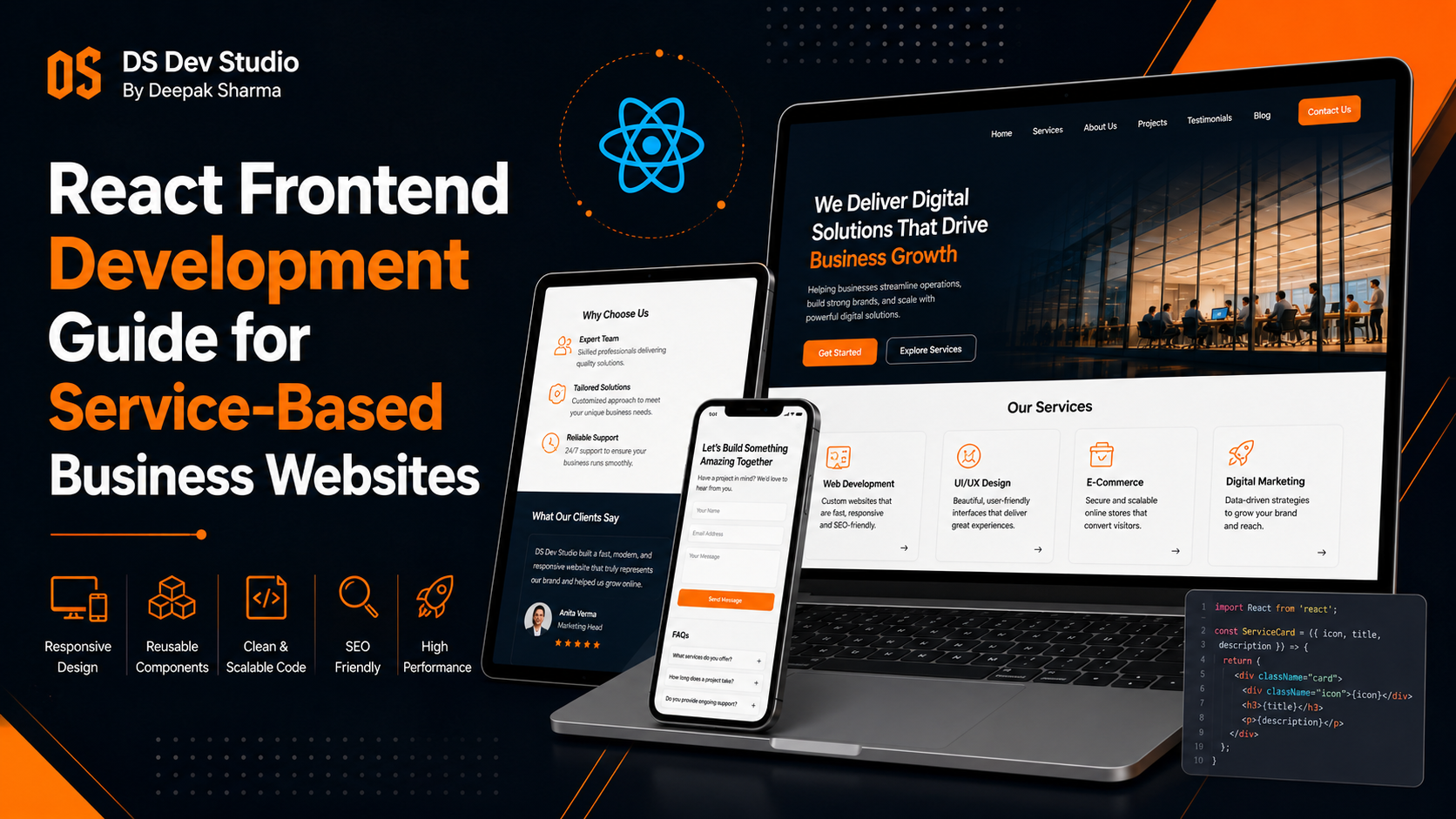
React Frontend Development can help service-based businesses build modern, responsive, clean, and scalable websites that explain services clearly and support customer enquiries. A service-based business website has a different purpose from an ecommerce store or entertainment platform. It needs to present services, build trust, answer common questions, show proof of work, and guide visitors toward contact. React can support this by creating reusable frontend components and smooth user interfaces.
Many service-based businesses depend on enquiries from Google Search, WhatsApp, social media, referrals, email campaigns, ads, and direct website visits. When users land on the website, they should quickly understand what the business offers, who it serves, what problems it solves, and how to contact. A React Developer Freelancer can build structured pages that make this journey easier for visitors.
React is especially useful when the website needs reusable sections such as service cards, testimonial blocks, project cards, FAQ accordions, pricing blocks, CTA sections, contact forms, blog previews, and dashboard components. Instead of building every section separately from zero, a Frontend Developer Freelancer can create clean components that can be reused across homepage, service pages, landing pages, blogs, and future custom web application screens.
DS Dev Studio by Deepak Sharma helps service-based businesses with React frontend development, responsive website development, business websites, landing pages, service pages, WordPress customization, PHP backend systems, Laravel development, CodeIgniter projects, MySQL databases, API integration, admin panels, CRM modules, and custom web applications. This guide explains how React Frontend Development can support service-based business websites and what to consider before starting a React website project.
What is React Frontend Development?
React Frontend Development means building the visible part of a website or web application using ReactJS. The frontend includes layout, navigation, buttons, forms, service cards, page sections, animations, responsive behavior, and user interaction. React helps developers create these sections as reusable components.
A component is a reusable part of the website. For example, a service card, testimonial card, FAQ block, contact form, header, footer, blog card, or CTA section can be created as a component. These components can then be used on different pages with different content. This makes the website easier to update and maintain.
For service-based business websites, this approach is practical because many pages need similar sections. A website development service page, landing page development page, React frontend development page, WordPress development page, backend development page, and API integration page may all use similar layouts with different content. React makes this structure easier to manage.
Why service-based businesses can benefit from React
Service-based businesses can benefit from React because their websites often grow over time. A business may start with a homepage and contact page, but later it may need separate service pages, landing pages, blogs, project showcases, lead forms, dashboards, CRM panels, and API-connected sections. React can support this growth with a structured frontend system.
A service-based business website should not feel static or outdated. Users should be able to move smoothly between pages, scan service sections, open FAQs, submit forms, and explore related content. React can help create a modern interface that feels consistent across the website.
React also helps when the business wants custom UI instead of a fixed template. A Custom Website Developer can build layouts around the exact service model, brand style, content flow, and customer journey. This is useful for consultants, agencies, developers, clinics, institutes, local services, B2B companies, and professional service providers.
React frontend vs traditional website development
Traditional website development may use HTML, CSS, and JavaScript directly to create pages. This can work well for simple websites. However, when a website has many repeated sections, dynamic content, reusable layouts, and future application features, React can make frontend development more organized.
In a traditional setup, similar sections may be copied across multiple pages. If one design element needs to change, the developer may need to update several places. In React, a reusable component can be updated once and reflected wherever it is used. This improves maintainability.
However, React should be chosen based on project need. A very simple content website may not always need React. A service-based business should choose React when it needs custom frontend structure, reusable components, future expansion, API-connected sections, dashboards, or a more scalable frontend setup.
Important pages for service-based business websites
A service-based business website should have a clear page structure. The homepage should introduce the business and guide users to important services. Service pages should explain each offering in detail. Landing pages should focus on specific campaigns or offers. Blogs should answer customer questions and support long-term content growth. Contact pages should make enquiries easy.
React can be used to build all of these pages with reusable components. The same header, footer, CTA block, service card, FAQ section, testimonial block, and contact form can be reused across pages. This creates consistency and saves development effort when the website grows.
- Homepage with clear business introduction, services, trust points, and CTA sections.
- Service pages for each important business offering.
- Landing pages for campaigns, ads, local promotions, or specific service offers.
- Blog pages for helpful articles and SEO-friendly content growth.
- Project or portfolio pages to show work examples and proof.
- Contact page with form, email, phone, WhatsApp, and location details.
- FAQ sections to answer common customer doubts.
- Internal links connecting services, blogs, projects, and contact page.
- Future dashboard or CRM pages if the business needs internal workflows.
React homepage development for service businesses
The homepage is usually the first page visitors see. A React homepage for a service-based business should quickly explain what the business does, who it helps, what services are offered, and how users can contact. The homepage should not be overloaded with random sections. Every section should guide users toward understanding or action.
A good homepage can include a hero section, service overview, benefits, process, project highlights, testimonials, FAQs, blog previews, and contact CTA. In React, each of these sections can be built as a reusable component. This makes it easier to maintain the homepage and reuse sections on other pages.
A Business Website Developer should also make the homepage responsive. On desktop, the hero section may show text and visuals side by side. On mobile, the content should stack properly. CTA buttons should remain easy to tap. Service cards should not become too small. The homepage should feel smooth on all devices.
React service page development
Service pages are very important for service-based businesses. Each major service should have its own page where users can read details before contacting. A homepage service list is useful, but it is not enough when visitors need deeper information.
A React service page can include service introduction, benefits, features, process, use cases, FAQs, related services, testimonials, and contact CTA. These sections can be built as reusable React components. The developer can create a consistent service page layout and use it for multiple services with unique content.
For example, DS Dev Studio can have service pages for website development, React frontend development, WordPress development, landing page development, backend development, API integration, admin panels, CRM web applications, and custom web application development. Each page can share a similar structure while explaining a different service clearly.
React landing pages for lead generation
Landing pages help service-based businesses promote one specific service, offer, campaign, or audience segment. A Landing Page Developer can use React to create focused pages that guide visitors toward one action such as sending an enquiry, booking a call, requesting a quote, or contacting on WhatsApp.
A React landing page can use reusable components such as hero sections, benefit cards, CTA blocks, testimonial blocks, FAQ accordions, and enquiry forms. If a business runs multiple campaigns, these components can be reused with different content. This creates a consistent landing page system.
Landing pages should be fast, mobile-friendly, and focused. They should not include unnecessary distractions. A user clicking from an ad or WhatsApp link should quickly understand the offer and know what to do next. React can support this when the page is built with performance and clarity in mind.
Reusable React components for service websites
Reusable components are one of the biggest strengths of React Frontend Development. A service-based business website usually needs many repeated sections. Instead of building each section again and again, a React Developer Freelancer can create components that can be reused across the website.
For example, a service card component can be used on the homepage, services page, landing pages, and related service sections. A testimonial component can be used on multiple pages. A CTA component can be placed after service details, blog posts, and landing page sections. This creates consistency and makes updates easier.
- Header and navigation component.
- Hero section component.
- Service card component.
- Benefit card component.
- Project showcase component.
- Testimonial component.
- FAQ accordion component.
- CTA section component.
- Contact form component.
- Blog card component.
- Footer component.
- Dashboard summary card component for future business tools.
Responsive Website Development with React
Responsive Website Development is essential for React websites because many users open business websites from mobile phones. A React website should work smoothly on mobile, tablet, laptop, and desktop screens. The layout should adjust properly, text should remain readable, images should resize correctly, and forms should be easy to complete.
A Responsive Website Developer can use modern CSS, Tailwind CSS, Bootstrap, CSS modules, or custom styling with React to create flexible layouts. Service sections may use three columns on desktop and one column on mobile. Blog cards may stack vertically on small screens. Dashboard tables may need mobile-friendly alternatives.
Responsive testing should happen at the component level. If one reusable component breaks on mobile, it may break across many pages. A React Developer Freelancer should test headers, cards, forms, buttons, modals, accordions, navigation, and CTA sections across different screen sizes.
Mobile user experience in React websites
Mobile user experience matters because many service-based business visitors come from mobile channels. Users may click from Google Search, Instagram, WhatsApp, Facebook, email, or local listings. The website should load quickly and show the important message clearly on the first screen.
A mobile-friendly React website should have readable text, proper spacing, simple navigation, clear CTA buttons, optimized images, and easy forms. Users should not need to zoom or scroll sideways. The website should guide them naturally from service information to enquiry.
A Frontend Developer Freelancer should avoid mobile issues such as oversized hero images, tiny text, cramped cards, hidden CTA buttons, difficult forms, and menus that do not close properly. These small issues can reduce trust and enquiries.
React contact forms for business enquiries
Contact forms are important because they turn website visitors into business enquiries. A React contact form should be simple, clear, and mobile-friendly. It should collect only the information required for the first conversation. Too many fields can reduce submissions.
A basic service business form may include name, phone number, email, service requirement, and message. Some businesses may also need budget, timeline, location, or preferred contact method. The form should include validation, success messages, and error messages so users understand what is happening.
A Backend Developer Freelancer can connect React forms with PHP, Laravel, CodeIgniter, MySQL, Google Sheets, CRM dashboards, or email notifications. This helps the business manage leads properly after submission. A form should not only look good; it should deliver lead data reliably.
React and API integration
React often works with APIs. The React frontend sends and receives data from a backend or third-party system. For service-based business websites, API integration can be used for contact forms, service listings, blog content, project data, testimonials, CRM dashboards, booking systems, or enquiry tracking.
An API Integration Developer can connect React with PHP, Laravel, CodeIgniter, Firebase, Google Sheets, CRM platforms, email tools, or custom backend systems. For example, a React landing page form can send data to a Laravel API, store it in MySQL, send an email alert, and show the lead in an admin panel.
API integration should include loading states, error handling, validation, and security where needed. Users should know whether their enquiry was submitted successfully. A professional React frontend should not leave users confused after clicking a button.
React with backend systems for service businesses
Many service-based businesses need backend systems along with a frontend website. The frontend may explain services and collect enquiries, while the backend stores leads, manages follow-ups, handles user login, or powers an admin panel. React can work with backend systems to create a complete business web solution.
PHP, Laravel, CodeIgniter, and MySQL are practical backend options for many business websites and custom applications. Laravel can support structured APIs, authentication, validation, and admin workflows. CodeIgniter can support lightweight PHP applications and existing CRM systems. MySQL can store leads, customers, users, services, reports, and form submissions.
A Full Stack Web Developer Freelancer can connect React frontend with backend APIs and database workflows. This is useful when the business needs both a public website and an internal system such as a CRM, dashboard, lead manager, or admin panel.
React dashboards for service-based businesses
React is also useful for dashboards. A service-based business may need a dashboard to manage leads, customers, service requests, bookings, projects, payments, reports, or team activity. React can create interactive dashboard screens with cards, tables, filters, charts, forms, and status labels.
For example, a lead dashboard can show total enquiries, new leads, pending follow-ups, completed projects, service categories, assigned users, and recent messages. A CRM dashboard can show customer profiles, notes, follow-up dates, and status updates. A React dashboard can make these workflows easier to manage.
Although a service website may start with public pages, React makes it easier to add dashboard features later. A Custom Web Application Developer can plan the frontend so it supports both website pages and future business tools.
SEO-friendly React website structure
An SEO Friendly Website Developer should plan React websites carefully when public pages need search visibility. A React website should have clear headings, useful content, internal links, image alt text, metadata, clean URLs, responsive layout, and fast loading. React should not be used only for visual effects while ignoring content structure.
Service pages should have clear topics. Blog pages should answer useful questions. Landing pages should focus on one service or offer. Internal links should connect blogs, services, projects, and contact pages. This structure helps users move through the website and supports long-term content growth.
SEO-friendly React development also requires attention to how pages are rendered and how metadata is managed. The exact setup depends on the project. The important point is that React websites for public business pages should be planned for both users and search visibility.
React website speed and performance
Website speed affects user experience and lead generation. A slow React website can reduce enquiries because users may leave before reading services or submitting a form. Performance should be considered during development, not only after launch.
A React Developer Freelancer can improve performance by keeping components clean, optimizing images, avoiding unnecessary libraries, using efficient routing, managing assets properly, and loading only required data. Landing pages and service pages should be lightweight and fast.
Performance also matters for dashboards. A slow dashboard table, delayed form update, or heavy report screen can reduce team productivity. Good React Frontend Development should focus on both public website speed and internal dashboard usability.
React vs WordPress for service-based websites
React and WordPress both have different strengths. React is useful for custom frontend interfaces, reusable components, dashboards, API-connected pages, and future web application features. WordPress is useful when the business needs easy content management, blog publishing, and page editing from an admin dashboard.
A service-based business should choose based on needs. If the website mainly needs content pages and regular blog updates, WordPress can be practical. If the project needs custom UI, landing page systems, dashboard features, CRM integration, or future app-like functionality, React may be better.
Some businesses may even use both approaches depending on the project. The public content website may use WordPress, while custom dashboards or portals may use React. A good Website Developer Freelancer should recommend the right setup instead of forcing one technology for every project.
When should a service business hire a React Developer Freelancer?
A service business should hire React Developer support when it needs custom frontend pages, reusable components, landing page systems, dashboards, API-connected features, or a website that may grow into a custom web application. React is useful when the website needs flexibility beyond a basic static page.
You may also hire React support when your current website feels outdated, difficult to maintain, or unable to support new sections properly. A React developer can rebuild the frontend with clean components and responsive layouts. This can make future improvements easier.
- Hire React Developer support when you need reusable website components.
- Hire React support when you need custom landing pages.
- Hire React support when you need service pages with consistent layouts.
- Hire React support when your website needs API-connected forms or content.
- Hire React support when you need dashboards, admin panels, or CRM screens.
- Hire React support when the website may grow into a custom web application.
- Hire React support when you need responsive UI across devices.
- Hire React support when you want a custom frontend instead of a generic template.
What to prepare before starting a React website project
Before starting a React website project, prepare your business details, services, required pages, content, brand colors, logo, images, contact details, reference websites, and website goals. Clear preparation helps the developer plan components and page structure properly.
For service-based businesses, prepare the service list and decide which services need dedicated pages. Prepare landing page requirements if you plan to run campaigns. Prepare blog topics if content growth is part of the strategy. If you need backend features, prepare form fields, data requirements, CRM needs, and API expectations.
- Prepare business name, logo, colors, and brand style.
- List required pages such as Home, About, Services, Blog, Projects, and Contact.
- Prepare service descriptions and landing page offers.
- Share reference websites for layout and design direction.
- Prepare images, testimonials, FAQs, and project examples.
- Clarify required forms, CTA buttons, and enquiry flow.
- List backend needs such as APIs, CRM, database, or admin panel.
- Discuss responsive testing, speed optimization, deployment, and support.
What to check before hiring a React developer
Before hiring a React developer, check whether they understand React components, responsive design, frontend structure, API integration, forms, performance, service page layouts, landing pages, and business website goals. React knowledge alone is not enough. The developer should also understand user experience and business flow.
Review live work on mobile and desktop. Check whether pages load smoothly, buttons work, forms submit properly, sections are readable, and the layout feels consistent. If the developer has dashboard experience, ask about tables, filters, forms, API connections, and user roles.
Also ask about maintainability. React projects can become messy if components are not organized properly. A good React Developer Freelancer should create clean folder structure, reusable components, readable code, and a frontend setup that can support future updates.
Common React frontend mistakes to avoid
One common mistake is using React for every project even when it is not needed. React is powerful, but the technology should match the requirement. If a business only needs a simple content website with easy editing, WordPress may be more practical. React is stronger when custom frontend, reusable components, dashboards, or API connections are needed.
Another mistake is building components without responsive testing. A service card, testimonial block, form, or dashboard table may look good on desktop but break on mobile. Since components are reused, one issue can affect many pages. Testing is important.
Other mistakes include too many unnecessary libraries, poor form validation, missing loading states, confusing error messages, weak SEO structure for public pages, slow images, unclear CTA buttons, no internal links, and poor folder structure. A skilled React Developer Freelancer can help avoid these problems through better planning.
How DS Dev Studio can help
DS Dev Studio by Deepak Sharma can help service-based businesses with React frontend development, responsive websites, service pages, landing pages, reusable components, contact forms, API-connected frontend sections, dashboard interfaces, admin panels, CRM screens, and custom web applications.
Deepak Sharma Web Developer work includes ReactJS, HTML, CSS, JavaScript, responsive UI, WordPress customization, PHP backend development, Laravel systems, CodeIgniter projects, MySQL databases, APIs, admin panels, CRM modules, and full stack web development. This is useful for businesses that need frontend and backend support together.
If you want React Frontend Development for a service-based business website, DS Dev Studio can help plan the component structure, build responsive layouts, create service pages, develop landing pages, connect forms with backend systems, improve user experience, and prepare the website for future growth.
Conclusion
React Frontend Development can help service-based businesses build professional, responsive, and scalable websites with reusable components, clear service pages, focused landing pages, contact forms, API-connected sections, and future dashboard possibilities. React is useful when a business needs custom frontend structure, consistent UI, dynamic interactions, and a website that can grow over time. Service-based websites should still focus on clarity, mobile user experience, page speed, SEO-friendly structure, and enquiry flow. DS Dev Studio by Deepak Sharma can help businesses with React frontend development, responsive website development, service pages, landing pages, backend systems, API integration, admin panels, CRM modules, and custom web applications. With the right React development approach, a service-based business website can become easier to use, easier to maintain, and better prepared for long-term growth.
Useful internal links
Frequently asked questions
Can I hire Deepak Sharma for React Frontend Development?+
Yes. You can hire Deepak Sharma for React frontend development, responsive business websites, service pages, landing pages, reusable components, API-connected forms, dashboards, admin panels, CRM interfaces, and custom web applications.
Why is React useful for service-based business websites?+
React is useful because it supports reusable components, responsive UI, custom landing pages, service page layouts, dynamic sections, API-connected forms, dashboards, and future web application features.
Can React be used for SEO-friendly service pages?+
Yes. React can be used for SEO-friendly service pages when the website is planned with clear headings, useful content, metadata, clean URLs, responsive design, internal links, optimized images, and proper page structure.
Can DS Dev Studio connect React forms with backend systems?+
Yes. DS Dev Studio can connect React forms with PHP, Laravel, CodeIgniter, MySQL, email notifications, Google Sheets, admin panels, CRM dashboards, or custom APIs.
Should I choose React or WordPress for my service business website?+
React is useful for custom frontend interfaces, reusable components, dashboards, and API-connected pages. WordPress is useful when easy content management and regular blog publishing are important. The right choice depends on your business requirement.