SEO Friendly Business Website Development
A practical guide to SEO Friendly Business Website Development for small businesses, service providers, startups, and personal brands.

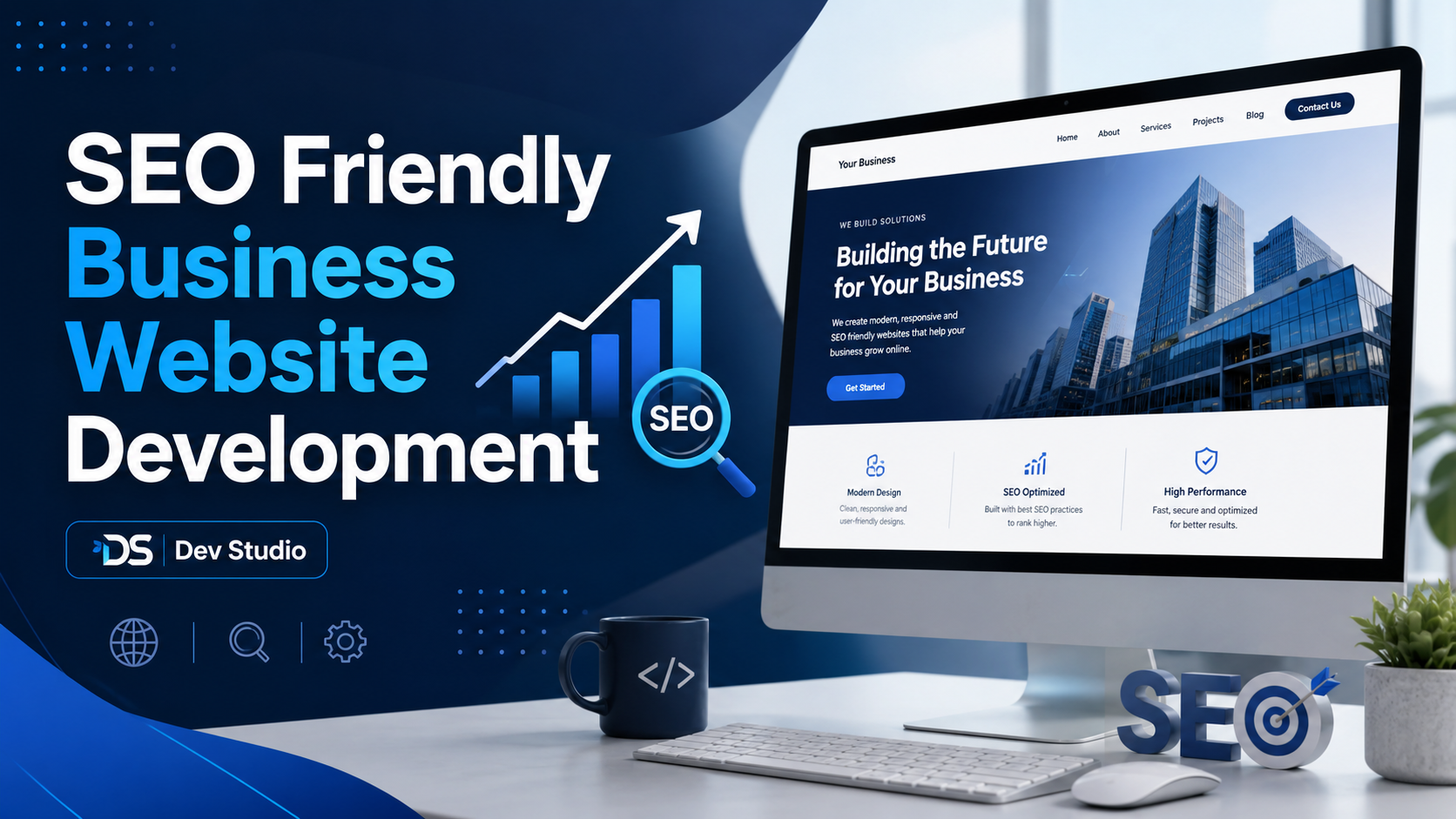
SEO Friendly Business Website Development refers to the development of the website that not only requires a clean graphical interface but also the usability for both users and search engines. The web pages of such website contain a correct structure, appropriate headings, useful and informative content, good links, proper images optimization, fast loading pages, and responsive design. Hence, when all these things work together, the website is made easy for crawling, for reading, and ultimately it becomes very useful for users.
The foundational role of SEO-conscious website development is attributed to the fact that the website usually stimulates first inquiries from customers regarding the provided type of activities, services, trustworthy proof, coordination of action, etc. The existence of a functional website should mean that potential users are able to comprehend the overall scope of what the business does, its target customers, the scope of services available and the approach to take to use the offered services. In case the website is visually appealing but structurally poor (i.e. it has no headings, mediocre content, bad mobile version support, etc.) the website will not perform satisfactorily from the viewpoint of customers as well as of search engines.
SEO Friendly Website Developers work on content structuring as well as development itself. Here, keyword stuffing is not meant. Rather, you need to make the necessary pages around real services, provide clear headings, write several meaningful paragraphs, use alt texts for images, create internal links, generate clear URLs and ensure that all your pages are functional. In business websites, this is important since SEO is not just about ranking high, but also helping people find what they need fast.
What makes a website SEO friendly?
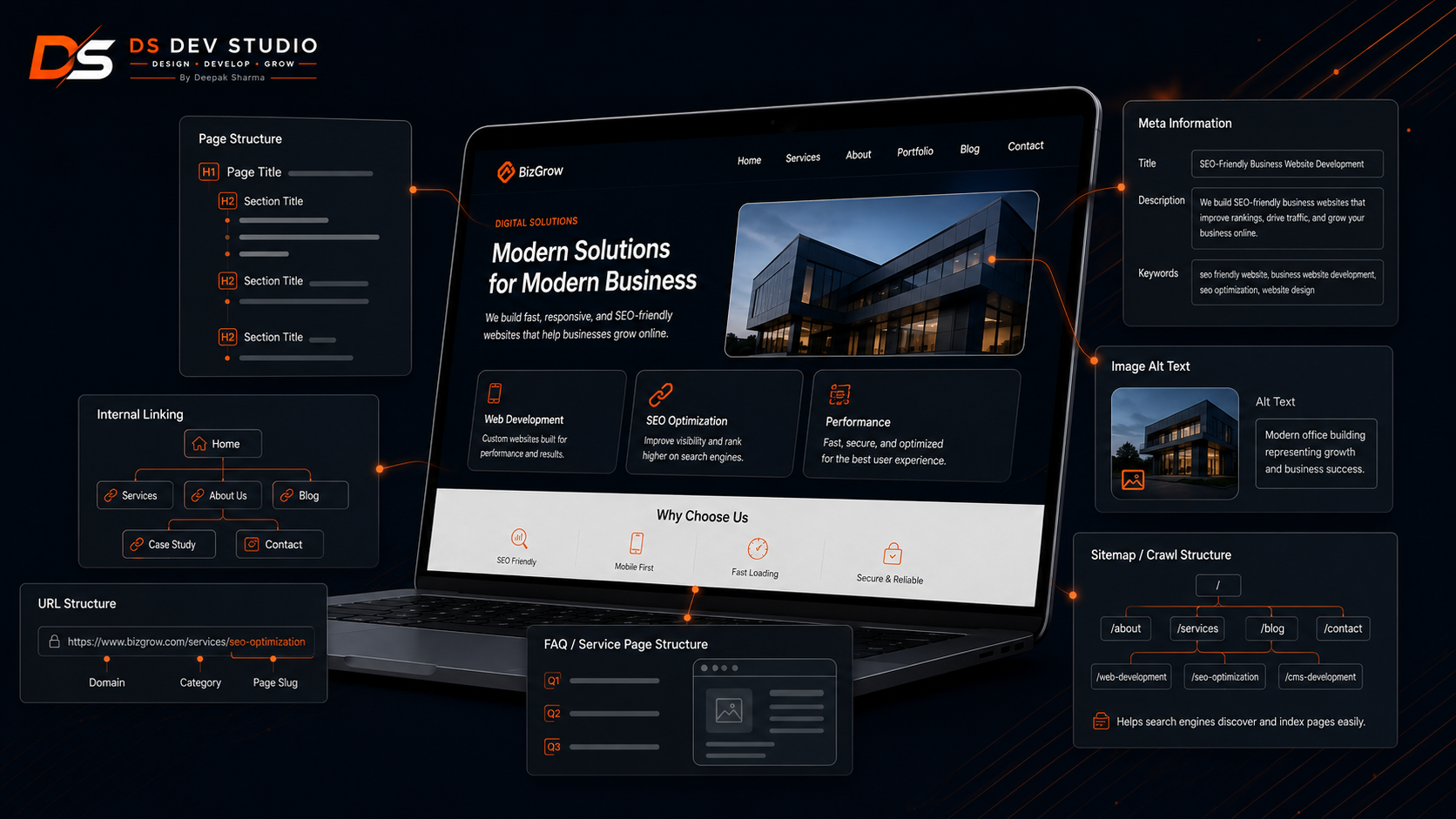
A website that is optimized for search engines has to begin with a proper structure. This means that every major site page should be marked with a good H1 header showing the subject matter of that particular page. H2 headers serve the purpose of dividing the main body of the website into useful sections. The text in these sections should not only be informative but also include corresponding keywords wherever it is needed. As for the images used in the contents, they should have an alt text related to the image. Finally, instead of using a generic link text, specific anchor text should be used to make it user-friendly and enable search engines to evaluate the page properly.
Technical arrangement plays an important role too. The website must have the following features: easy-to-read URLs, a proper navigation system, responsive design, all website contents load quickly, metadata is placed correctly, canonical URLs are used, Open Graph tags are applied, and a sitemap is provided. Those elements do not replace useful articles, but they definitely provide a good foundation for discovering useful content. A web developer dealing with business websites should consider the mentioned aspects during the designing stage and not as an afterthought.
- The primary keyword should appear in the H1 heading.
- The H2 headers should be of service types to have a better topic structure.
- The paragraphs should be easy to read, and related keywords must be used in a natural manner.
- There should be informative alt text for images that describes their context - project or service.
- There should be links to pages throughout the site with meaningful anchor text.
- The website should have a fast loading speed and be responsive.
- The URLs should be clean for Service Pages, Blog Posts, Projects, and Contact Us pages.
- Metadata should be provided, such as title, description, canonical URL, and Open Graph tags.
- There should also be FAQ sections to answer common user inquiries.
- Each Service Page must contain a single topic instead of mixing everything on one page.
Why small businesses need SEO-friendly websites
The online presence of a Small Business Developer must embrace the provision of all the essential information. Many small business websites have failed because they are only pretty but do not have any good content, headings, service pages, project examples, FAQs, and contact sections. A customer can visit such a web page and remain clueless about the services, location, reliability, and contact details of the business.
An effective small business website should provide the customers and potential clients with straightforward answers to the following questions: what is the nature of the services the business provides? Who is a business’s target audience? What completed projects the business has? What about the contacts? Does the company complete the projects requiring website development, React development, WordPress customization, landing pages or backend work? The answers to the questions above should be easy to find and, preferably, not mixed with lengthy sections of general information.
An online business website developer must develop web pages about services offered, about the website developer, projects accomplished, blogs written, frequently asked questions (FAQs) section, and contact information. This will give visitors a reason to trust the business and will also provide search engines with structured content. For example, instead of having just one section for services, the website can have separate service pages for different service types, such as website development, React front-end development, WordPress custom creation, landing page creation and development, back-end development, and web app or admin panel development.
Business Website Development with service pages
Development of a business site becomes even more efficient if all major services are given separate pages. Although one single services page can define all services, it is much more imperative to concentrate on single service pages because they will provide more details about the particular service. Searching for a specific service is easier this way and the search engine receives more precise content to analyze. For instance, a page explaining React provides all information about reusable components, responsive UI, route pages, and performance of the front end. A backend development page can provide information about PHP, Laravel, CodeIgniter, MySQL, APIs and admin panels.
Service pages are not mere keyword stuffing. Rather, they must serve as an encouragement for actual customers to understand whether the service is relevant to them. A well-structured service page should contain information about what exactly the service is, how it can be used, what technologies to be applied, what benefits it has, the step-by-step process to be followed, common questions, and examples of projects done with it, as well as a contact link.
The service-oriented approach is beneficial for DS Dev Studio as it enables its website to meet various users’ needs. One customer may be looking for a React Developer Freelancer while another one may require a WordPress customization service. A separate service page helps to keep user paths distinct.
Responsive Website Development matters
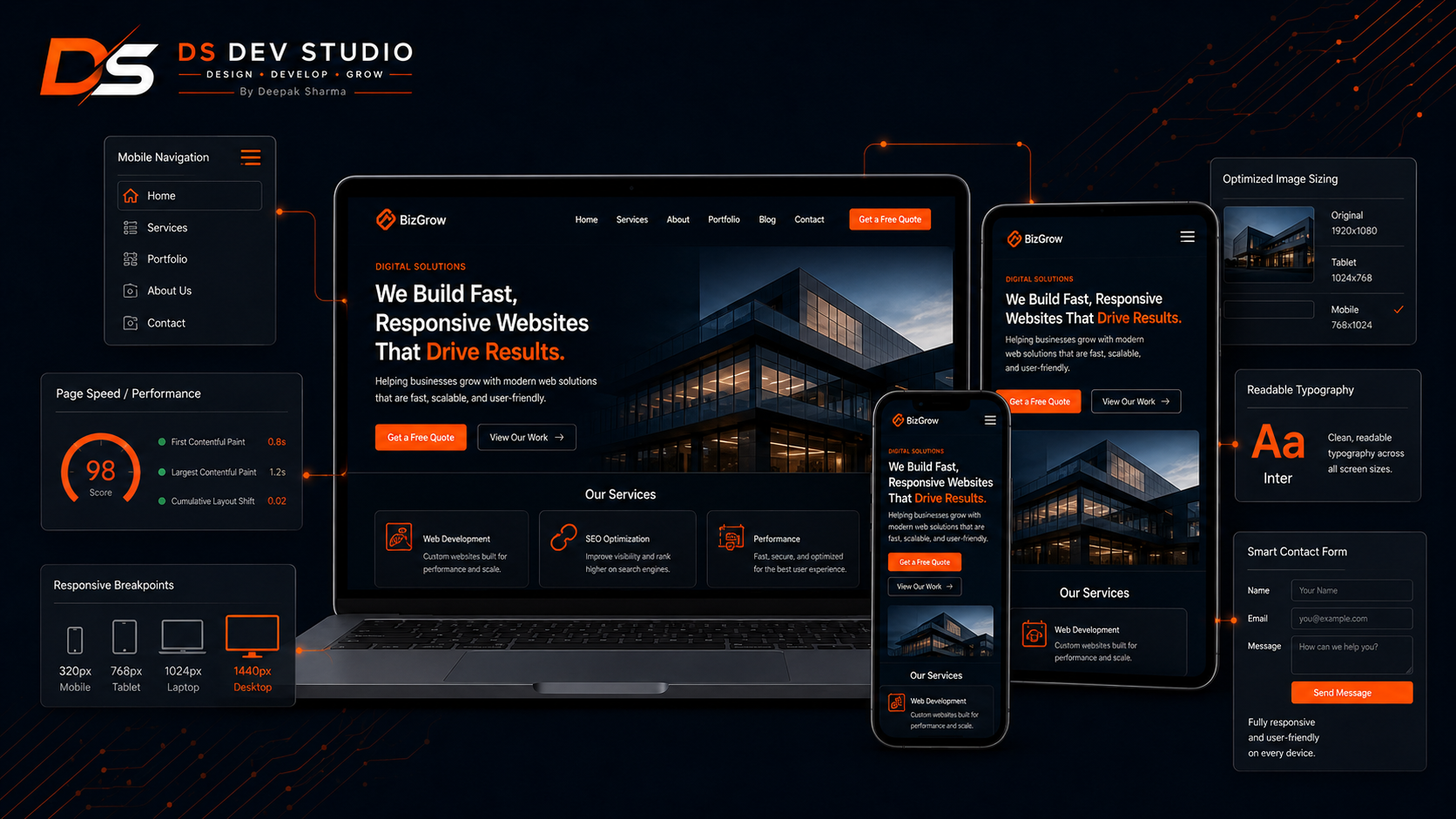
Creation of responsive websites is now an essential part of web development. A responsive website is more functional because it can be run on the smart gadgets such as smartphones, tablets, computers. If your users face some problems while reading content on your website, they will not stay there for long.
Responsive design entails much more than merely reducing a desktop layout. It also involves strategizing how the components sit in relation to each other, how the navigation functions, how forms act, how images adjust, and how text maintains readability on small screens. A good responsive website developer tests the components through different screen sizes to ensure that the site remains clean and user-friendly.
Users of mobile devices are commonly much less patient than people who use computers. They may want to find a service quickly, review some projects, see a few highlights, and get in touch with the business. If a website on a mobile device does not perform well, even good content will not matter. Therefore, responsive layout, quick loading images, appropriate spacing, and easy navigation are essential components of SEO-friendly web development.
SEO-friendly content structure for business pages
The way the content is structured is significant in making the development SEO-friendly. SEO-friendly development cannot simply come as random paragraphs put together somewhere on the page. The page should be logically organized and may consist of an introduction, description of the service, use cases, benefits, process of providing the service, tools used, frequently asked questions, and contact details.
Headlines ought to consist of service-related keywords that they naturally fit into. This could be seen in exemplifying examples of H2 headings such as Responsive Website Development is Important, Business Website Development with that has Service Pages, or Internal Links which are Beneficial for Both Users and Google. Such H2 headers are informational and provide users and search engines with better signals on the content being discussed in that particular section.
The paragraphs need to encompass relevant keywords organically, i.e. a page written on SEO friendly business website development can refer to such terms as business website developer, custom website developer, website developer India, responsive website development and website developer for small business. Keywords have to fit the theme of the text perfectly without being awkward.
Internal links help users and Google
The anchor text of the internal links must be meaningful. Rather than saying click here, it would be much better to say read about web development services, learn about React frontend development, or contact Deepak Sharma about developing business websites. This makes it easier for people to know where they are going at all times, as well as to provide Google with better context.
Internal links assist in linking pages that share similar content or theme. For example, a post regarding SEO-friendly sites can also link to pages that deal with web design development, web design responsive projects, and their contact page. A services page can link to related projects and FAQs. A project case study can link back to the service that was used in that particular project. This leads to a robust site structure and improves navigation of the site.
When browsing a site that lacks internal links, users may feel lost. They can visit a page and leave soon after without having the chance to find what else the site has to offer. Internal links help direct them to the various services, projects, blogs, or contact pages the website may have. This greatly improves the user experience as well as the site's rank on search engines.
Image SEO and alt text for website pages
Visual representation is very necessary when it comes to images, yet it is crucial to also optimize them. The name of an image file should be descriptive instead of being random. For instance, rather than naming an image image1.png, the better option would be to choose seo-friendly-business-website-development.png. Also, the alt tags should elaborate on the images while putting the service provided in the context of the image whenever applicable.
The dimension of pictures is equally essential. Big images that are not compressed can lead to low loading speeds of the site. When web pages load slowly, they tend to annoy both desktop and mobile users. In web development, it’s very important to choose the level of images wisely, compress them in a way that doesn’t compromise quality, provide relevant alt texts, and place pictures close to the content they support.
When creating an online developer portfolio or business page, you can optimize your image alt descriptions and incorporate phrases like Freelance React Developer creating dashboard UI, SEO Friendly Website Builder offering responsive web pages, or Custom Web Application Developer creating a CRM dashboard. The most important thing here is to be clear on what the text really conveys.
Metadata and clean URLs for SEO-friendly websites
With the use of metadata, the way a certain page shows up in search results and those on social media is properly defined. A good page needs to have a title, a description, a canonical URL, an Open Graph title, an Open Graph description, and social image wherever needed. As a rule, a title doesn't exceed 50-60 letters while a description should be about 150-160 letters in total.
Clean URLs are also necessary. The path /services/website-development is much better than a URL containing just numbers or vague terms. Blog URLs are expected to reflect the subject of the article, for example /blogs/developing-seo-friendly-business-website. The same goes for project URLs - it should represent the case study or project being conducted. These small things make a big difference when it comes to user experience and search experience.
When it comes to React websites, it is important to manage metadata properly since page content as well as head tags may be altered with the help of dynamic rendering. A good setup needs to ensure that each page has its own title, description, canonical URL as well as pertinent keywords. For those pages that are important to the public, prerendering or static generation can enhance the strength of view-source content for crawlers.
How blogs support SEO-friendly website growth
Blogs enable a business website to attract search queries related to education and service. A page on services is meant to describe what services they provide, while a blog helps answer the common queries related to them. For instance, if you run a web development business, you can write a blog post on hiring a Web Developer Freelancer, React Developer Freelancer for Your Website, SEO-Friendly Business Website Development, WordPress Developer Freelancer, Backend Developer Freelancer, and a Custom Web Application Developer for CRM and ERP needs.
Blogs can also serve as a source of internal links. For example, a React development blog can link to React front-end development services and other projects. A backend development blog can link to backend services and application development pages. This way, a blog may help users in discovering more useful content while enhancing the topical structure of the website.
Nonetheless, it is important to avoid making blogs too short or repetitive. An article that has between 2,000 to 2,500 words is capable of explaining the chosen topic well, answering the audience's questions, providing practical examples, listing frequently asked questions, and linking to relevant service pages. This is more beneficial than creating a lot of short pages containing the same material.
How DS Dev Studio builds SEO-friendly pages
DS Dev Studio pays attention to the clean layout, responsive sections, title and description setup, routes pages, sitemap support, internal links, image alt text, FAQ pages, service pages, project pages, and blog structure to create a solid base for the long-term development of the website. The intention of DS Dev Studio is to build websites that look trendy and also clearly explain services.
The duties of Deepak Sharma as a web developer involve development of Web sites, development of the front end of React, customizing WordPress, creating landing pages, full-stack development, developing various modules of Customer Relationship Management (CRM), creating back end administration panels, integrating APIs, and designing unique web applications. If Deepak Sharma desires to develop SEO-friendly content, he can properly arrange all the aforementioned services into separate pages with suitable headings, beneficial text, links to the projects, FAQs, and CTAs in the contacts.
DS Dev Studio may additionally assist with the enhancement of already existing websites i.e. by assessing the structure of different pages, layout used in different mobile devices, internal links, metadata, contact flow, alt image texts, services, and blog strategies. Many websites do not need a complete overhaul right away, and sometimes just by improving the structure and content of some essential pages, you can make the website more effective.
Conclusion
SEO Friendly Business Website Development refers to the process of creating a professional-looking website that works properly on all platforms and provides search engines with clear content to crawl efficiently. It is also important for such a website to have headings, service pages, links, alt texts for images, FAQs, metadata, URLs, images that are easy to load, layout that is responsive, and content that is useful and meets the real users' inquiries. There are many small companies, startups, business service providers, and personal brand companies who can benefit from these principles of development as they will help build a solid foundation for their website, which will let it grow. The main goal of Development Studio is to help business website owners with all kinds of development services, offer them professional websites that can easily be improved by adding the new services, blogs, projects, and case studies.
Useful internal links
Frequently asked questions
Can I hire Deepak Sharma for SEO-friendly website development?+
Yes. You can hire Deepak Sharma for SEO-friendly business websites, responsive website development, React websites, WordPress customization, landing pages, service pages, and custom web pages. DS Dev Studio focuses on clean structure, useful content, metadata, internal links, and responsive layout.
Does an SEO-friendly website need blogs?+
Blogs are useful because they help a website target service keywords, hiring intent keywords, location-based keywords, and educational search queries over time. Blogs also support internal linking between services, projects, and contact pages.
What is important for image SEO?+
Images should use descriptive file names, relevant alt text, compressed file size, proper dimensions, and placement near related content. Good image SEO supports accessibility, page speed, and better context for search engines.
Why are internal links important for SEO?+
Internal links help users and search engines discover related pages. Descriptive anchor text such as view React frontend development services is better than generic text like click here because it gives users and search engines clearer context.
What should a business website include for better SEO?+
A business website should include clear H1 and H2 headings, service pages, project pages, FAQs, metadata, sitemap, internal links, responsive design, optimized images, useful written content, clean URLs, and strong contact flow.