Website Developer for Consultants, Agencies, and Service Providers
A practical guide for consultants, agencies, and service providers that want to hire a Website Developer for responsive business websites, service pages, landing pages, blogs, contact forms, SEO-friendly structure, and online growth.

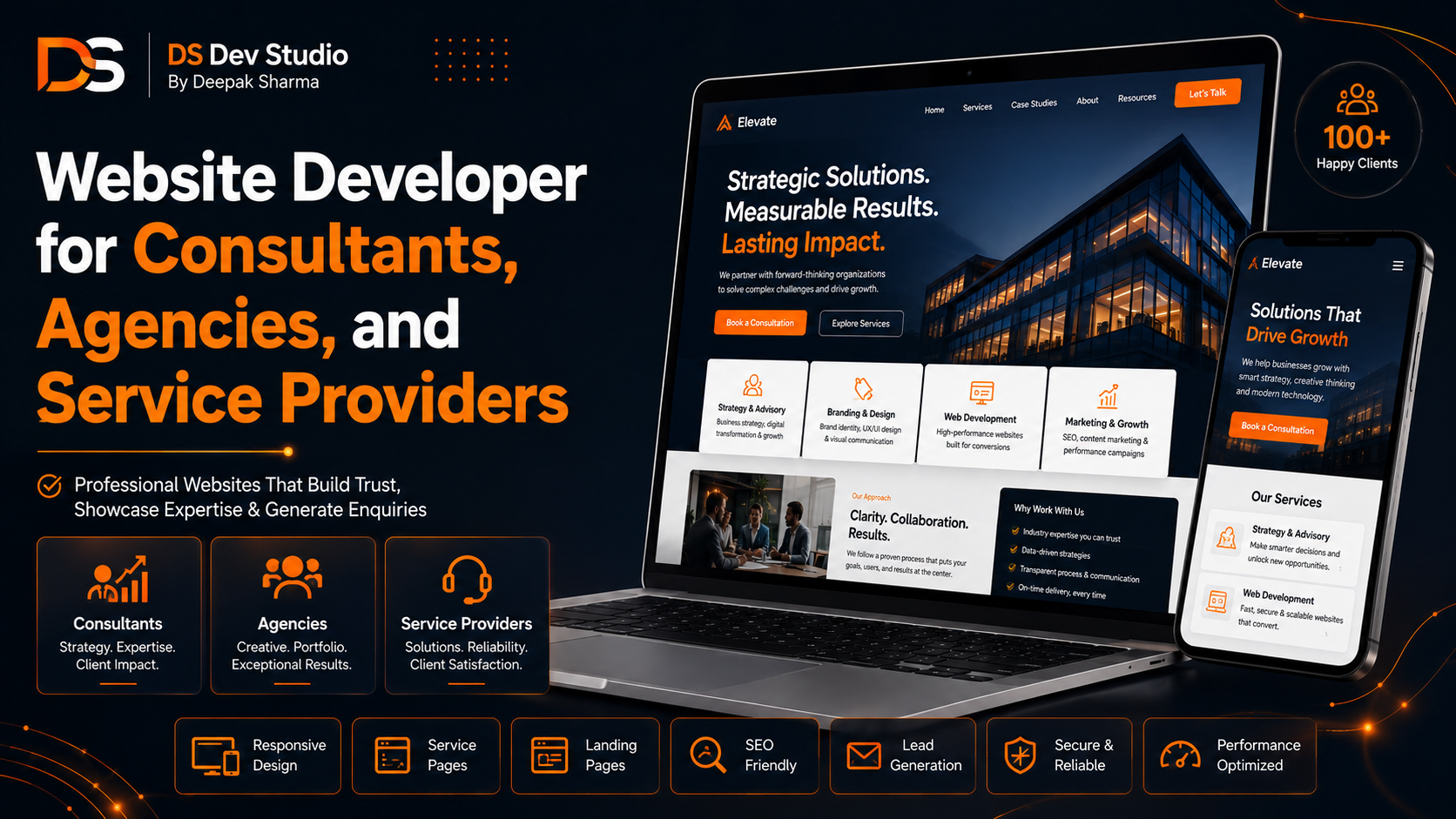
A Website Developer can help consultants, agencies, and service providers build a professional online presence that explains services clearly, builds trust, and turns visitors into enquiries. For service-based businesses, a website is not only a digital profile. It is often the first place where potential clients check credibility, understand expertise, compare service options, and decide whether to contact.
Consultants, agencies, and service providers usually sell expertise, trust, process, and results. Their website must communicate these points better than a basic template. A strong business website should show what the service provider does, who they help, what problems they solve, how their process works, and how clients can start a conversation.
Many service businesses rely on referrals, social media, WhatsApp, LinkedIn, or offline networking. These channels are useful, but when someone asks for more details, the business needs a website that supports the next step. A responsive and SEO-friendly website gives potential clients a professional place to learn more and submit an enquiry.
DS Dev Studio by Deepak Sharma helps consultants, agencies, freelancers, local service providers, and small businesses with responsive website development, custom website development, service pages, landing pages, React frontend development, WordPress customization, contact forms, PHP backend systems, API integration, CRM modules, admin panels, and custom web applications. This guide explains how a Website Developer can support consultants, agencies, and service providers.
Why consultants need a professional website
Consultants sell knowledge, experience, advice, strategy, and problem-solving ability. Whether the consultant works in business consulting, marketing, finance, HR, education, technology, legal support, management, career guidance, or operations, the website should clearly explain their expertise and service value.
A consultant’s website should answer important questions before the first call. What type of clients do they help? What problems do they solve? What services do they offer? What is their approach? What experience or proof do they have? How can someone book a consultation? A Website Developer for Consultants should structure the website around these questions.
A consultant website may include a homepage, about page, service pages, consultation booking section, case studies, testimonials, blog articles, FAQs, and contact form. These pages help build authority and make the consultant easier to trust.
Why agencies need a strong business website
Agencies need websites that show capability, process, service depth, portfolio, and client trust. A marketing agency, branding agency, web design agency, creative agency, consulting agency, recruitment agency, or digital service agency should use its website to explain services and prove why clients should choose it.
An agency website should not only look attractive. It should show what the agency does, which industries it serves, what results or deliverables it provides, and how the client journey works. Dedicated service pages, portfolio sections, testimonials, case studies, and clear CTA buttons are important.
A Website Developer for Agencies can build layouts that support service categories, project showcases, team sections, process blocks, blog resources, lead generation forms, and landing pages for campaigns. Agencies often need scalable website structures because they may add new services, industries, and case studies over time.
Why service providers need responsive websites
Service providers need responsive websites because customers often search and compare services from mobile phones. A service provider may receive traffic from Google Search, WhatsApp, Instagram, Facebook, LinkedIn, local listings, ads, referrals, or email campaigns. If the website does not work well on mobile, the business can lose enquiries.
Service providers can include coaches, trainers, repair services, consultants, developers, designers, local businesses, clinics, education providers, real estate professionals, freelancers, and B2B service companies. Each business needs a website that explains its service clearly and makes contact easy.
A Responsive Website Developer should make sure service pages, forms, buttons, menus, images, testimonials, FAQs, and contact sections work smoothly across mobile, tablet, laptop, and desktop screens. Mobile experience matters directly for lead generation.
What a Website Developer should build for service-based businesses
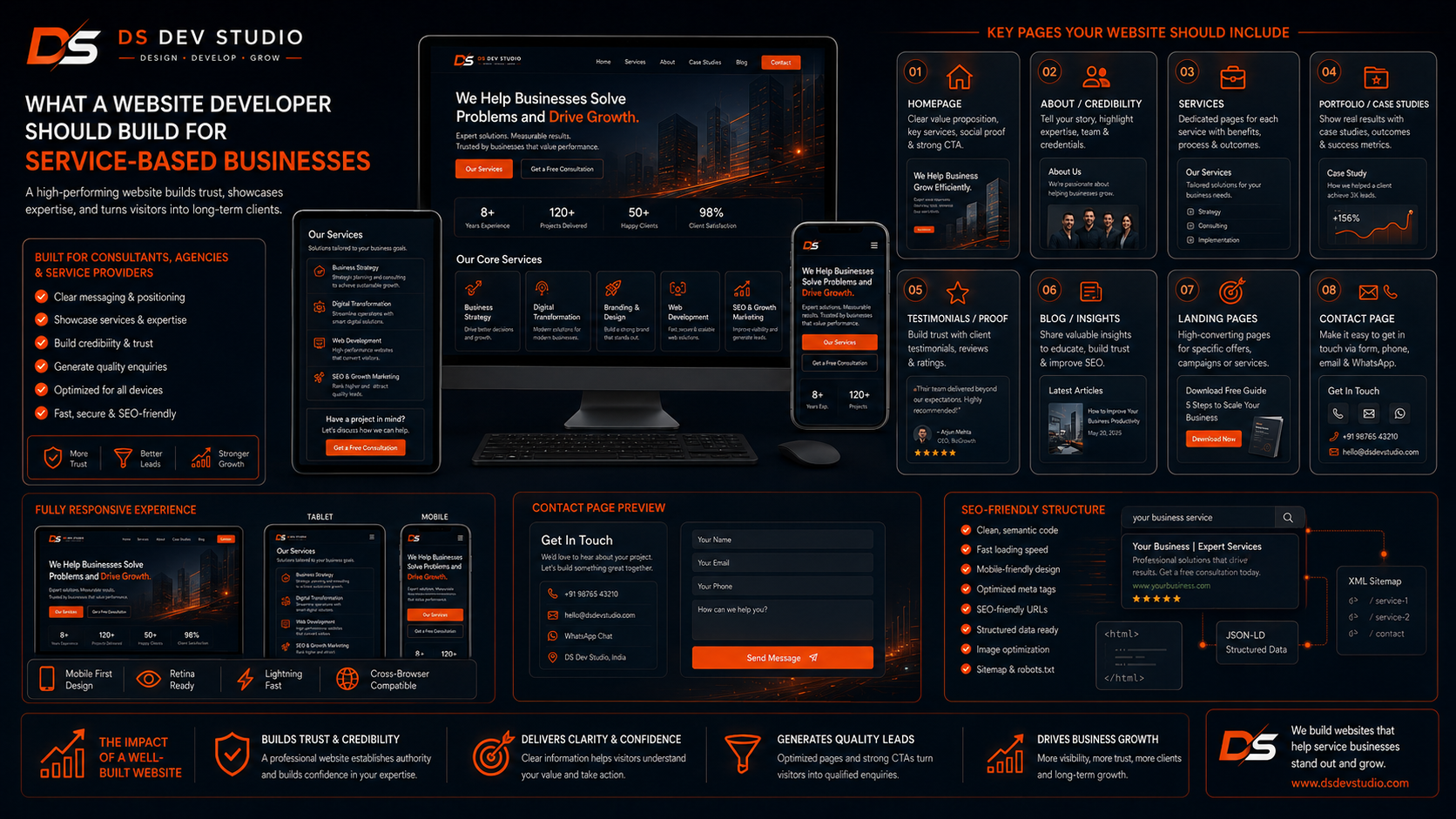
A Website Developer for consultants, agencies, and service providers should build more than a basic homepage. The website should include clear structure, responsive design, service-focused content, SEO-friendly pages, lead generation forms, trust sections, and internal links. It should help visitors move from awareness to enquiry.
The website should also match the business type. A consultant may need authority-building content and booking CTAs. An agency may need portfolio and case study sections. A local service provider may need service area, phone, WhatsApp, reviews, and quick contact forms. A Custom Website Developer should plan the website based on business needs.
- Homepage that clearly explains the business and main services.
- About page that builds trust and credibility.
- Dedicated service pages for each important offering.
- Portfolio, case study, or project section where relevant.
- Testimonials, reviews, proof points, or client results.
- Blog section for helpful content and online visibility.
- Landing pages for specific campaigns or service offers.
- Contact page with form, phone, email, WhatsApp, and location if needed.
- Responsive design for mobile, tablet, laptop, and desktop.
- SEO-friendly structure with headings, metadata, internal links, and clean URLs.
Homepage structure for consultants and agencies
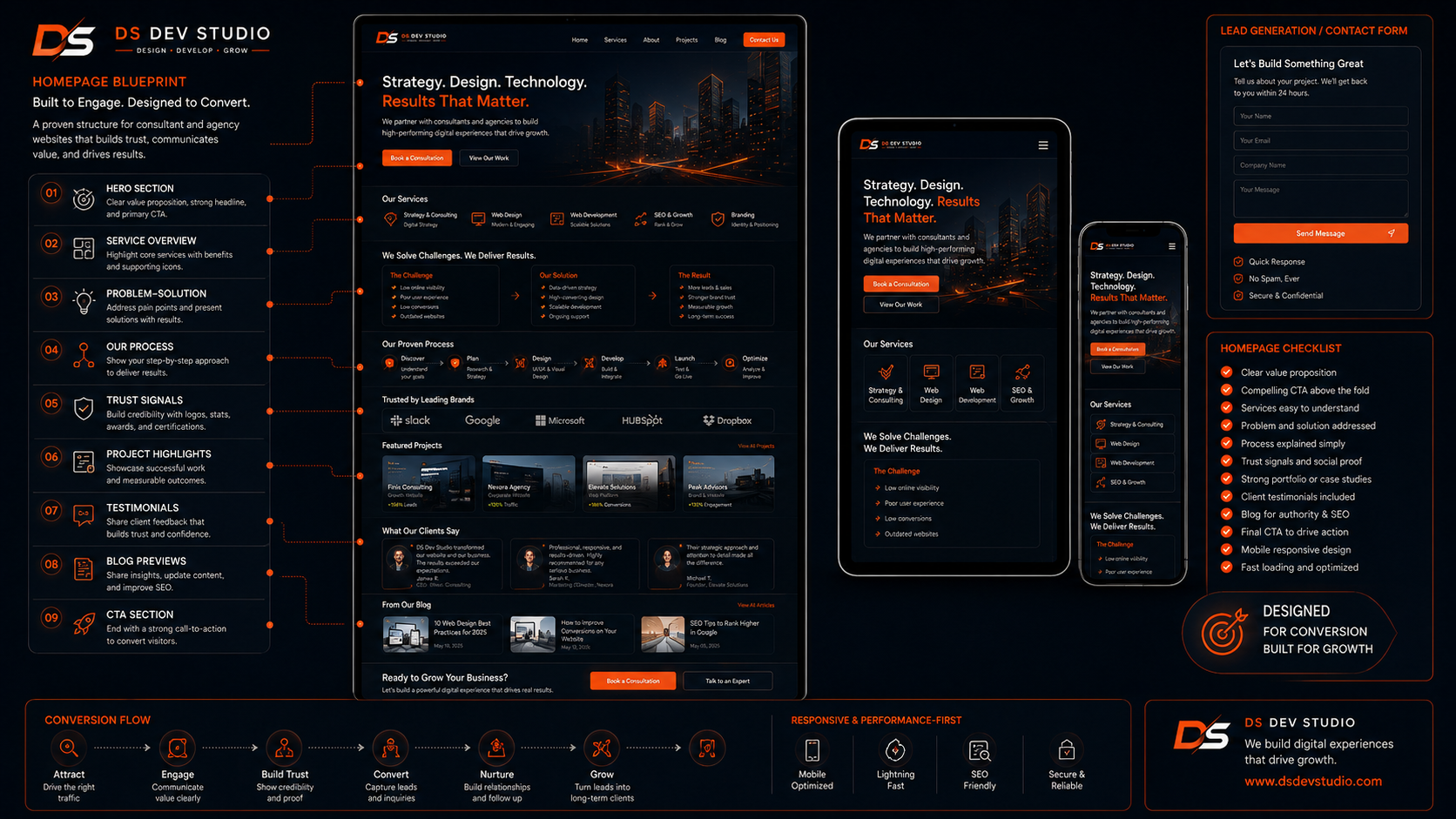
The homepage should quickly tell visitors what the business does and why they should continue. A homepage for consultants, agencies, and service providers should not start with vague slogans. It should use clear messaging that explains the service category, target audience, and value.
A strong homepage can include a hero section, service overview, problem-solution section, process, trust signals, project highlights, testimonials, blog previews, and CTA section. The page should guide visitors to service pages or contact options depending on their need.
On mobile, the homepage should stay clean and easy to scan. The headline should be readable, CTA buttons should be visible, and service cards should stack properly. A Frontend Developer Freelancer should make sure the homepage is responsive and conversion-focused.
Service pages for consultants, agencies, and providers
Service pages are very important for service-based businesses. A homepage may introduce services, but each major service should have its own page when possible. This helps visitors understand the details and supports SEO-friendly website structure.
A consultant may need service pages for strategy consulting, business planning, marketing advisory, career consulting, or training. An agency may need pages for branding, SEO, website development, social media, content, or paid ads. A service provider may need pages for each specific service or package.
A strong service page should explain what the service is, who it is for, what problems it solves, what is included, how the process works, and how visitors can contact. A Service Page Development approach makes the website more useful for visitors and better organized for growth.
Landing pages for lead generation
Landing pages are useful for consultants, agencies, and service providers that run campaigns, promotions, ads, email outreach, WhatsApp campaigns, or LinkedIn campaigns. A landing page focuses on one service, one offer, or one audience segment. This makes it more direct than a general homepage.
A Landing Page Developer can create pages for consultation booking, service packages, quote requests, audit offers, discovery calls, lead magnets, or campaign-specific services. The landing page should include a clear headline, benefits, trust points, FAQs, CTA buttons, and a short contact form.
Landing pages should be fast, mobile-friendly, and focused. Too many menu links or unrelated sections can reduce attention. The page should guide visitors toward one clear action.
SEO-friendly website structure for service businesses
An SEO Friendly Website Developer helps build a website structure that supports search visibility and user clarity. For service-based businesses, SEO-friendly structure usually means clear service pages, helpful blogs, clean URLs, proper headings, metadata, internal links, responsive design, and readable content.
Consultants and agencies should avoid putting every service on one page only. If each important service has its own dedicated page, the website becomes more focused. Blogs can then support those service pages by answering common questions and explaining related topics.
SEO-friendly development should be natural. The website should not force keywords unnaturally. It should explain services in a useful way and help visitors find the right information. A website that is organized for users is usually stronger for long-term online visibility.
Blog content for consultants and service providers
Blogs can help consultants, agencies, and service providers grow online visibility by answering customer questions and supporting service pages. A blog section gives the business a place to publish guides, checklists, comparisons, FAQs, and educational content around its expertise.
A consultant can publish blogs about planning, common mistakes, strategy tips, and decision guides. An agency can publish blogs about marketing, branding, website development, lead generation, and case studies. A service provider can publish blogs about service benefits, maintenance tips, preparation guides, and local customer questions.
A Business Website Developer should build blog layouts that are readable, responsive, and connected with service pages. Blog pages should include internal links, CTA sections, related posts, and clear categories.
Contact forms and enquiry flow
Contact forms are essential for consultants, agencies, and service providers because they turn website visitors into enquiries. A form should be simple enough for users to complete and detailed enough for the business to understand the enquiry.
A general form may include name, phone, email, service requirement, and message. A consultant may add consultation type or preferred time. An agency may ask for project type, budget, and timeline. A service provider may ask for location, service category, and urgency.
A Backend Developer Freelancer can connect forms with email notifications, MySQL databases, Google Sheets, CRM systems, admin dashboards, or API workflows. This makes enquiries easier to track after submission.
CRM and lead tracking for service-based businesses
Many consultants, agencies, and service providers lose leads because enquiries are scattered across emails, social media, WhatsApp, forms, and spreadsheets. A CRM system or admin dashboard can help organize lead tracking and customer records.
A CRM Web Application Developer can build a system where leads are stored with name, phone, email, service, source, status, assigned user, notes, and follow-up date. This helps the business know which leads are new, which need follow-up, and which converted into customers.
API integration can connect website forms with the CRM so new enquiries appear automatically. This is useful for agencies and service providers that receive regular enquiries from service pages, landing pages, blogs, and contact pages.
React websites for agencies and custom service websites
React is useful for agencies and service providers that need custom frontend design, reusable sections, landing page systems, API-connected forms, dashboards, or interactive user interfaces. A React Developer Freelancer can build modern responsive layouts with components for services, testimonials, FAQs, CTA sections, forms, and project cards.
React Frontend Development is useful when the website needs a custom feel and future scalability. Agencies may use React for portfolio websites, custom landing pages, client dashboards, or internal tools. Consultants may use React for a fast and professional personal brand website with custom sections.
React can also connect with PHP, Laravel, CodeIgniter, or other backend systems through APIs. This makes it suitable for service websites that may later need CRM, admin panels, or client portals.
WordPress websites for consultants and service providers
WordPress is useful for consultants, agencies, and service providers that want easy content management, blog publishing, page updates, and service page editing. A WordPress Developer Freelancer can customize WordPress websites with service pages, landing pages, contact forms, blog layouts, testimonials, and SEO-friendly structure.
WordPress can be practical when the business owner wants to publish blogs regularly or update pages without developer help every time. Consultants can publish thought leadership content. Agencies can publish case studies and service guides. Service providers can update offers and FAQs.
A WordPress website should still be optimized properly. Heavy themes, too many plugins, and unoptimized images can slow the website. The developer should keep the setup clean, responsive, and easy to maintain.
Custom website development for service businesses
Custom Website Development is useful when a consultant, agency, or service provider needs a unique website structure, custom UI, backend forms, CRM connection, admin panel, or future web application features. A Custom Website Developer can build the site around the exact business process.
Custom websites can be built with React, PHP, Laravel, CodeIgniter, MySQL, APIs, or a mixed technology stack depending on the requirement. This is useful when the business does not want to depend on generic templates or plugin-heavy setups.
For example, an agency may need a custom project showcase with filters. A consultant may need booking request forms and resource pages. A service provider may need a quote request system connected with an admin dashboard. Custom development can support these needs.
Trust signals that service websites should include
Trust signals are important because service-based businesses depend on credibility. Visitors may not contact unless they feel confident. A website should include proof elements that show experience, reliability, and professionalism.
Trust signals can include testimonials, client logos, case studies, portfolio examples, certifications, process steps, team details, years of experience, before-after examples, FAQs, reviews, or clear contact information. These should be real and relevant.
A Business Website Developer should place trust signals naturally. For example, testimonials can appear after service benefits. Case studies can appear before CTA sections. FAQs can answer doubts before enquiry.
- Testimonials from real clients.
- Case studies or project examples.
- Client logos or industries served.
- Clear process and service deliverables.
- Professional about section.
- FAQs that answer common doubts.
- Accurate phone, email, WhatsApp, and location details.
- Blog content that shows expertise.
- Portfolio or service results where relevant.
Website speed and mobile performance
Website speed matters for consultants, agencies, and service providers because visitors may leave if pages load slowly. Slow websites can reduce trust and enquiries. Mobile speed is especially important because many users open service websites from phones.
A Responsive Website Developer can improve speed by optimizing images, reducing unnecessary scripts, using clean CSS and JavaScript, avoiding heavy plugins, and testing performance before launch. For React websites, component and asset optimization matter. For WordPress websites, plugin control and caching matter.
A fast website creates a smoother experience. Visitors can read service pages, submit forms, and explore blogs without frustration. Performance should be part of development from the beginning.
Website design style for consultants and agencies
Website design style should match the business identity. A consultant website may need a clean, authoritative, and personal style. An agency website may need a creative, portfolio-focused, and modern style. A local service provider may need a practical, direct, and trust-focused style.
The design should support readability and action. Clear typography, consistent colors, good spacing, readable sections, and strong CTA buttons matter more than unnecessary animations. Visitors should be able to understand the service quickly.
A Frontend Developer Freelancer should keep the design consistent across homepage, service pages, landing pages, blogs, and contact pages. A website should feel like one connected brand experience.
What to prepare before hiring a Website Developer
Before hiring a Website Developer, consultants, agencies, and service providers should prepare business details, service list, target audience, website goal, required pages, content, images, testimonials, reference websites, and contact information. Clear preparation helps the developer build the right structure.
If the website needs backend features, prepare form fields, CRM workflow, user roles, lead tracking needs, and reporting requirements. If the business needs blogs, prepare topic categories. If it needs landing pages, prepare campaign goals and offers.
- Prepare business name, logo, brand colors, and contact details.
- List all services and decide which services need separate pages.
- Define target audience such as clients, businesses, local customers, or agencies.
- Prepare homepage messaging and main CTA.
- Collect testimonials, reviews, portfolio items, or case studies.
- Prepare blog topic ideas and service page content.
- Decide form fields and enquiry flow.
- Clarify whether you need WordPress, React, PHP, Laravel, CodeIgniter, or API integration.
- Share reference websites for design direction.
- Discuss launch, testing, maintenance, and future updates.
What to check before hiring a Website Developer Freelancer
Before hiring a Website Developer Freelancer, check whether they understand responsive design, service page development, landing pages, SEO-friendly structure, contact forms, mobile usability, speed optimization, and backend integration. Service business websites need more than visual design.
Ask whether the developer can build websites for consultants, agencies, and service providers with clear content flow, CTA sections, trust signals, blog layouts, and enquiry tracking. Also ask whether they can support WordPress, React, PHP, Laravel, CodeIgniter, MySQL, and APIs if your project needs those technologies.
Review live websites where possible. Check mobile experience, page speed, service page clarity, form behavior, CTA placement, and overall structure. A good developer should be able to explain the process and guide you toward the right solution.
Common website mistakes service businesses should avoid
One common mistake is building a website that looks good but does not explain services clearly. Visitors need to understand what you offer before they contact. Service pages should be detailed enough to answer common questions.
Another mistake is ignoring mobile design. Many potential clients open websites from mobile devices. If forms, menus, and service pages are difficult to use on mobile, the business may lose leads.
Other mistakes include weak CTA buttons, no testimonials, no blog section, poor contact forms, slow loading, no internal links, no SEO-friendly structure, generic content, outdated visuals, no CRM tracking, and no maintenance plan. A skilled Website Developer can help avoid these problems.
How DS Dev Studio can help
DS Dev Studio by Deepak Sharma can help consultants, agencies, and service providers build responsive business websites with clear service pages, landing pages, blogs, contact forms, SEO-friendly structure, React frontend development, WordPress customization, backend systems, API integration, CRM workflows, and admin panels.
Deepak Sharma Web Developer work includes HTML, CSS, JavaScript, ReactJS, WordPress, PHP, Laravel, CodeIgniter, MySQL, APIs, frontend development, backend development, responsive UI, business websites, admin panels, CRM systems, and full stack web development. This is useful for service-based businesses that need both public website pages and backend lead management support.
If you are a consultant, agency, freelancer, or service provider and want to hire Website Developer support, DS Dev Studio can help plan your website structure, build responsive pages, create service pages, develop landing pages, connect forms, improve SEO-friendly structure, and prepare the website for better online visibility and enquiries.
Conclusion
A Website Developer can help consultants, agencies, and service providers build websites that explain services clearly, build trust, work smoothly on mobile, and support lead generation. A strong service business website should include a clear homepage, dedicated service pages, landing pages, blogs, contact forms, trust signals, SEO-friendly structure, responsive design, and proper enquiry flow. Consultants need authority and clarity. Agencies need portfolio, process, and service depth. Service providers need easy contact, mobile usability, and trust. DS Dev Studio by Deepak Sharma can help with responsive website development, React frontend development, WordPress customization, service pages, landing pages, contact forms, backend systems, API integration, CRM modules, admin panels, and custom web applications. With the right website development approach, consultants, agencies, and service providers can create a stronger online presence and generate better business enquiries.
Useful internal links
Frequently asked questions
Can I hire Deepak Sharma as a Website Developer for consultants or agencies?+
Yes. You can hire Deepak Sharma for website development for consultants, agencies, freelancers, and service providers. Services include responsive websites, service pages, landing pages, blogs, contact forms, React frontend development, WordPress customization, backend systems, and API integration.
What pages should a consultant website include?+
A consultant website should usually include a homepage, about page, service pages, consultation or booking section, testimonials, blogs, FAQs, and contact page. The exact structure depends on the consultant’s services and target audience.
Why do agencies need dedicated service pages?+
Agencies need dedicated service pages because each service needs proper explanation, benefits, process, proof, FAQs, and CTA sections. Service pages also support SEO-friendly website structure and better visitor clarity.
Can DS Dev Studio build contact forms and CRM-connected websites?+
Yes. DS Dev Studio can build contact forms and connect them with email notifications, MySQL databases, Google Sheets, CRM systems, admin dashboards, or custom APIs for better lead tracking.
Should service providers choose WordPress or React?+
WordPress is useful when easy content management and blog publishing are important. React is useful for custom frontend interfaces, reusable components, landing pages, dashboards, and API-connected websites. The right choice depends on the project requirement.