Website Developer for Small Business India
A practical guide for small businesses in India that need a website developer for responsive pages, service content, forms, and online presence.

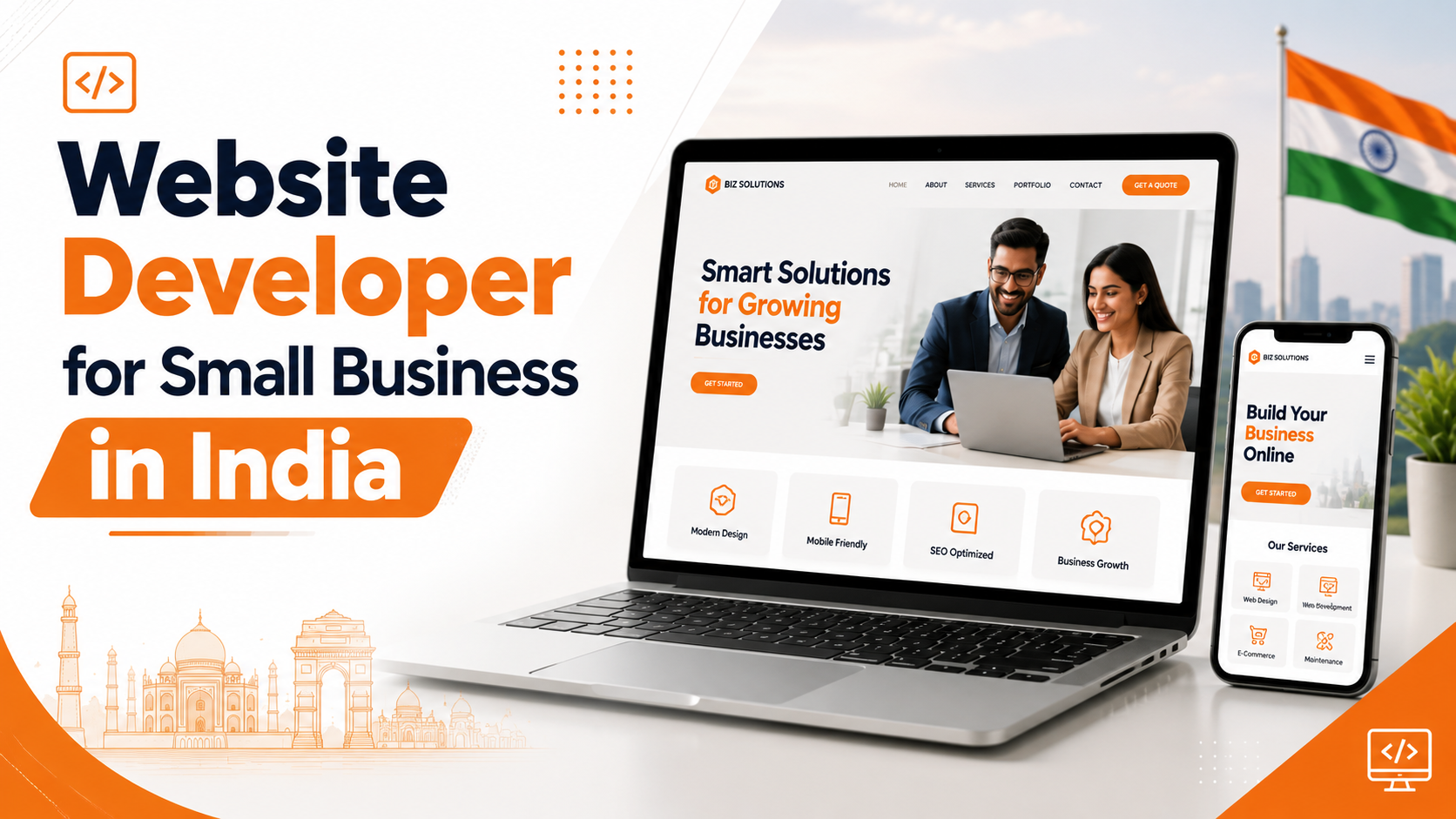
The best website developer for small business can assist various service providers, local businesses, freelance professionals, consultants, startups, and enterprises achieve an online footprint for their businesses. Many small businesses in India think referrals, social media pages, WhatsApp communications, and promotional networks are adequate ways to connect, but it still pays to have a website to centralize all important information pertaining to the business in one place where potential clients can know about the services provided, their details, their credibility, and get in touch with the businessman easily.
A website for a small business must contain information about services, be well-designed for mobile and desktop devices, provide contact details, and direct visitors to make a request or inquiry. A good website cannot be limited to a logo and a couple of photos. An effective website must provide answers to essential customer questions, show possible products and services, help build trust, and make the next step straightforward.
The decision to hire a Web Developer in India or a Web Developer Freelancer in India can prove to be advantageous for the small-sized businesses looking for cost-effective and targeted development assistance. The freelancer can create a business website, landing page, services page, contact form, WordPress website, React website, or any other custom webpage as per the actual needs. This means small businesses can begin their work by having clear guidelines.
Why small businesses need a website
A website serves the purpose of informing users about what services the company, independent contractor, local provider, or consultant specializes in, where they operate, how clients can reach out to them, and why it is worthwhile to trust the company. People will usually look on the internet to find more information about a business once they hear about it. If there is no website, or if there is insufficient information about it, or if the company has just social media pages, the client might feel uncertain.
A business website brings a level of professionalism to your identity. It can showcase your services, expertise, projects, processes, FAQs, contact information, and story of your business. Unlike social media posts that are gone in a feed, pages of websites stay organized and can be shared easily with clients, partners, and prospects.
For small firms in India, having a website can also help achieve regional visibility. Service providers may build pages dedicated to particular service offerings on the internet. Consultancy firms may showcase their knowledge about the area of specialization. Local companies may highlight their location as well as contact details. Freelancers may showcase portfolios online. These pages provide information to clients before they contact the business.
What should a small business website include?
A small business website should be designed simply and clearly. There should be no unnecessary complexity but there should be the right pages and sections. A small business website usually has a homepage that introduces the business and what it offers. Then the website helps to find the needed information about the services, examples of projects, about the company, frequently asked questions, and contact details.
The fundamental pages differ from business to business. In the case of the company providing some local services, the most essential thing is to have service pages along with contact details, while freelancers might want to have a portfolio and some case studies. Startups might need landing pages that explain the product and consultants might require an about page, information regarding the services, and a lead form. A business website developer should build the website according to the objectives of the business rather than using a pre-made template.
- Main page conveys easy-to-follow service message.
- About page gives business information to cultivate trustworthiness.
- Service pages feature every major service.
- Pages showing examples of work, projects, and case studies.
- Contact page includes phone number, email, and physical address.
- FAQs along with trust-building materials.
- SEO-enhanced title and descriptions.
- Website is mobile responsive and running well on all devices.
- Internal links within service, blog, project, and contact pages.
- There are CTA sections that bring visitors to the form for inquiries or consultation.
Homepage structure for small business websites
As the home page is often the initial page for the users accessing a site, it is very important that the home page should describe the essence of the business in a concise way. Thus, a good home page must have a powerful and relevant hero headline, a short introductory paragraph, description of main services, indications of trust, examples of the projects, a description of the process, answers to frequently asked questions, and contact options.
It is a frequent mistake to have the homepage containing vague information. Phrases such as the best solutions available do not give you enough information. A more appropriate homepage claims that the website developer will make business websites including responsive designs, service pages, landing pages, contact pages, and search engine optimized ones.
A fundamental aspect for small businesses to remember while creating their website is ensuring that the homepage allows the visitors to reach them effortlessly. Customers should have phone numbers, email address as well as the contact form or WhatsApp link prominently displayed on the site so that they do not face any trouble contacting the business.
Service pages for small business websites
The significance of having service pages is that every service offered is covered in detail. While having a service subsection on the homepage is important, having a dedicated service page for each service allows the user to gather more in-depth information about the company’s offering.
For instance, a web development firm could have a separate web page for the services rendered in terms of website development, React frontend development,WordPress customization, landing page development, backend development, and web app/admin panel development. Each page could contain in-depth explanations of the services and give practical examples of their uses, as well as the process, technologies used in providing the given service, an FAQ section, and contact details.
A website developer for small businesses needs to help companies determine which service pages they should have. While not every business will have lots of pages from the very beginning, the key services offered by the company should have some information needed for the proper comprehension of these services.
Responsive Website Development for small businesses
Responsive Web Development is one of the essential needs for every small business website. A majority of people access websites through mobile phones. In India, customers are very likely to get to the website through WhatsApp, social media platforms, google search, and various links shared on other platforms. If the website is not functioning well on mobile, the business can suffer great loss of calls.
The website must be responsive so that it can work correctly on any screen – be it mobile, tablet, laptop or desktop. The texts should remain easy to read, images should resize, buttons should be simple to click on and site sections should be displayed properly. Moreover, all contact forms should not cause any issues with filling them out.
Testing the layouts carefully and not just checking the desktop version is something a Responsive Website Developer should do. Small enterprises require websites that serve users, and real users come from various devices.
Custom Website Developer vs template website
Templates can be made very quickly, however a Custom Website Developer creates pages according to your business goals, services, branding, content, and user flow. Template websites can be helpful when you cannot afford much time or funds for your project, but they might look very plain if they were not customized appropriately.
Custom website development is beneficial in terms that is provides a structure tailored to the needs of the business. For example, service company may require detailed service pages. A freelancer is better off having portfolio pieces and case studies. A small business can have a section dedicated to a location. Start-up will need a landing page. Template will not match these needs all the time.
Your project will determine the keenest angle of approach. A small company might begin with either a standard custom website or a modified WordPress template. As its needs change, it can add things like blog pages, landing pages, project pages, services detail pages or any back-end features.
WordPress, React, or custom website development
The choice of website technology depends on the nature of the business. If a business needs to frequently update its web pages and blogs, WordPress can be helpful. While on some occasions React has its applications in websites that require reuse of components, route-based pages, levels of functionality, and frontend architecture. Moreover, basic static pages are taken care of by using pure HTML, CSS, and JavaScript.
A Developer of Business Websites should suggest technology as per the needs of the business. For instance, in the case of a business that needs simple content management, one may suggest WordPress as the way to go. In the case of projects that involve portfolio style websites with reusable components, React may be a good idea. If backend forms, admin panel and CRM modules are required, then those looking for a solution can choose from PHP, Laravel, CodeIgniter and MySQL as the technology needed.
The aim isn't to work with the most complicated stack out there since the aim is just to create a website corresponding with the business's goals, operational efficiency, and maintainability. An efficient developer uses the simplest technology suitable for the demand.
SEO-friendly website structure for small businesses
An SEO-friendly small business website is one that maintains a well-structured layout and actively delivers helpful information. For every crucial page, H1 headings must be distinct, and the subheadings must be service-related H2 headings, paragraphs must be easy-to-read, image alt texts must be informative, internal links must be placed, metadata must be accurate and clean URLs must be used.
SEO doesn’t involve repeating keywords in an unhealthy way rather it involves creating informative pages about actual products. For instance, a website about web development can have pages on business website development, React development, WordPress modifications, backend development, landing pages, and custom web apps. Each of the pages must answer the questions of the visitors clearly.
The use of various techniques can help enhance small business SEO, including blogging. For example, a website can create articles like “How to hire a web developer,” “When to use React,” “Why responsive design is necessary,” or “How landing pages can help small business.” This way, these blogs can create links to the service pages and improve the website's architecture.
Contact forms and enquiry flow
One of the crucial elements of any small business website is the contact flow. Even if the visitor is satisfied with the services, any difficulty in finding or filling the contact form could result in a lost query. The right website must include at least one option for its visitors to get in touch with its representatives, such as contact forms, phone numbers, emails, WhatsApp links, or address details.
Contact forms must collect relevant information but not become unnecessarily lengthy. Generally, asking someone for their name, email, phone number, location, type of project, and message is sufficient for making inquiries. They need, also, to display a success message or redirect to the page where the user is thanked after making the submission.
A Web Developer for Small Business can also link forms to email alerts or storage based on requirements. This allows the organization to take necessary follow-up actions rather than just losing leads.
Landing pages for small business campaigns
Small businesses can use landing pages when trying to market a single service or offer. By directing visitors to a landing page, you can provide a more targeted message and action. The use of landing pages is ideal for receiving visitors from ads, special events, offers, or campaigns.
Your landing page must contain an easy to understand title, brief description of the services, points of interest to potential customers, elements for building trust, frequently asked questions and feedback form. A good landing page developer can create a landing page that functions effectively in terms of driving business.
Landing pages are useful for small enterprises, and businesses allow such services as website development, consultation, repair services, coaching, real estate inquiries, local offers, and professional services. The landing page should be consistent with the campaign message and effectively direct users to contact information.
What to check before hiring a Website Developer India
Before selecting a website developer in India, it is crucial to ensure that the individual knows exactly how to develop business websites as well as responsive website designs, contact forms, SEO and page structure. The developer needs to do more than just create appealing design elements for the web pages.
Check on and understand the various examples and portfolios that have been shared. This would help you see how clear the websites are when displayed on mobile or desktop devices. Ask beforehand about the types of technology being used including but not limited to WordPress, React, PHP, HTML, CSS, JavaScript, Tailwind CSS, Laravel, or CodeIgniter depending on what you need. You may also want to confirm whether the developer will be providing post delivery support.
- Look at design portfolio to see projects and actual examples in business.
- Inquire if the website will be designed in a mobile-friendly way.
- Find out if there’s a possibility to add contact forms and thank-you pages.
- Ask whether an appropriate SEO setup will be used in the future, including title, description, headings, and image alt.
- Clarify whether WordPress, React, or custom developing will be used in the process of making the website.
- Ask about the deadline, content requirements, and any review process.
- Inquire if the company would continue to provide support.
How DS Dev Studio can help
Deepak Sharma's DS Dev Studio specializes in creating business websites, service pages, landing pages, WordPress websites, and React websites along with contact forms and SEO-friendly webpage structure. DS Dev Studio aims to design websites that are simple, adaptable, functional, and user-friendly.
Deepak Sharma has been engaged in web development services which includes constructing of business websites, development of React frontend, WordPress customization, backend development, designing of landing pages, admin panels, and creating web applications that fit the requirements. As such, DS Dev Studio is relevant to small companies that need a site with a good appearance and usability.
When you need assistance to set-up your new business website or enhance your existing website, you can get in touch with DS Dev Studio for them to help plan the structure, design the pages, incorporate responsive sections, implement contact flow and make the website future-ready.
Conclusion
A small business website must be easy to navigate and reliable. This site must describe your business’ services, develop credibility and lead a visitor to actions like contacting the seller or making an inquiry. Therefore, small businesses in India need a professional website that ensures online presence, customer trust, service visibility, and lead generation. DS Dev Studio by Deepak Sharma is the best company for creating websites for small business owners and service-providing companies, contractors, and consulting firms. In case you require a business site, WordPress site, React site, landing page, services pages, contact form, or a site with SEO-friendly structure, the best website developers will make your website more attractive and useful.
Useful internal links
Frequently asked questions
Can I hire Deepak Sharma as a Website Developer for Small Business?+
Yes. You can hire Deepak Sharma for small business websites, service pages, landing pages, WordPress customization, React websites, contact form setup, responsive design, and SEO-friendly page structure.
What pages should a small business website have?+
A small business website should usually include home, about, services, projects or portfolio, blogs, FAQs, and contact pages. Service detail pages and landing pages can also be added based on the business goal.
Can DS Dev Studio build responsive websites?+
Yes. DS Dev Studio builds responsive websites that work properly on mobile, tablet, laptop, and desktop screens with clean layouts, readable sections, and mobile-friendly contact forms.
Can a small business website be SEO-friendly?+
Yes. A small business website can include clear headings, service keywords, meta descriptions, internal links, image alt text, clean URLs, sitemap support, and useful page content.
Can contact forms be added to a small business website?+
Yes. Contact forms, enquiry forms, email notifications, thank-you pages, mobile number fields, location fields, and project detail fields can be added based on the requirement.